
Image Usage Information
Family: Philomycidae
Common name: Carolina Mantleslug
Discovery: Bosc, 1802
Identification
Length: 50-100 mm
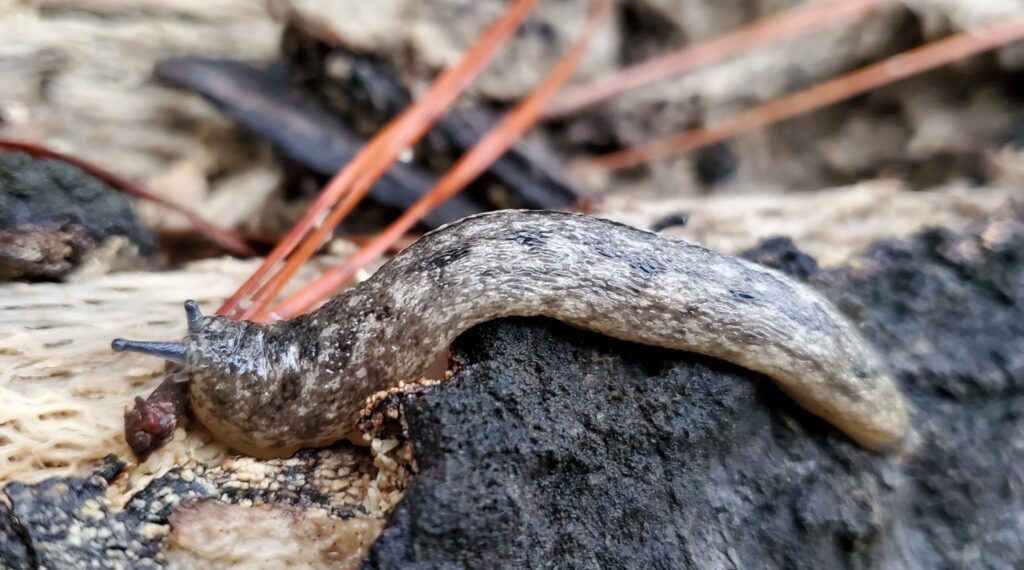
Philomycus carolinianus is a large slug with a mantle that covers the entire dorsal surface. The mantle is tan to tan-grey mottled with small irregular elongate flecks of slightly darker brown. These flecks usually coalesce to form a band along the lateral edge of each side of the mantle as well as a poorly defined central band that runs the length of the slug. In addition to this coloration there are two rows of dark-brown to nearly-black spots that flank the central band and run the length of the mantle. The reproductive system is equipped with a dart sac containing a short wide dart.
Ecology
This species is very common in swamps along the Gulf and Atlantic coasts and in floodplain woods on the piedmont and interior of the continent. They are often observed feeding on fungi and lichens at night and during wet weather and they aestivate under loose bark and under rotting logs. This species produces a bitter slime when irritated (Dourson, 2010).
Taxonomy
Unpublished DNA sequence data suggests that many mountain populations attributed to this species are undescribed species.
Distribution
Philomycus carolinianus is a widespread species found throughout eastern North America from Ontario to Florida and west to eastern Texas. In Virginia the species is primarily a coastal plain species with some populations on the piedmont and with one record from Lee County in the extreme southwestern part of the state. However, because of the difficulty in identifying philomycid slugs, some of the reported distribution records may refer to other species.
Conservation
NatureServe Global Rank: G5
NatureServe State Rank: S4
