• Skip to primary navigation
  • Skip to main content
  • Skip to primary sidebar

Carnegie Museum of Natural History

One of the Four Carnegie Museums of Pittsburgh

  • Visit
    • Buy Tickets
    • Visitor Information
    • Exhibitions
    • Events
    • Dining at the Museum
    • Celebrate at the Museum
    • Powdermill Nature Reserve
    • Event Venue Rental
  • Learn
    • Field Trips
    • Educator Information
    • Programs at the Museum
    • Bring the Museum to You
    • Guided Programs FAQ
    • Programs Online
    • Climate and Rural Systems Partnership
  • Research
    • Scientific Sections
    • Science Stories
    • Science Videos
    • Senior Science & Research Staff
    • Museum Library
    • Science Seminars
    • Scientific Publications
    • Specimen and Artifact Identification
  • About
    • Mission & Commitments
    • Directors Team
    • Museum History
  • Tickets
  • Give
  • Shop

Schenley Park’s Snail Population

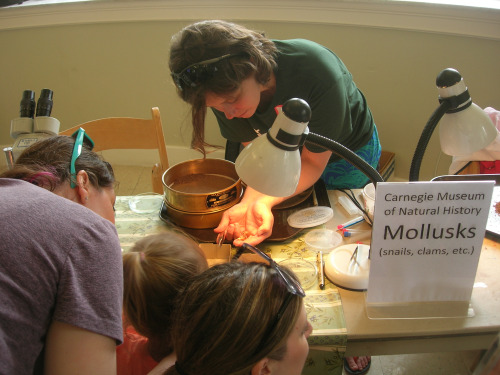
Volunteer Katie Zawrotniak showing snail finds to visitors.
Volunteer Katie Zawrotniak showing snail finds to visitors. (Photo by Tim Pearce).

by Timothy A. Pearce

What lives in our city parks? A BioBlitz is a good way to find out. At a BioBlitz, biologists search in a defined area (such as a park) for a given amount of time (5 a.m. to 5 p.m. in this case) to find as many species as they can in their area of specialty. These biologists share their methods and finds with curious members of the public.

Phipps Conservatory organized a BioBlitz of Schenley Park, which neighbors Carnegie Museum of Natural History in Oakland, on June 5. Museum Curator Dr. Tim Pearce and museum volunteer Katie Zawrotniak headed the snail team and looked in leaf litter samples to find minute snails. They showed snail finds to about 50 visitors. Of the 13 species of land snails they discovered in the park, only one was non-native.

Land snails can be used as an indicator of park’s health (T.A. Pearce. 2009. Land snails as indicator species: examples from seven bioblitzes in the eastern United States. Tentacle, Mollusk Conservation Newsletter, number 17: 12-14). Surprisingly,
compared to other city parks, this was a very low proportion of non-native species. Although the number of species was relatively low, these results suggest that Schenley Park is moderately healthy from the perspective of the land snail community.

Timothy A. Pearce, PhD, is the head of the mollusks section at Carnegie Museum of Natural History. Museum employees are encouraged to blog about their unique experiences and knowledge gained from working at the museum.

sidebar

About

  • Mission & Commitments
  • Directors Team
  • Museum History

Get Involved

  • Volunteer
  • Membership
  • Carnegie Discoverers
  • Donate
  • Employment
  • Events

Bring a Group

  • Groups of 10 or More
  • Birthday Parties at the Museum
  • Field Trips

Powdermill

  • Powdermill Nature Reserve
  • Powdermill Field Trips
  • Powdermill Staff
  • Research at Powdermill

More Information

  • Image Permission Requests
  • Science Stories
  • Accessibility
  • Shopping Cart
  • Contact
  • Visitor Policies
One of the Four Carnegie Museums | © Carnegie Institute | Privacy Policy | Terms of Use | Accessibility
Rad works here logo