• Skip to primary navigation
  • Skip to main content
  • Skip to primary sidebar

Carnegie Museum of Natural History

One of the Four Carnegie Museums of Pittsburgh

  • Visit
    • Buy Tickets
    • Visitor Information
    • Exhibitions
    • Events
    • Dining at the Museum
    • Celebrate at the Museum
    • Powdermill Nature Reserve
    • Event Venue Rental
  • Learn
    • Field Trips
    • Educator Information
    • Programs at the Museum
    • Bring the Museum to You
    • Guided Programs FAQ
    • Programs Online
    • Climate and Rural Systems Partnership
  • Research
    • Scientific Sections
    • Science Stories
    • Science Videos
    • Senior Science & Research Staff
    • Museum Library
    • Science Seminars
    • Scientific Publications
    • Specimen and Artifact Identification
  • About
    • Mission & Commitments
    • Directors Team
    • Museum History
  • Tickets
  • Give
  • Shop

bird hall

September 4, 2018 by wpengine

Fire Destroys Brazilian Museum Once Called House of the Birds

by Chase D. Mendenhall

One of Latin America’s most important museums burned Sunday night —destroying up to 20 million scientific and historical artifacts. It is unclear how many of the irreplaceable treasures housed at the National Museum in Rio de Janeiro were lost. The museum was established in 1818 by the King of Portugal and in its early days was known as the “Casa dos Pássaros,” or House of the Birds, for its impressive bird collections.

Today, the museum was best known for its exhibits of the Americas consisting of mammals, birds, reptiles, amphibians, insects, minerals, aboriginal collections of utensils, Egyptian mummies, South American archaeological artifacts, meteorites, fossils and many other findings. Sadly, many of these invaluable objects are permanently lost.

Novelist Paulo Coelho described the reaction to the fire by saying, “the country is in tears.” Others have demonstrated their pain by carrying signs that say “200 years of history, 20 million items, reduced to ashes.”

We find comfort knowing that some pieces of Brazilian history are safely stored in other museums around the world. The Carnegie Museum of Natural History represents Brazil strongly in its collections, especially in the Section of Birds. We house one of the most comprehensive collections of Brazilian birds outside of Rio de Janeiro. We have 885 species of birds from Brazil, represented by 20,292 specimens—4,357 of which are on loan around the world.

Museums generate millions of data points and inform published scientific debates that are shared through networks. Today, these networks of knowledge and sharing define museum collections and exist precisely to safeguard against disasters.
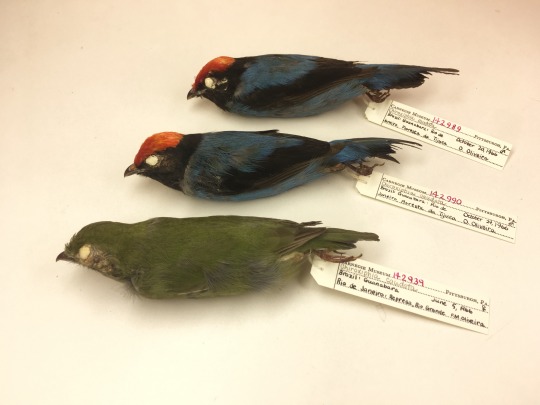
Chiroxiphia caudata study skins

Birds from the Carnegie Museum of Natural History collected from Rio de Janero include Blue Manakins (Chiroxiphia caudata), a species with one of the best examples of a cooperative breeding behavior. Males (red, black, and blue birds in background) meet in groups to dance in a coordinated, circular loop to breed with the solitary females (green bird in foreground) who raise the young on their own.
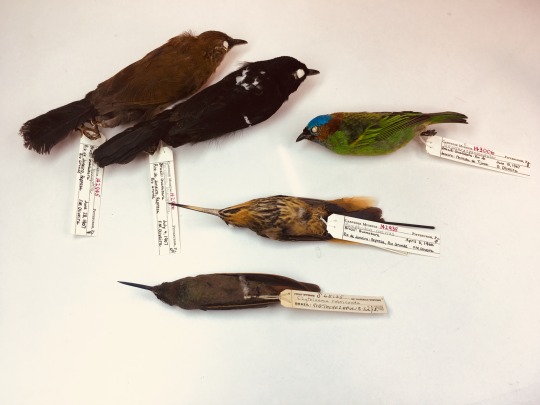
study skins of Brazilian birds

Other birds representing Brazil from the collections at the Carnegie Museum of Natural History include a pair of White-shouldered Fire-eye (Pyriglena leucoptera), a Red-necked Tanager (Tangara cyanocephala), a Saw-billed Hermit (Ramphodon naevius), and a Brazilian Ruby (Clytolaema rubricauda). Specimens are listed in the image from top to bottom.

Chase Mendenhall is Assistant Curator of Birds, Ecology, and Conservation at Carnegie Museum of Natural History. Museum employees are encouraged to blog about their unique experiences and knowledge gained from working at the museum.
Filed Under: Blog Tagged With: bird hall, Birds, Chase Mendenhall, Mason Heberling, Section of Birds

February 5, 2018 by wpengine

In its early years, Carnegie Museum often purchased…

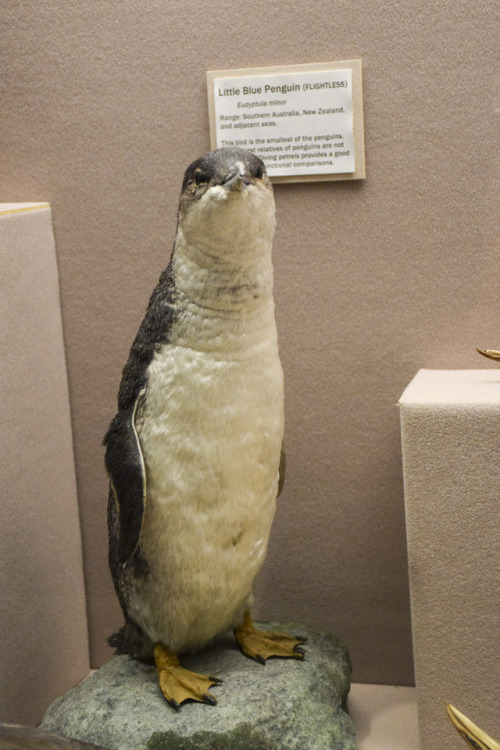
Little Blue Penguine Taxidermy

In its early years, Carnegie Museum often purchased birds from different areas of the world. One excellent collection came from Sir Walter Buller who built a collection from New Zealand for his groundbreaking books on birds of that country. We have more bird specimens from that country (645) than any other museum in the United States like this mounted little blue penguin on display in Bird Hall.

Filed Under: Blog Tagged With: bird hall, Birds

October 5, 2017 by wpengine

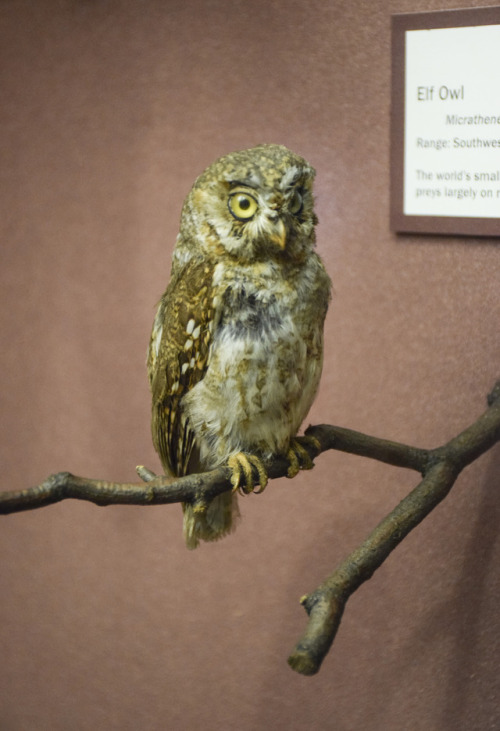
The elf owl

elf owl specimen in Bird Hall

The elf owl, found from the southwestern United States to central Mexico, is the world’s smallest owl. Examine this taxidermy specimen up close, and see just how tiny these little birds are in Bird Hall!

(photo by Hayley Pontia)

Filed Under: Blog Tagged With: bird hall

August 21, 2017 by wpengine

Specimen Preservation

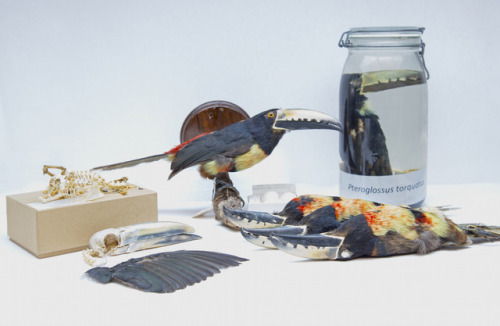
examples of different kinds of bird preservation

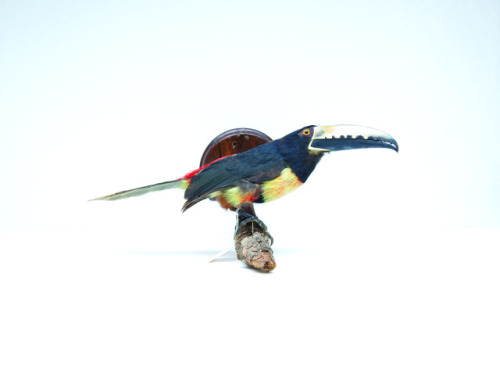
taxidermy mount of a tropical bird with a long beak
Taxidermy mount
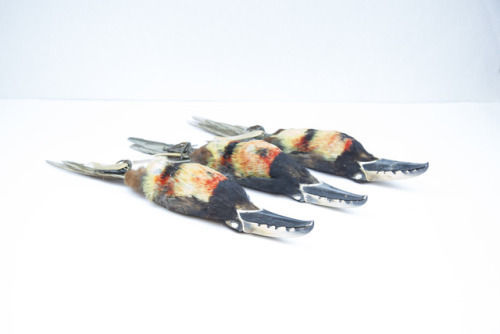
Study skins of three balck, red, and yellow birds
Study skins

When you stroll down Bird Hall at Carnegie Museum of Natural History, most of the birds you will see in the cases are sitting on branches or faux ground surfaces, seemingly alive but frozen in time.

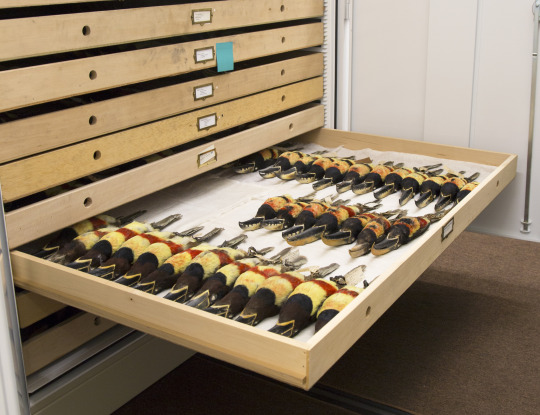
But the roughly 190,000 birds in the museum’s collection are preserved and stored in a variety of ways for different purposes that include display and scientific study.

As seen in the photo above, stored specimens can be taxidermy mounts (preserved as they would have been seen in life), specimen skins (which are seen lying on their backs), skeletons, dried spread wings, and eggs. A select few birds, like this Collared Aracari (Pteroglossus torquatus), are even stored in 70% ethanol alcohol.

Each type of preparation has a purpose. Taxidermy mounts are for education and display. Skeleton preparations allow study of bones, which is helpful in understanding evolution, especially since often that is what is left in fossils found by vertebrate paleontologists.

Eggs document breeding localities and can even show changes in size and number through time as a method of climate change. Fluid specimens can be used for dissection in study of anatomy (muscles, brains, stomach contents, etc.) and recently have been used in CT scanning methods that even outline muscles and organ systems without dissection. Spread wings can show molt patterns and color patterns, which are often important in mating.

Finally, the study skin is the most common preparation type as it, as well as other preps, document the exact location, time, and condition of the bird when collected or salvaged. The feathers often indicate the age class of the bird, and it can serve in other more modern ways. DNA can be obtained from tissue and stable isotope data can be obtained from feathers allowing study of shifts in breeding ranges through time.

bird study skins in a drawer

Filed Under: Blog Tagged With: bird hall, Birds

July 11, 2017 by wpengine

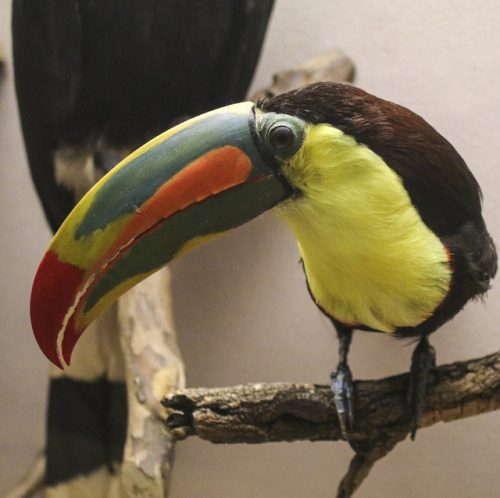
keel-billed toucan

keel-billed toucan

The keel-billed toucan is the national bird of Belize. This taxidermy mount is on display in Bird Hall.

(photo by Hayley Pontia)

Filed Under: Blog Tagged With: bird hall

July 7, 2017 by wpengine

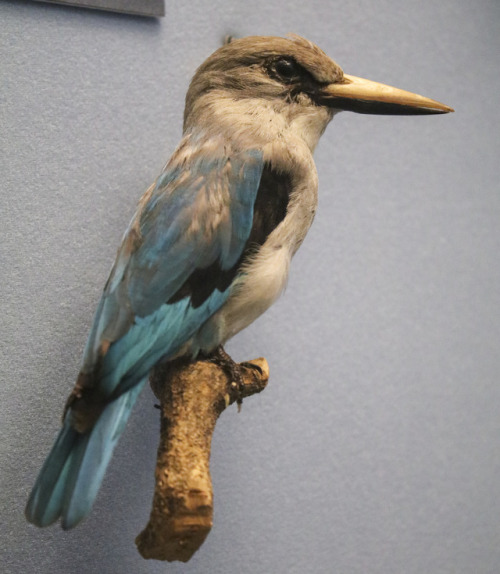
woodland kingfisher

woodland kingfisher taxidermy

The woodland kingfisher perches and swoops like its aquatic relatives, but it mostly targets insects and other terrestrial prey instead of fish. This taxidermy mount is on display in Bird Hall at Carnegie Museum of Natural History.

(photo by Hayley Pontia)

Filed Under: Blog Tagged With: bird hall

  • « Go to Previous Page
  • Page 1
  • Page 2
  • Page 3
  • Page 4
  • Page 5
  • Go to Next Page »

sidebar

About

  • Mission & Commitments
  • Directors Team
  • Museum History

Get Involved

  • Volunteer
  • Membership
  • Carnegie Discoverers
  • Donate
  • Employment
  • Events

Bring a Group

  • Groups of 10 or More
  • Birthday Parties at the Museum
  • Field Trips

Powdermill

  • Powdermill Nature Reserve
  • Powdermill Field Trips
  • Powdermill Staff
  • Research at Powdermill

More Information

  • Image Permission Requests
  • Science Stories
  • Accessibility
  • Shopping Cart
  • Contact
  • Visitor Policies
One of the Four Carnegie Museums | © Carnegie Institute | Privacy Policy | Terms of Use | Accessibility
Rad works here logo