• Skip to primary navigation
  • Skip to main content
  • Skip to primary sidebar

Carnegie Museum of Natural History

One of the Four Carnegie Museums of Pittsburgh

  • Visit
    • Buy Tickets
    • Visitor Information
    • Exhibitions
    • Events
    • Dining at the Museum
    • Celebrate at the Museum
    • Powdermill Nature Reserve
    • Event Venue Rental
  • Learn
    • Field Trips
    • Educator Information
    • Programs at the Museum
    • Bring the Museum to You
    • Guided Programs FAQ
    • Programs Online
    • Climate and Rural Systems Partnership
  • Research
    • Scientific Sections
    • Science Stories
    • Science Videos
    • Senior Science & Research Staff
    • Museum Library
    • Science Seminars
    • Scientific Publications
    • Specimen and Artifact Identification
  • About
    • Mission & Commitments
    • Directors Team
    • Museum History
  • Tickets
  • Give
  • Shop

Cretaceous Seaway

March 2, 2021 by Erin Southerland

Carnegie Museum of Natural History Adds Five New Specimens to Cretaceous Seaway Display

New specimens include world’s only juvenile skeleton of plesiosaur Libonectes
 
Enhancements made possible with support from The Elijah Straw Memorial Fund 
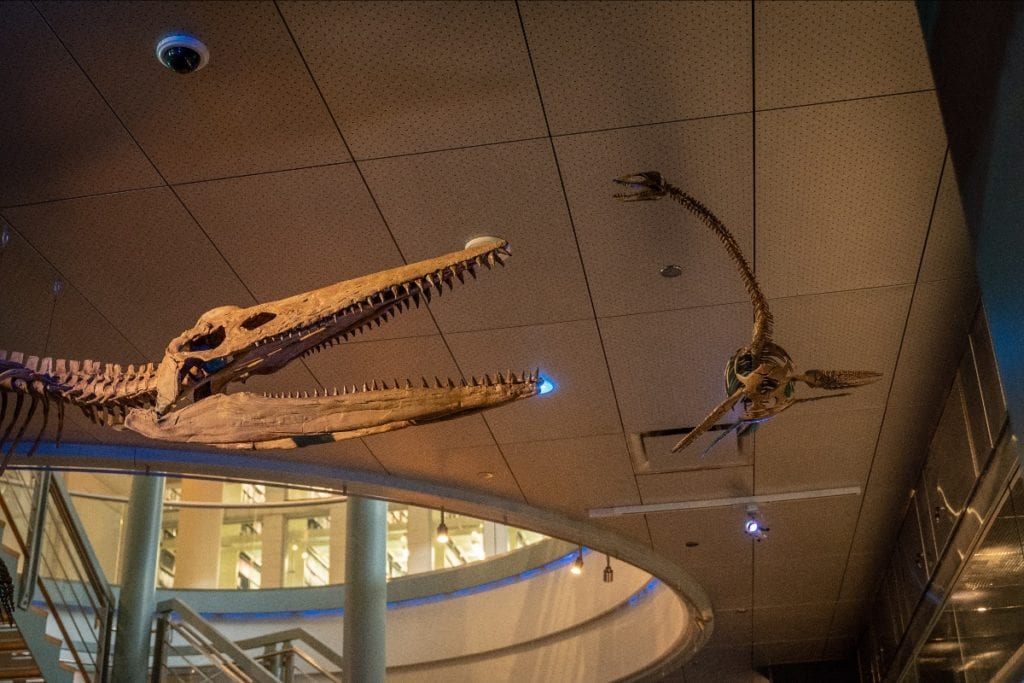
The massive Manitoba pliosaur closes in on its potential prey, a juvenile of the plesiosaur Libonectes morgani. Photo: Tim Evans, Carnegie Museum of Natural History.

Visitors at Carnegie Museum of Natural History may now view five impressive new specimens in the Cretaceous Seaway display of its flagship exhibition Dinosaurs in Their Time. The specimens include a newly restored Tylosaurus mosasaur fossil skull and four replica skeletons (a pliosaur, a plesiosaur, and two fishes) created by Triebold Paleontology, Inc. The freshly updated gallery is now on view. 
 
“Our new Cretaceous Seaway displays put visitors smack dab in the middle of a life-and-death struggle taking place in midwestern North America some 92 million years ago,” says Matt Lamanna, Carnegie Museum of Natural History’s Daniel G. and Carole L. Kamin Co-Interim Director and Mary R. Dawson Associate Curator of Vertebrate Paleontology. “Collectively, our new Seaway beasts tell the story of evolution and extinction in an ancient ocean over the span of more than 30 million years. And they remind us that no species—not even humans—is immune to extinction.”
 
The juvenile plesiosaur Libonectes is the only one of its kind, replica or otherwise, on display anywhere in the world. Lamanna and Triebold Paleontology, Inc. worked closely together to create the specimen. “Nobody’s ever found a baby Libonectes before, so to produce one, the gang at Triebold Paleontology and I had to digitally alter a virtual 3D model of an adult skull and then digitally sculpt other bones using photos of Libonectes skeletons and those of related plesiosaurs,” says Lamanna. “When all the computer work was done, the 3D models were then printed to yield the physical replica. The whole process really opened my eyes to the possibilities of 3D scanning, modeling, and printing in paleontology.”
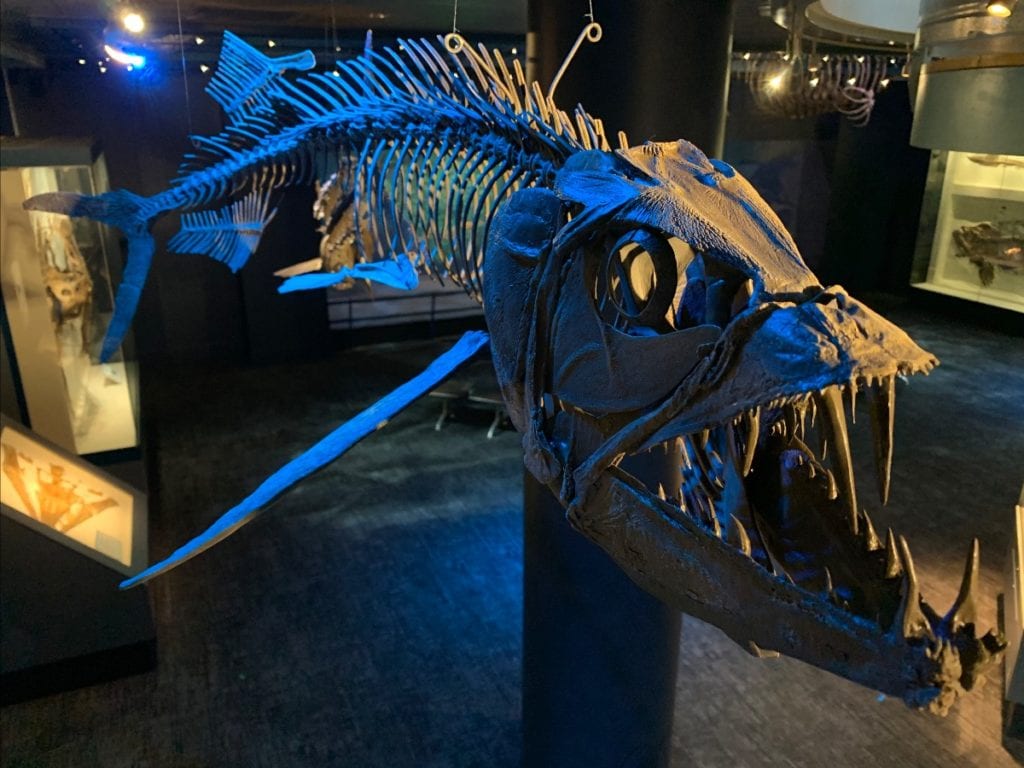
Another of the newly-added specimens, the large Cretaceous predatory fish Enchodus petrosus. Photo: Calder Dudgeon, Carnegie Museum of Natural History.

The new specimens are made possible with support from The Elijah Straw Memorial Fund. According to Tom Straw, Elijah’s father, the natural history museum was a special place for Elijah, and one particular display captured his imagination.  
 
“When Elijah was five years old, he fell in love with the skull cast of Dunkleosteus terrelli, a prehistoric fish,” said Straw. “When that went off view, Elijah was very concerned. I wrote to Dr. Matt Lamanna to ask what was going on,” said Straw, who was surprised when Lamanna responded by inviting them in to see the specimen in the museum’s behind-the-scenes area.
 
That tour, which also included a glimpse of the world’s first T. rex fossil, led to a lasting friendship with the Carnegie Museums.
 
When Lamanna learned of Elijah’s death a year later, he put a plan in motion to honor the little boy and his love of prehistoric life. A few months later, he contacted the family to let them know that the museum had dedicated the Dunkleosteus terrelli cast, now back on display in the museum, to Elijah.
 
The Elijah Straw Memorial Fund has since supported numerous improvements in the Cretaceous Seaway, including lighting, engineering and installation of four new replica skeletons, and the unveiling and display of a real fossil skull of the giant marine reptile Tylosaurus to honor Elijah’s memory. The Tylosaurus fossil skull, collected over a century ago, was newly restored by fossil preparator Dan Pickering, returning the specimen to display after many years stored behind the scenes. Tylosaurus is a member of the mosasaur group, which became famous in recent years for oversized “starring roles” in two Jurassic World movies. The Cretaceous Seaway enhancements were also made possible thanks to the generous support of Dr. Richard W. Moriarty.
Filed Under: Uncategorized Tagged With: Cretaceous Seaway, dinosaurs in their time, Vertebrate Paleontology

June 29, 2020 by wpengine

Mesozoic Monthly: Protostega

June 20th was the first day of summer! The weather here in Pittsburgh is already beautiful. It’s enough to make one dream of a socially distant beach! Summer, of course, is sea turtle nesting season: during the next several weeks, female sea turtles all across our planet’s Northern Hemisphere will return to the beach where they hatched, drag themselves onto land, and lay their eggs in the sand. It would have been an incredible sight to see Protostega gigas, one of the largest sea turtles of all time, hauling itself onto the beach to lay its eggs! For June’s Mesozoic Monthly, we’re going to “dive in” to the paleontology of this giant reptile.

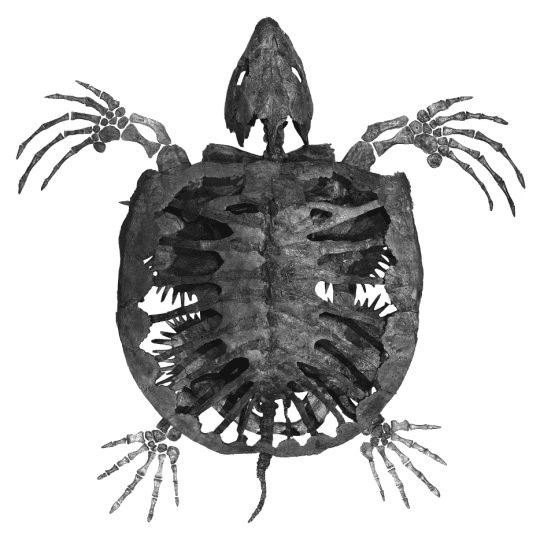
Carnegie Museum of Natural History’s spectacular skeleton of Protostega gigas is a composite made from the fossilized bones of two different individuals. Come see it on display in our Dinosaurs in Their Time exhibition when the museum reopens at the end of this month. But don’t forget to purchase your timed ticket in advance!

All turtles, including sea turtles like Protostega and tortoises like the Galápagos giant tortoise, belong to the group Testudines. This group originated during the Triassic Period, the first of the three time periods of the Mesozoic Era (aka the Age of Dinosaurs). Turtles split from other reptiles to form their own group before crocodiles and dinosaurs evolved! This means that turtles are not descended from dinosaurs, no matter how primordial some tortoises may look. Turtles differ from other reptiles in many ways, the most noticeable being their iconic shells. 

A turtle shell is formed of two main parts: the carapace, or top shell, and the plastron, or bottom shell. The shell is made of bone fused directly to the spine and ribcage, so a turtle cannot crawl out of its shell without leaving its skeleton behind! Another major difference between turtles and other modern reptiles involves skull anatomy. Turtles have anapsid skulls: the bony case that protects their brain lacks any external openings behind their eyes (known as temporal openings). All other extant reptiles plus birds are diapsids, meaning their skulls have two holes behind their eyes. Mammals differ from both conditions because we have only one temporal opening, making us synapsids. Traditionally, the anapsid condition of turtle skulls has been taken to indicate that they are the most primitive of living reptiles. More recently, however, many paleontologists and biologists have uncovered evidence that turtles are in fact diapsids whose evolutionary course led, for some reason, to a secondary closure of their temporal openings. According to these scientists, the closest relatives of turtles among today’s diapsids are either lepidosaurs (lizards, snakes, and kin) or archosaurs (crocodilians and birds).

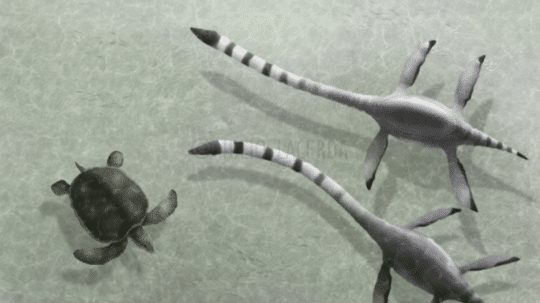
A bird’s (or pterosaur’s!) eye view of Protostega gigas (left) swimming past two long-necked elasmosaurid plesiosaurs in shallow waters of North America’s Western Interior Seaway roughly 85 million years ago. (This scene is set in what’s now Kansas!) Art by Julio Lacerda; see more of his beautiful work here.

Reptiles, mammals, and birds all belong to a group called Amniota, and the key defining feature of amniotes is a protective layer around their eggs that allows this vulnerable life stage to survive on land. Having eggs that did not have to be laid in water meant that animals could move to less-wet habitats, a significant step in evolution! Unfortunately for sea turtles, which spend most of their lives at sea, this means they must return to land to lay their eggs. An amniotic egg would “drown” in water because the embryo still needs access to air. As a sea turtle, Protostega would have faced these same reproductive challenges, plus one more: it was huge!The largest modern turtle, the leatherback sea turtle, can grow over seven feet (2.1 meters) long; Protostega dwarfs it at 9.8 feet (3 meters)! If you’ve ever seen video of a sea turtle crawling onto the beach to nest, you know that it’s an awkward process. Imagine seeing a turtle that weighs at least a ton try to do the same! Although surely clumsy on land, Protostega was a graceful swimmer, using its four rigid flippers like wings to “fly” through the water.

Protostega lived in the Western Interior Seaway, an inland sea that stretched across much of North America during the Cretaceous Period (the third and final period of the Mesozoic Era). The seaway was warm, shallow, and teeming with all kinds of aquatic life: the perfect habitat for an omnivorous sea turtle. Because sea turtles are ectothermic (sometimes erroneously called “cold-blooded”), they cannot regulate their own body temperature. Instead, Protostega relied on warm water temperatures and sunlight hitting its back to keep warm. Although we don’t have a fossil record of the coloration of Protostega, we know that today’s large sea turtles are counter-shaded, with heat-absorbing, dark-colored backs and pale undersides. In an ocean environment where both predator and prey shift positions in the water column, this combination aids concealment. From below, a light-colored underside blends with light-saturated water. From above, a dark back blends with dark water. Camouflage in the water was an important feature when living alongside so many sizable predators. Protostega fossils have been found with bite marks from the large shark Cretoxyrhina mantelli, and it almost certainly was also on the menu for the mighty mosasaurs as well. Fortunately for us, we humans can enjoy the ocean knowing that few creatures are interested in eating us!

Lindsay Kastroll is a volunteer and paleontology student working in the Section of Vertebrate Paleontology at Carnegie Museum of Natural History. Museum staff, volunteers, and interns are encouraged to blog about their unique experiences and knowledge gained from working at the museum.

Related Content

Mesozoic Monthly: Citipati

Science Chats: Herpetologist Talks Dinosaurs with Paleontologist 

The Volunteers: Can’t Live Without Them

Filed Under: Blog Tagged With: Cretaceous Seaway, dinosaurs in their time, fossils, Lindsay Kastroll, Museum from Home, Science News, Section of Vertebrate Paleontology

sidebar

About

  • Mission & Commitments
  • Directors Team
  • Museum History

Get Involved

  • Volunteer
  • Membership
  • Carnegie Discoverers
  • Donate
  • Employment
  • Events

Bring a Group

  • Groups of 10 or More
  • Birthday Parties at the Museum
  • Field Trips

Powdermill

  • Powdermill Nature Reserve
  • Powdermill Field Trips
  • Powdermill Staff
  • Research at Powdermill

More Information

  • Image Permission Requests
  • Science Stories
  • Accessibility
  • Shopping Cart
  • Contact
  • Visitor Policies
One of the Four Carnegie Museums | © Carnegie Institute | Privacy Policy | Terms of Use | Accessibility
Rad works here logo