• Skip to primary navigation
  • Skip to main content
  • Skip to primary sidebar

Carnegie Museum of Natural History

One of the Four Carnegie Museums of Pittsburgh

  • Visit
    • Buy Tickets
    • Visitor Information
    • Exhibitions
    • Events
    • Dining at the Museum
    • Celebrate at the Museum
    • Powdermill Nature Reserve
    • Event Venue Rental
  • Learn
    • Field Trips
    • Educator Information
    • Programs at the Museum
    • Bring the Museum to You
    • Guided Programs FAQ
    • Programs Online
    • Climate and Rural Systems Partnership
  • Research
    • Scientific Sections
    • Science Stories
    • Science Videos
    • Senior Science & Research Staff
    • Museum Library
    • Science Seminars
    • Scientific Publications
    • Specimen and Artifact Identification
  • About
    • Mission & Commitments
    • Directors Team
    • Museum History
  • Tickets
  • Give
  • Shop

Gil Oliviera

March 11, 2019 by wpengine

The Symbol of the Anthropocene in Preparation at the Carnegie Museum

black question mark on white background

As an intern in the Anthropocene section at the Carnegie Museum, I had the privilege of exploring some of its treasures, either preserved in the collections or displayed for the public, and reflecting on how objects can help us consider the planetary changes underway in the Anthropocene.

During my explorations, I was asked what was my highlight, or what object best exemplifies the Anthropocene to me?
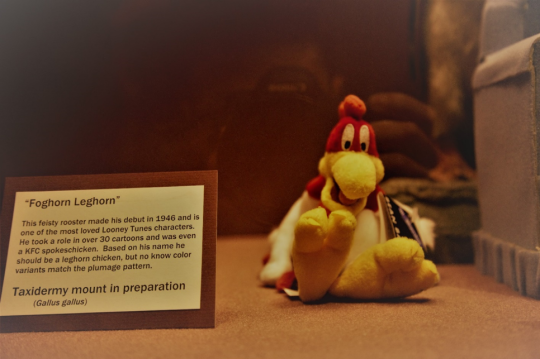
Picture from case in Bird Hall. Taxidermy mount in preparation because Steve Rogers, collections manager of Birds, is still waiting to find a specimen that looks like the Foghorn Leghorn.

Turns out – my most vivid symbol of the Anthropocene is absent. It is not found in either the collections, or in the gallery halls (although it is found in the cafeteria)!

Yes indeed, my favorite symbol is the commercial broiler chicken, likely one of the most common birds in the world because it reaches slaughter weight in less than half the time of other domestic or wild chickens! Surprised? Disappointed? Let me explain…

Last year, the director of the museum, Dr. Eric Dorfman, wrote a compelling blog titled Counting Your Chickens: The World’s Most Numerous Bird. Chickens are likely the most numerous bird in the world. In light of the Anthropocene, we could even say in Earth history. There are about 23 billion chickens alive at any given time. By comparison, the second most numerous bird reported is the red-billed quelea, which lives across the continent of Africa, with an estimated population of 1.5 billion.

You probably wonder how the chicken conquered the world. Its long journey began around 7,000 years ago when it was first domesticated from the red junglefowl (Gallus gallus), native to south-east Asia. But the bird’s trajectory radically changed in the second half of the 20th century, during what is now called “The Great Acceleration.” With changes in farming practice and the intensive production of broilers, the chicken population exploded. Meat-chicken consumption is still on the rise with more than 65 billion chickens consumed globally in 2016.

The commercial broiler chicken is even more radically different from its ancestors and other kinds of chickens. The change is about their shape, genes, and chemistry. Their genes, for instance, have been altered so that the birds are constantly hungry. In other words, they have been bred for a specific purpose: to gain weight rapidly (and they do it five times faster than chickens from the mid-20th century). It is a perfect example of what Richard Pell, director of the Center for PostNatural History and Associate Professor of Art at Carnegie Mellon University, means by the term “postnatural,” that is an organism that has been intentionally and heritably altered by humans.

The commercial broiler chicken is the direct result of human intervention. One could argue that selective breeding practices are not new. However, the Anthropocene captures a very recent rupture in Earth’s history by highlighting rapid and unprecedented changes at a planetary scale. Commercial broiler chickens and their biology shaped by humans, created in just a few decades, symbolize the transformation of the Earth’s biosphere. And new research suggests that the commercial broiler chicken’s distinctive bones could become fossilized markers of the Anthropocene. Perhaps it would be more appropriate to talk about the Gallucene.

Stories like this show how the Anthropocene offers an opportunity to rethink how we view natural history and what we put in our collections. The Carnegie Museum of Natural History is undertaking this ambitious and necessary shift in order to understand what it means to live in this new epoch.

Gil Oliveira is an intern in the Section of the Anthropocene. Museum employees are encouraged to blog about their unique experiences and knowledge gained from working at the museum.
Filed Under: Blog Tagged With: Anthropocene, bird hall, Birds, Gil Oliviera

January 2, 2019 by wpengine

Earth History in Your Hand

By Gil Oliveira

© Chart: The Conversation, CC-BY-ND

In my previous blog, I wrote about the last Jurassic World movie, which ends with the rise of a new fictional Jurassic Age, where humans and dinosaurs must learn to coexist. The Jurassic is one of the most famous geological time-periods. But when exactly was the Jurassic? The Jurassic Period ran from 200 to 145 million years ago. A long time ago… To put it into perspective, the origin of our species, Homo sapiens, dates back approximately 300 thousand years ago, which also seems a long time ago, but represents only 0.007% of the entire history of the planet (4.5 billion years)! What happened on Earth the 99.993% of the time when we did not yet even exist?

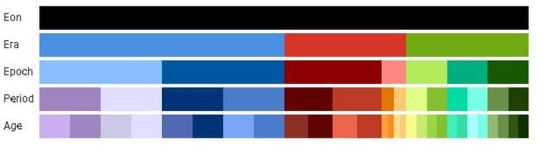
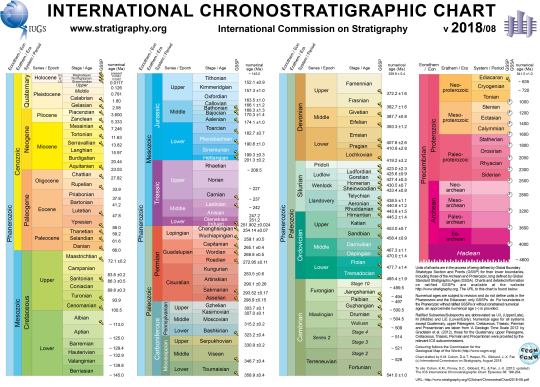
To understand earth history, natural history museums travel back through time. To do this they use a communication tool called the Geological Time Scale. In the same way we measure time with segments (such as years, months, weeks, and days), geologists subdivide deep time into useable, agreed upon units (eons, eras, periods, epochs, and ages).

chronostratigraphic chart
© ICS: http://www.stratigraphy.org, CC BY-NC-ND

But the Geological Time Scale is not exactly a calendar, because these time intervals are not equal in length like the hours in a day. Instead, divisions are based on significant events in the history of the Earth, that are detectable in rock, fossil and ice records, such as the extinction of the dinosaurs 66 million years ago, which defines the beginning of the Cenozoic era.

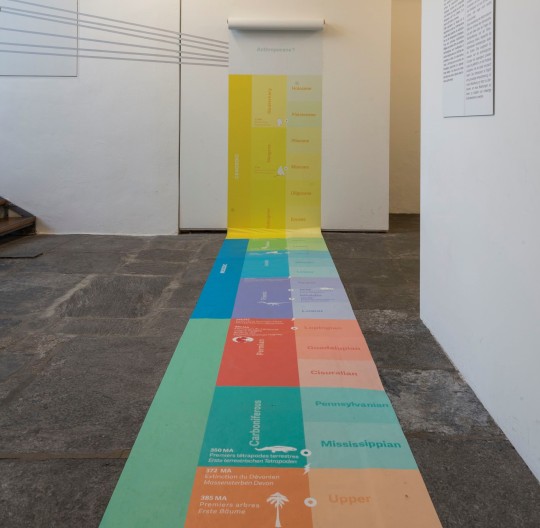
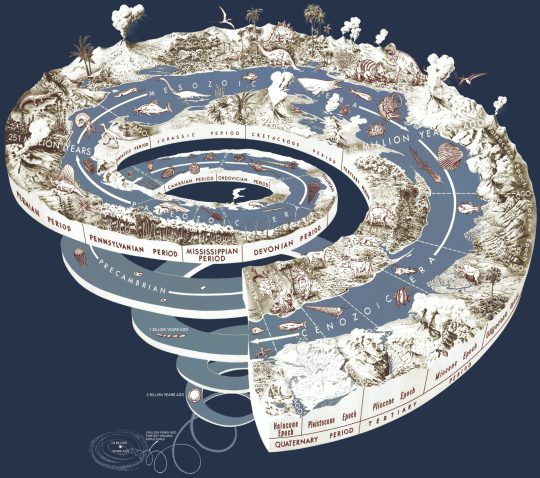
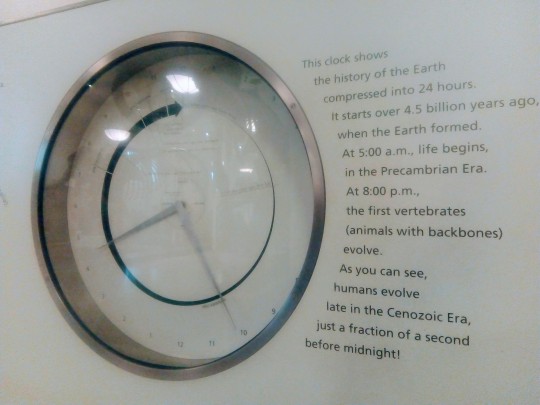
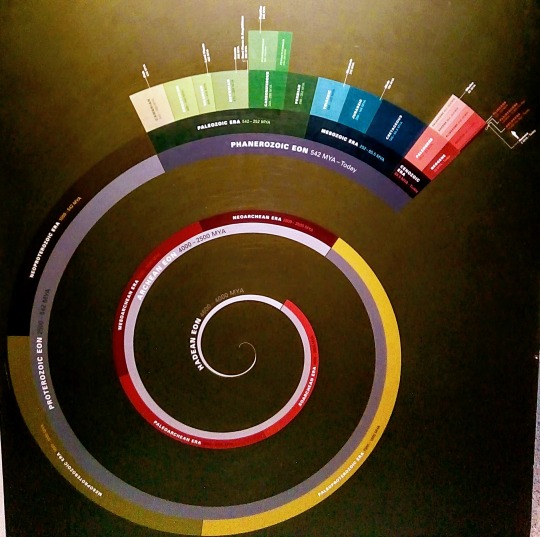
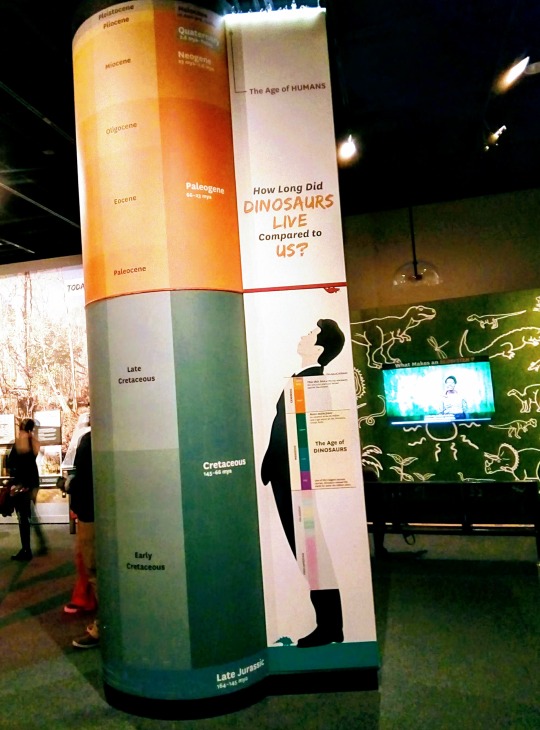
Museums don’t seek to teach the official chart of geologic time. But they seek to teach about deep time and the planet’s history, helping to put current times into a longer historical context. Museums use different techniques to make the geological time scale comprehensible. One approach is linear and usually consists of a strip of paint that represents the geological time scale rolled out on a surface. It was used for instance in the Objective Earth: Living in the Anthropocene exhibition at the Valais Nature Museum (Switzerland), which rolled out a linear poster around 30 feet long on the ground (and the wall). A second approach I have seen is more focused on aesthetics and takes the form of a spiral of time. Another technique is to take the age of the Earth and compress it into one year or one day. The American Museum of Natural History in New York used this approach with a 24-hour clock. The label indicates that life began at 5 am and the first vertebrates evolved at 8 am. As for the humans, they appeared just a fraction of a second before midnight.

Objective Earth. Living the Anthropocene © Robert Hofer


illustration of deep time
© USGS https://pubs.usgs.gov/gip/2008/58/


clock illustrating deep time
© Gil Oliveira

Each approach has benefits and disadvantages. The Geologic Time Spiral for instance can be visually striking, but the perspective of the spiral’s depth runs the risk to lose any perception of the proportion of geological time, which is the main information. It may also give a false impression of accelerating events (geological, biological, climatic, human) as we move closer to the present.

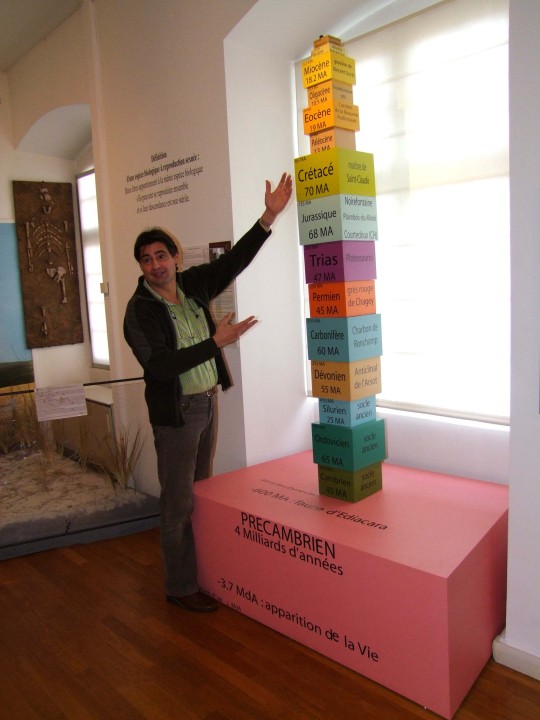
In 2007, the Cuvier Museum in Montbeliard (France) came up with a new way to represent the geological time scale. Thierry Malvesy, now curator of Geology Collections at the museum of natural history of Neuchatel (Switzerland), did it using cubes of different volumes. The advantage is to respect the proportions of time while allowing the public to see everything at a glance. It was used to explain the principle of biological evolution, emphasizing the importance of time in the evolution of life.

Cuvier Museum, 2007 © Thierry Malvesy

What is the best way to make the geological time scale understandable? There’s no easy answer. Each approach is a compromise in a way. The dinosaurs exhibit at the Smithsonian’s National Museum of Natural History uses both the spiral and the linear approach. This choice may only be temporary, as the new hall called The David H. Koch Hall of Fossils—Deep Time will open in less than a year. I wonder which approach they will use to help visitors connect to Earth’s distant past?

illustration of deep time
© Gil Oliveira

how long did dinosaurs live compared to us?
© Gil Oliveira


As the Carnegie Museum of Natural History is embracing the Anthropocene as a major theme for the future, it is important to place this newly proposed epoch in deep time. It is equally important for museums to find the best way to do it.

Gil Oliveira is postgraduate student working as an intern in the Section of the Anthropocene at the Carnegie Museum of Natural History. Museum employees are encouraged to blog about their unique experiences working at the museum.

Filed Under: Blog Tagged With: Anthropocene, Anthropocene Living Room, Gil Oliviera, museums

sidebar

About

  • Mission & Commitments
  • Directors Team
  • Museum History

Get Involved

  • Volunteer
  • Membership
  • Carnegie Discoverers
  • Donate
  • Employment
  • Events

Bring a Group

  • Groups of 10 or More
  • Birthday Parties at the Museum
  • Field Trips

Powdermill

  • Powdermill Nature Reserve
  • Powdermill Field Trips
  • Powdermill Staff
  • Research at Powdermill

More Information

  • Image Permission Requests
  • Science Stories
  • Accessibility
  • Shopping Cart
  • Contact
  • Visitor Policies
One of the Four Carnegie Museums | © Carnegie Institute | Privacy Policy | Terms of Use | Accessibility
Rad works here logo