• Skip to primary navigation
  • Skip to main content
  • Skip to primary sidebar

Carnegie Museum of Natural History

One of the Four Carnegie Museums of Pittsburgh

  • Visit
    • Buy Tickets
    • Visitor Information
    • Exhibitions
    • Events
    • Dining at the Museum
    • Celebrate at the Museum
    • Powdermill Nature Reserve
    • Event Venue Rental
  • Learn
    • Field Trips
    • Educator Information
    • Programs at the Museum
    • Bring the Museum to You
    • Guided Programs FAQ
    • Programs Online
    • Climate and Rural Systems Partnership
  • Research
    • Scientific Sections
    • Science Stories
    • Science Videos
    • Senior Science & Research Staff
    • Museum Library
    • Science Seminars
    • Scientific Publications
    • Specimen and Artifact Identification
  • About
    • Mission & Commitments
    • Directors Team
    • Museum History
  • Tickets
  • Give
  • Shop

Lindsay Kastroll

September 25, 2020 by wpengine

Mesozoic Monthly: Champsosaurus

Good news everyone: it’s September! We’ve made it to month nine of 12! Sometimes it feels like this year will never end. I take comfort in the idea that if life can survive the traumatic Cretaceous-Paleogene (K-Pg) extinction that killed the non-avian dinosaurs, I can make it through 2020. One of the survival champs of the K-Pg extinction was Champsosaurus, a superficially crocodile-like reptile belonging to the extinct group Choristodera.
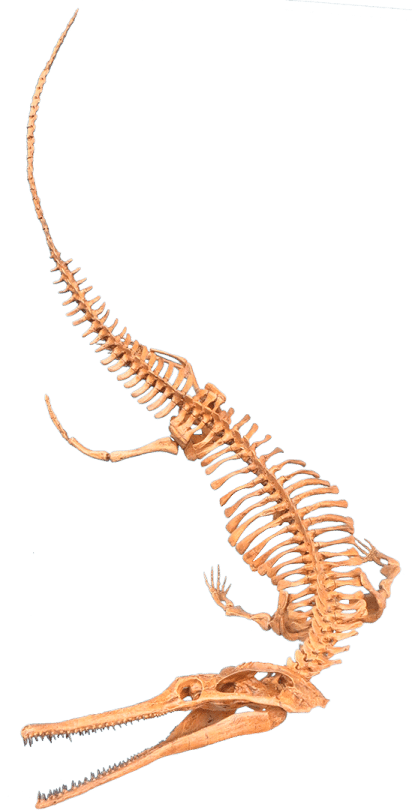
The skeleton of Champsosaurus laramiensis looks superficially like that of a crocodilian, but this is the result of convergent evolution. Choristoderes (like Champsosaurus) and crocodilians lived contemporaneously for at least 150 million years, until the choristoderes said “after a while, crocodile!” and went extinct. Photo by Triebold Paleontology, Inc., used with permission.

The class Reptilia encompasses an incredible variety of animals: lizards, snakes, turtles, crocodilians, pterosaurs, dinosaurs, and even birds are just a few of its members. In addition to the familiar reptiles that live today, many other reptile groups thrived for millions of years before eventually going extinct. It’s easy to think of dinosaurs like Tyrannosaurus or Triceratops when we talk about extinct reptile groups, but in reality, many extinct groups of animals with no living relatives escape the public eye. Choristodera, an order within the class Reptilia, is one of these groups. Choristoderes were semi-aquatic or aquatic carnivorous reptiles that evolved during the Mesozoic Era (the Age of Dinosaurs) and died out in the Cenozoic Era (the Age of Mammals). Just because they went extinct does not mean they were unsuccessful; the group survived for at least 150 million years! Like many animals, a rapidly shifting environment was probably the source of their demise. Until that point, choristodere evolution was able to ‘keep up’ with the changing times, including the monumental global changes that came with the K-Pg extinction. The combination of a massive asteroid impact in what’s now Mexico, extensive volcanic activity in India, and worldwide climatic shifts resulted in the extinction of over 75% of all species. Research on choristodere teeth suggests that they beat the odds by adapting to new prey.

When you think of an aquatic carnivorous reptile, you probably think of a crocodilian – and that’d be right! The crocodilian body plan is a very successful build for hunting prey in the water. As another aquatic carnivorous reptile, Champsosaurus evolved similar traits. This is an example of convergent evolution, in which unrelated species develop similar characteristics to deal with comparable circumstances. (You can read about more examples of convergent evolution in the January edition of Mesozoic Monthly about the sauropodomorph dinosaur Ledumahadi.) Some of the shared features between Champsosaurus and crocodilians include long, muscular jaws for catching fish, eyes at the top of the head for peering out of the water, and a flattened tail that was paddled side-to-side for propulsion. Of course, Champsosaurus and the rest of the choristoderes had many features that set them apart as well. Unlike crocodilians, which have bony armor called osteoderms embedded in their skin, choristoderes just had skin covered with tiny scales. In addition, crocodilians have nostrils on top of their snouts so that they can breathe while lurking beneath the surface of the water; choristodere nostrils were at the end of their snouts, so that they could stick the tip of their nose out of the water like a snorkel and breathe from down below.
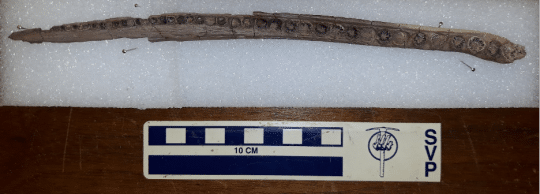
A right dentary (tooth-bearing lower jaw bone) of Champsosaurus sp. from the Upper Cretaceous of Wyoming in Carnegie Museum of Natural History’s Vertebrate Paleontology collection (specimen number CM 96509). The bone is facing upwards, so you’re looking down on the teeth. Check out the dark ‘stripes’ on the enamel of each tooth. These unusual enamel striations are a hallmark of neochoristoderes, the particular choristodere subgroup to which Champsosaurus belongs. Photo by Joe Sawchak.

The traits we see in the skeleton of Champsosaurus help paleontologists paint a picture of its behavior. Instead of lurking at the surface of the water, Champsosaurus would wait on the bottom of a shallow lake or stream for prey to come close, lifting the tip of its snout out of the water to breathe. When a tasty fish approached, it would spring off the bottom with its powerful legs and snatch it with its toothy jaws. Despite having strong legs, Champsosaurus was not adapted to a terrestrial lifestyle. In fact, adult males may not have been able to leave the water at all! Fossils attributed to females have more robust hips and hind limbs, allowing them to crawl onto land to lay eggs. According to this hypothesis, the less-robust males would have been restricted to an aquatic-only lifestyle.

Some of the freshwater environments that Champsosaurus inhabited were relatively cold, but that wasn’t a big deal; choristoderes may have been able to regulate their body temperature (a talent known as endothermy or ‘warm-bloodedness’). Crocodilians, by contrast, live in warm, tropical habitats because they are not capable of regulating their body temperature and rely on the sun to warm their bodies (aka ectothermy or ‘cold-bloodedness’). This would explain why choristoderes were able to live further north than crocodilians. However, it seems that crocodilians had the right idea; temperatures around the tropics change less during cooling and warming periods than those at higher latitudes. So, when the current Antarctic ice sheets began to form and the planet started cooling, the temperate choristoderes had to deal with more environmental change than the tropical crocodilians, and finally went extinct. I think the moral of the story is, we would all be handling 2020 better if we lived in the tropics!

Lindsay Kastroll is a volunteer and paleontology student working in the Section of Vertebrate Paleontology at Carnegie Museum of Natural History. Museum staff, volunteers, and interns are encouraged to blog about their unique experiences and knowledge gained from working at the museum.
Related Content

In the Field: Following the Work of a Paleontologist

Jurassic Days: Camptosaurus

Behind the Scenes of Dinosaur Armor

Filed Under: Blog Tagged With: dinosaurs in their time, Lindsay Kastroll, Mesozoic Monthly, Museum from Home, Science News, Vertebrate Paleontology

August 24, 2020 by wpengine

Mesozoic Monthly: Gryposaurus

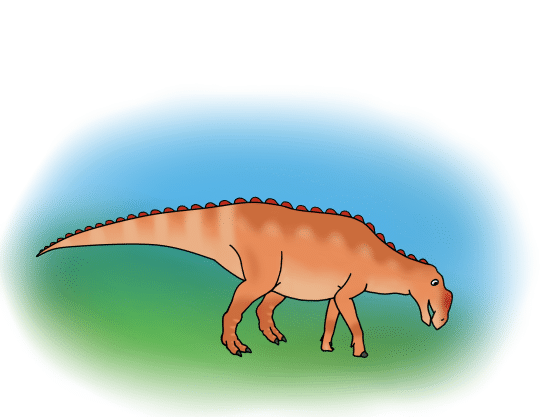
The Late Cretaceous-aged (~75 million-year-old) large-nosed North American hadrosaur (aka duck-billed dinosaur) Gryposaurus by ginjaraptor on DeviantArt.

Anyone who frequents the Pittsburgh area is familiar with ‘Pittsburghese,’ the regional dialect given full voice in what was once voted America’s ugliest accent (a fact that does not diminish our pride for it). One of my personal favorite Pittsburghese words is “nebby,” which translates to “nosy” for any non-local readers. “Nebby” can be used in a variety of contexts: the distant relative asking prying questions about your love life at Thanksgiving dinner is nebby, the pet cat trying to crawl under the bathroom door to see what you’re doing is nebby, and even the statue of Carnegie Museum of Natural History mascot Dippy the Diplodocus, silently judging your driving on Forbes Avenue, is nebby. We can assume other dinosaurs were nebby too, since so many had huge noses to stick into things. One of the biggest noses in the fossil record belongs to Gryposaurus notabilis, the star of this edition of Mesozoic Monthly.

Gryposaurus belongs to a group of dinosaurs called hadrosaurs, which are commonly referred to as duck-billed dinosaurs. Hadrosaurs were herbivores that got their nickname from the flat, toothless, somewhat duck-like beaks at the tips of their jaws. These beaks were used to bite through tough vegetation so that it could be ground up by the numerous teeth embedded in the rear half of the jaws. There are two main groups of hadrosaurs, both of which are featured in CMNH’s Dinosaurs in Their Time exhibition. Probably the more famous group is the Lambeosaurinae, known for their distinctive head crests that housed extra-long nasal passages. Virtually everyone can recognize the incredible backward-curving crest of Parasaurolophus (featured multiple times in the Jurassic Park franchise), and visitors to CMNH will also know the helmet-like crest of Corythosaurus. The second group is the Saurolophinae (traditionally known as the Hadrosaurinae), which typically lack bony crests. You can find a simulated carcass of the saurolophine Edmontosaurus (lovingly known to those of us in CMNH’s Section of Vertebrate Paleontology as “Dead Ed”) between the two imposing Tyrannosaurus skeletons in Dinosaurs in Their Time.

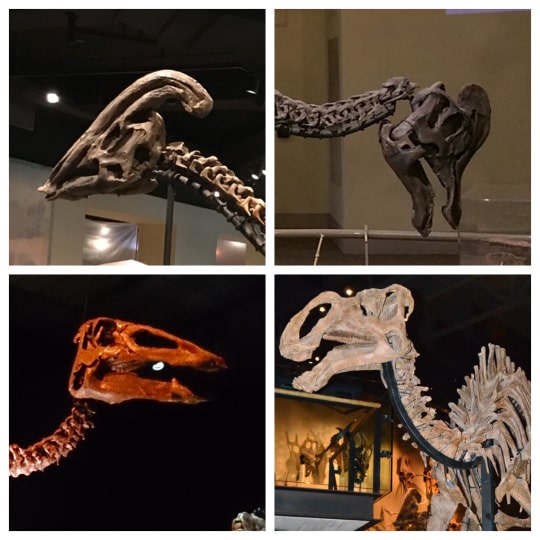
A gallery of hadrosaur heads. Top left: the lambeosaurine Parasaurolophus at the Field Museum of Natural History in Chicago (photo by the author). Top right: the lambeosaurine Corythosaurus at Carnegie Museum of Natural History (photo from Wikimedia Commons). Bottom left: the saurolophine Edmontosaurus at the Houston Museum of Natural Science (photo from Wikimedia Commons). Bottom right: the saurolophine Gryposaurus at the Natural History Museum of Utah in Salt Lake City (photo from Wikimedia Commons).

As a crestless hadrosaur, Gryposaurus was a saurolophine. Despite its lack of crest, its skull still had pizzazz: its nasal bone arched dramatically, giving the impression of a ‘Roman nose’ (which is very noticeable if you compare the skulls of Edmontosaurus and Gryposaurus in the image above). The name Gryposaurus notabilis means “notable hooked-nose lizard” in homage to this feature. G. notabilis is the type species of Gryposaurus; type species are typically the first ones to be named in a genus, and therefore become the reference to which all new specimens that may belong to that genus are compared. The other species (such as G. monumentensis, shown in the photo montage above) are similar enough to the type species that they can be referred to the genus Gryposaurus, but they differ in too many ways to be assigned to G. notabilis itself.

Occasionally, paleontologists will revisit a fossil species or genus and decide that it is either too similar to another to justify its own name or that certain specimens are too different to be grouped under the same name. Kritosaurus, another saurolophine with a ‘Roman nose,’ has fallen victim to both of these circumstances. It was originally considered its own genus, but was subsequently revisited by paleontologists who decided that it was so similar to Gryposaurus that the two genera were lumped together under the name Gryposaurus (when combining taxonomic groups, the first name that was published is the one that gets used). However, later paleontologists reviewed the evidence again and split a single species of Kritosaurus back out of Gryposaurus. The famous sauropod (giant long-necked herbivorous dinosaur) Brontosaurus underwent a similar series of changes over the years: originally, it and Apatosaurus were considered different animals, but after a review they were lumped together under Apatosaurus. Recently, the two were split apart again and the name Brontosaurus was revived (to the delight of fans of that name around the world).

It is not uncommon in paleontology for species to be lumped or split based on new or revisited evidence. When you consider that the decision to name new fossil species is often based on fragmentary, highly incomplete skeletons, you can see why it might be difficult to get things right the first time! These changes sometimes give people the impression that paleontologists “can’t make up their minds” or “contradict themselves,” but we must remember two things. First, that science is meant to change based on new evidence. Second, there have been thousands of paleontologists over the course of history, and every one of them is an individual person who can draw their own conclusions based on the same evidence. Although the resulting changes can disappoint fans of a specific animal or hypothesis, revision is normal and beneficial for the field as a whole. Scientists are supposed to be nebby – it’s how we make new discoveries!

Lindsay Kastroll is a volunteer and paleontology student working in the Section of Vertebrate Paleontology at Carnegie Museum of Natural History. Museum staff, volunteers, and interns are encouraged to blog about their unique experiences and knowledge gained from working at the museum.
Related Content

Mesozoic Monthly: Aspidorhynchus

Ah, Snap! Dino Named for Marvel’s Thanos

Jurassic Days: Specimen Scavenger Hunt

Filed Under: Blog Tagged With: dinosaurs in their time, Educator Resources, Lindsay Kastroll, Mesozoic Monthly, Museum from Home, Science News, Section of Vertebrate Paleontology

July 31, 2020 by wpengine

Mesozoic Monthly: Aspidorhynchus

As we all seek out responsible ways to enjoy our summer months while the world continues to respond to COVID-19, many of us are embracing the therapeutic effects of the great outdoors. One popular activity, especially in and around the Three Rivers, is fishing. Some modern fishes look positively primeval, as if they were hooked straight out of the Age of Dinosaurs and reeled into the present day. For July’s edition of Mesozoic Monthly, our star is Aspidorhynchus, one of the weird and wonderful fishes that inhabited the oceans of the Mesozoic Era.

Let’s start with a quick lesson on fish, for context. There are two main groups of bony fishes. One group, the class Sarcopterygii, are called the lobe-finned fishes because they have fleshy, limb-like fins that they use to paddle through the water like oars. The first vertebrates to go on land were sarcopterygians, and the descendants of these adventurous fish eventually evolved into amphibians, reptiles, and mammals – including us! Despite their prolific limbed descendants, sarcopterygians make up only a small fraction of fishes today. The vast majority of fish belong to the other class: Actinopterygii, or the ray-finned fishes. These fishes have delicate ray-like bones supporting thinly webbed fins instead of the meaty fins of the sarcopterygians. Actinopterygians are so successful that they dominate both freshwater and saltwater ecosystems, thrive in a variety of habitats, and fill various ecological niches. Such diverse lifestyles mean that actinopterygians come in many shapes and sizes. Nemo (a clownfish) is an actinopterygian. So is the barracuda that ate his mother, the catfish in the Monongahela River, and the unfortunate goldfish you won at the carnival as a kid. Most fossil fishes, like Aspidorhynchus for example, are also actinopterygians.

Aspidorhynchus is an extinct member of the order Holostei, nested, in diagrams of relatedness, within the class Actinopterygii. The only members of the Holostei today are gars and bowfins. Superficially, Aspidorhynchus looks like a gar, but it is more closely related to bowfins. Its name means “shield snout,” in reference to its pointy, swordfish-like upper jaw. Unlike swordfish, which lack teeth as adults, this snout was filled with many sharp teeth. The limited flexibility of its skull restricted its diet to tiny fish, two inches (5 centimeters) in diameter at the largest. Aspidorhynchus was not very large itself, its slender body only growing to approximately two feet (60 centimeters) in length. It was covered with ganoid scales, which are hard, diamond-shaped scales made with a shiny compound called ganoin. Only a few types of modern fishes have ganoid scales, including gar, sturgeon, and paddlefish.

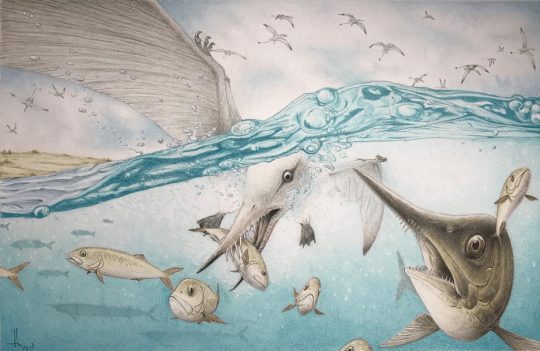
Jurassic feeding frenzy: the pterosaur (flying reptile) Rhamphorhynchus and the predatory fish Aspidorhynchus attack a school of smaller fish. Usually, the baitfish were the only casualties here, but once in a while, everybody lost (see below!). Art by RavePaleoArt on DeviantArt, reproduced with permission.

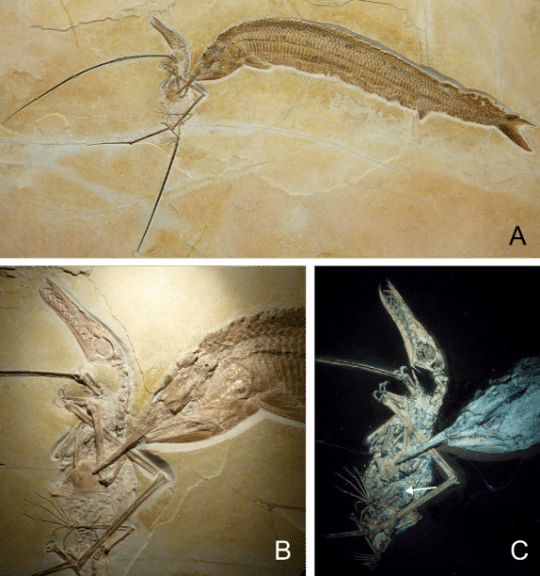
Although species of Aspidorhynchus lived in the Jurassic and Cretaceous periods, we know that it encountered the same struggles as some modern fish due to several remarkable fossils. Just like swordfish, the pointy snout of Aspidorhynchus frequently got it into trouble by impaling other animals! The abundance of fossil evidence for this was provided by the unique conditions of the habitat preserved in the famous Solnhofen Limestone of Germany. In the Late Jurassic, this area was an isolated series of lagoons that accumulated a bottom layer of anoxic brine, which is extra-salty, low-oxygen water where oxygen-dependent (aerobic) life cannot survive. Despite this, the surface still teemed with life: fishes and marine reptiles dominated the water, small non-avian dinosaurs scurried along the shore, and pterosaurs (flying reptiles) and archaic birds flew overhead. The fish-eating pterosaur Rhamphorhynchus seems to have been a fairly frequent victim of the snout of Aspidorhynchus, with multiple fossils documenting unfortunate collisions in which the fish’s snout pierced and became entangled in the wing membrane of the pterosaur. (For a summary of pterosaur wings, check out the March edition of Mesozoic Monthly, on Nemicolopterus.) It’s obvious from the size of the animals that neither was trying to eat the other, but somehow, they became stuck together. As the two animals struggled to survive, they slowly drifted downward into the anoxic brine, where they suffocated and settled onto the bottom of the lagoon. If any other animals had tried to eat or otherwise disturb the corpses, they would have died in the brine as well, so the fossils of the Solnhofen Limestone are typically pristine and undisturbed by scavengers.

Three views of the most famous (and probably the most beautiful) Aspidorhynchus vs. Rhamphorhynchus fossil from the Upper Jurassic Solnhofen Limestone of southern Germany. Avid fisherman Matt Lamanna, the head of Vertebrate Paleontology at Carnegie Museum of Natural History (CMNH), jokes that the Aspidorhynchus looks angry, as if it’s mad about getting its snout stuck in the Rhamphorhynchus and dooming them both. Sorry Matt, this is just a quirk of preservation – the compression of the Aspidorhynchus skull during fossilization gave it the appearance of having grouchy eyebrows that weren’t there in life. You can learn more about this specimen in a paper by Frey and Tischlinger (2012).And if you want to see real fossils of both of these animals in person (albeit preserved separately), come visit the Solnhofen case in CMNH’s Dinosaurs in Their Time exhibition.

Because Aspidorhynchus lived only during the Mesozoic, there’s no chance that a modern-day angler will ever hook one. But should you find yourself fishing in one of Pennsylvania’s rivers or lakes this summer, and manage to land a gar or bowfin, pause for a moment and reflect on the ancient legacy of these fishes – a heritage that dates to the Age of Dinosaurs.

Lindsay Kastroll is a volunteer and paleontology student working in the Section of Vertebrate Paleontology at Carnegie Museum of Natural History. Museum staff, volunteers, and interns are encouraged to blog about their unique experiences and knowledge gained from working at the museum.
Related Content

Preserving Fossil Treasures: Eocene Fishes from Monte Bolca, Italy

Science Chats: Herpetologist Talks About Dinosaurs with Paleontologist

The Bromacker Fossil Project Part VIII: Martensius bromackerensis Honoring a Colleague

Filed Under: Blog Tagged With: dinosaurs in their time, Lindsay Kastroll, Mesozoic Monthly, Museum from Home, Science News, Vertebrate Paleontology

June 29, 2020 by wpengine

Mesozoic Monthly: Protostega

June 20th was the first day of summer! The weather here in Pittsburgh is already beautiful. It’s enough to make one dream of a socially distant beach! Summer, of course, is sea turtle nesting season: during the next several weeks, female sea turtles all across our planet’s Northern Hemisphere will return to the beach where they hatched, drag themselves onto land, and lay their eggs in the sand. It would have been an incredible sight to see Protostega gigas, one of the largest sea turtles of all time, hauling itself onto the beach to lay its eggs! For June’s Mesozoic Monthly, we’re going to “dive in” to the paleontology of this giant reptile.

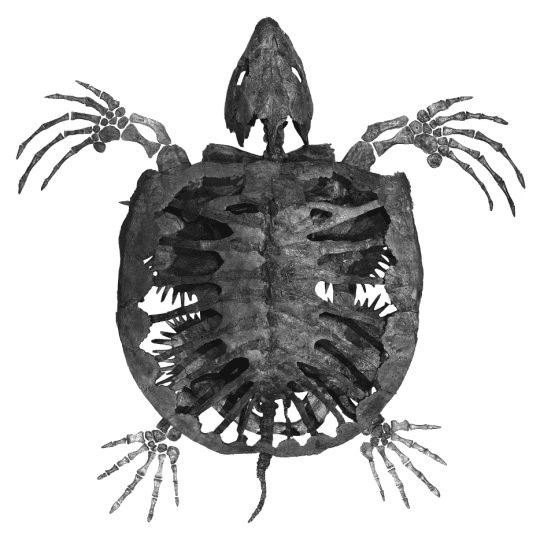
Carnegie Museum of Natural History’s spectacular skeleton of Protostega gigas is a composite made from the fossilized bones of two different individuals. Come see it on display in our Dinosaurs in Their Time exhibition when the museum reopens at the end of this month. But don’t forget to purchase your timed ticket in advance!

All turtles, including sea turtles like Protostega and tortoises like the Galápagos giant tortoise, belong to the group Testudines. This group originated during the Triassic Period, the first of the three time periods of the Mesozoic Era (aka the Age of Dinosaurs). Turtles split from other reptiles to form their own group before crocodiles and dinosaurs evolved! This means that turtles are not descended from dinosaurs, no matter how primordial some tortoises may look. Turtles differ from other reptiles in many ways, the most noticeable being their iconic shells. 

A turtle shell is formed of two main parts: the carapace, or top shell, and the plastron, or bottom shell. The shell is made of bone fused directly to the spine and ribcage, so a turtle cannot crawl out of its shell without leaving its skeleton behind! Another major difference between turtles and other modern reptiles involves skull anatomy. Turtles have anapsid skulls: the bony case that protects their brain lacks any external openings behind their eyes (known as temporal openings). All other extant reptiles plus birds are diapsids, meaning their skulls have two holes behind their eyes. Mammals differ from both conditions because we have only one temporal opening, making us synapsids. Traditionally, the anapsid condition of turtle skulls has been taken to indicate that they are the most primitive of living reptiles. More recently, however, many paleontologists and biologists have uncovered evidence that turtles are in fact diapsids whose evolutionary course led, for some reason, to a secondary closure of their temporal openings. According to these scientists, the closest relatives of turtles among today’s diapsids are either lepidosaurs (lizards, snakes, and kin) or archosaurs (crocodilians and birds).

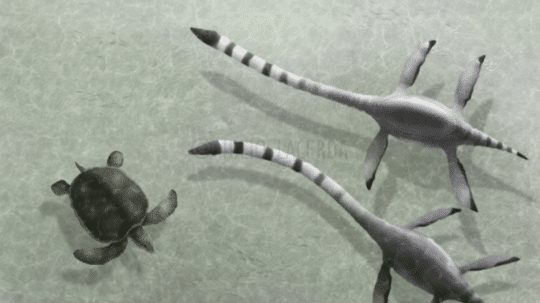
A bird’s (or pterosaur’s!) eye view of Protostega gigas (left) swimming past two long-necked elasmosaurid plesiosaurs in shallow waters of North America’s Western Interior Seaway roughly 85 million years ago. (This scene is set in what’s now Kansas!) Art by Julio Lacerda; see more of his beautiful work here.

Reptiles, mammals, and birds all belong to a group called Amniota, and the key defining feature of amniotes is a protective layer around their eggs that allows this vulnerable life stage to survive on land. Having eggs that did not have to be laid in water meant that animals could move to less-wet habitats, a significant step in evolution! Unfortunately for sea turtles, which spend most of their lives at sea, this means they must return to land to lay their eggs. An amniotic egg would “drown” in water because the embryo still needs access to air. As a sea turtle, Protostega would have faced these same reproductive challenges, plus one more: it was huge!The largest modern turtle, the leatherback sea turtle, can grow over seven feet (2.1 meters) long; Protostega dwarfs it at 9.8 feet (3 meters)! If you’ve ever seen video of a sea turtle crawling onto the beach to nest, you know that it’s an awkward process. Imagine seeing a turtle that weighs at least a ton try to do the same! Although surely clumsy on land, Protostega was a graceful swimmer, using its four rigid flippers like wings to “fly” through the water.

Protostega lived in the Western Interior Seaway, an inland sea that stretched across much of North America during the Cretaceous Period (the third and final period of the Mesozoic Era). The seaway was warm, shallow, and teeming with all kinds of aquatic life: the perfect habitat for an omnivorous sea turtle. Because sea turtles are ectothermic (sometimes erroneously called “cold-blooded”), they cannot regulate their own body temperature. Instead, Protostega relied on warm water temperatures and sunlight hitting its back to keep warm. Although we don’t have a fossil record of the coloration of Protostega, we know that today’s large sea turtles are counter-shaded, with heat-absorbing, dark-colored backs and pale undersides. In an ocean environment where both predator and prey shift positions in the water column, this combination aids concealment. From below, a light-colored underside blends with light-saturated water. From above, a dark back blends with dark water. Camouflage in the water was an important feature when living alongside so many sizable predators. Protostega fossils have been found with bite marks from the large shark Cretoxyrhina mantelli, and it almost certainly was also on the menu for the mighty mosasaurs as well. Fortunately for us, we humans can enjoy the ocean knowing that few creatures are interested in eating us!

Lindsay Kastroll is a volunteer and paleontology student working in the Section of Vertebrate Paleontology at Carnegie Museum of Natural History. Museum staff, volunteers, and interns are encouraged to blog about their unique experiences and knowledge gained from working at the museum.
Related Content

Mesozoic Monthly: Citipati

Science Chats: Herpetologist Talks Dinosaurs with Paleontologist 

The Volunteers: Can’t Live Without Them

Filed Under: Blog Tagged With: Cretaceous Seaway, dinosaurs in their time, fossils, Lindsay Kastroll, Museum from Home, Science News, Section of Vertebrate Paleontology

May 27, 2020 by wpengine

Mesozoic Monthly: Citipati

The month of May that we’re living in is very different from the one we all anticipated at the start of the year. However, society somehow manages to march on. College students are still graduating, moms are still being celebrated, and Mesozoic Monthly continues! Our honoree for the month of May is known to have been a dedicated parent due to several specimens that show adults guarding eggs. Say hello to Citipati osmolskae!

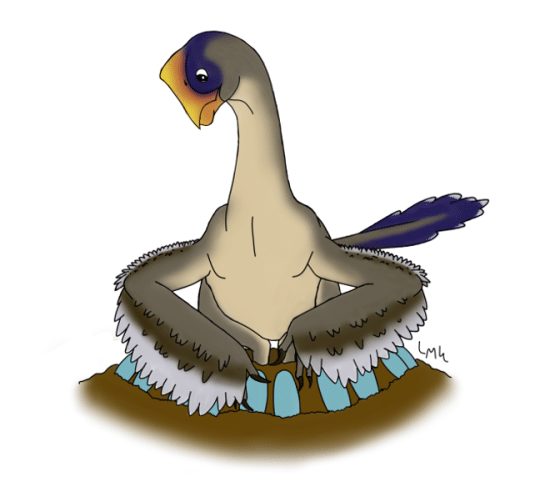
illustration of Citipati, a dinosaur that looks similar to a bird, on a nest of blue eggs

A devoted Citipati parent guarding its nest. Some evidence suggests that the Citipati skeletons found atop nests may have been males (rather than females as was originally thought). Also, recent research indicates that—believe it or not—oviraptorid eggs were blue! Art by ginjaraptor on DeviantArt.

It might not look like it, but Citipati is a theropod, like the more famous dinosaurs Tyrannosaurus, Allosaurus, and Velociraptor. Most theropods were carnivores, sporting skulls with big toothy grins, but not all theropods were ravenous predators! There are several groups of theropods that evolved toothless beaks for specialized diets. One of the stars of Jurassic Park, Gallimimus, was part of a predominantly herbivorous group of beaked theropods called Ornithomimidae. Citipati belongs to another group of beaked theropods called Oviraptoridae. “Oviraptor” means “egg thief,” in reference to an old hypothesis that oviraptorids stole and ate eggs from other dinosaurs’ nests. The discovery of a Citipati skeleton perched in a brooding position atop a nest of eggs was pivotal in changing this idea. We now know that instead of stealing others’ eggs to eat, fossilized oviraptorids preserved near eggs were actually protecting their own eggs! The eggs in an oviraptorid’s nest were arranged in circles with a space in the center for the parent to sit and spread their feathered arms over their incubating young.

photograph of Anzu dinosaur fossil

Citipati and other oviraptorids are closely related to one of Carnegie Museum of Natural History’s most bizarre dinosaurs, the ‘Chicken from Hell’ Anzu wyliei, shown here on display in the museum’s Dinosaurs in Their Time exhibition.

So, instead of eggs, what would the toothless beak of Citipati have been used to eat? Because most oviraptorid beaks are very deep, like those of modern parrots, most paleontologists infer that these dinosaurs ate mostly plants. However, this doesn’t necessarily mean that meat was off the menu; it would still have been possible for oviraptorids to have eaten small animals, making them omnivores. On top of its thick skull, Citipati possessed a tall, triangular crest that gave its small head a square-shaped profile. This crest was not as impressive as those on some other dinosaurs, but since Citipati grew to ten feet (three meters) long, the animal would still have been quite imposing. I certainly wouldn’t want to get between a Citipati parent and its eggs!

Citipati fossils are found in the modern Gobi Desert of Mongolia, in rocks known as the Djadokhta Formation. The Djadokhta rocks are made of sediments that were deposited late in the Cretaceous Period, preserving details of the ecosystem that existed there roughly 80–75 million years ago. The name Citipati means “funeral pyre lord,” which is fitting due to the hot environment in which this oviraptorid lived. Also, Citipati shares its name with a Buddhist deity that is believed to protect cemeteries from thieves, which is an appropriate parallel considering how the skeleton of this dinosaur was found guarding its fossilized nest.

Although the habitat Citipati lived in was a desert, like the Gobi Desert that is there today, this prehistoric desert was probably not as dry. In the event of rain, water gathered in temporary streams that drained the water to basins and oases. Since desert rain events are by definition few and far between, any animals that did not live near these oases would have needed to have adaptations for going without water for a long period of time. Some of the animals that lived in this unwelcoming environment alongside Citipati included everyone’s favorite small theropod Velociraptor, the hornless ceratopsian Protoceratops, and the tail-club wielding ankylosaur Pinacosaurus.

Lindsay Kastroll is a volunteer and paleontology student working in the Section of Vertebrate Paleontology at Carnegie Museum of Natural History. Museum staff, volunteers, and interns are encouraged to blog about their unique experiences and knowledge gained from working at the museum.
Filed Under: Blog Tagged With: dinosaurs in their time, Lindsay Kastroll, Mesozoic Monthly, Museum from Home, Science News, Vertebrate Paleontology

February 10, 2020 by wpengine

MESOZOIC MONTHLY: LEDUMAHADI

January brings with it a new year and a new installment of Mesozoic Monthly! At the start of a new decade, perhaps the perfect prehistoric creature to honor this month is the dinosaur Ledumahadi mafube, the “giant thunderclap at dawn.”

Ledumahadi was an early sauropodomorph, a group of herbivorous dinosaurs that ultimately produced the famous sauropods. Sauropods such as Brachiosaurus or Diplodocus are popular dinosaurs because of their often monstrous sizes, long necks, and lengthy, sometimes whip-like tails. One of the traits that paleontologists believe helped sauropods get so big was their pillar-like legs. Their legs were straight, like stilts, and heavily constructed so that they could support the weight of the animal. Modern elephants also have columnar legs, similar to those of sauropods, because this style of limb is so efficient for big animals. Non-sauropod sauropodomorphs tended to be smaller than their sauropod cousins, and could walk on either two legs or four. Quadrupedal early sauropodomorphs such as Ledumahadi did not have the columnar legs of sauropods, but instead walked with their forelimbs partially bent.

Life reconstruction of Ledumahadi by Nobu Tamura with a human silhouette for scale. This was a big beast! Note how, unlike its sauropod kin, this early sauropodomorph walked with its forelimbs flexed at the elbow. Read the 2018 scientific paper that described it (for free) here.

The largest known dinosaur of its kind, Ledumahadi weighed over 13 tons (12 metric tons), and reconstructions estimate that it grew over 30 feet (9 meters) long! This size is noteworthy, because it shows that it was possible for sauropodomorphs to reach gigantic sizes without columnar legs. This demonstrates that terrestrial animals can get big due to a variety of adaptations. In this case, the tremendous size of both sauropods and Ledumahadi is an example of convergent evolution, a process in which unrelated animals can evolve similar features. One classic example of convergent evolution is wings. Birds, bats, and pterosaurs are unrelated, yet all evolved similar structures that increase surface area for flying. But they all did it in different ways: birds have feathers anchored to the forearm and a fused hand, bats have skin stretched across five fingers, and pterosaurs had skin stretched along one long finger. Although we may not definitively know how Ledumahadi achieved its status as a “great thunderclap,” we do know that it did so along a different evolutionary pathway than its sauropod relatives.

The name Ledumahadi mafube means “great thunderclap at dawn,” referring to the massive size of the animal and its early place in the rock record. Unlike many dinosaur names, it is not derived from Latin or Greek; instead, it is from Southern Sotho, one of the languages spoken in South Africa, where the creature’s fossils were discovered.

Not many well-known animals lived in the Early Jurassic of southern Africa alongside Ledumahadi; the most famous dinosaurs are other sauropodomorphs such as Massospondylus, the small bipedal herbivores Heterodontosaurus and Lesothosaurus, and the small carnivore Coelophysis (formerly called Syntarsus) rhodesiensis. They all lived in an arid floodplain that was crisscrossed by meandering streams. Every so often, after a long period of stability, these water channels would flood, depositing new soil and nutrients and rejuvenating the ecosystem. A great deal of plant growth occurs after floodplains drain, reflecting a cycle of renewal that is familiar to us during each and every new year.

Lindsay Kastroll is a volunteer and paleontology student working in the Section of Vertebrate Paleontology at Carnegie Museum of Natural History. Museum staff, volunteers, and interns are encouraged to blog about their unique experiences and knowledge gained from working at the museum.
Filed Under: Blog Tagged With: Lindsay Kastroll, Science News, Vertebrate Paleontology

  • « Go to Previous Page
  • Page 1
  • Page 2

sidebar

About

  • Mission & Commitments
  • Directors Team
  • Museum History

Get Involved

  • Volunteer
  • Membership
  • Carnegie Discoverers
  • Donate
  • Employment
  • Events

Bring a Group

  • Groups of 10 or More
  • Birthday Parties at the Museum
  • Field Trips

Powdermill

  • Powdermill Nature Reserve
  • Powdermill Field Trips
  • Powdermill Staff
  • Research at Powdermill

More Information

  • Image Permission Requests
  • Science Stories
  • Accessibility
  • Shopping Cart
  • Contact
  • Visitor Policies
One of the Four Carnegie Museums | © Carnegie Institute | Privacy Policy | Terms of Use | Accessibility
Rad works here logo