Did you know that Pennsylvania is one of the top states for Christmas tree farms? In fact, southwestern Pennsylvania’s very own Indiana County is known as the “Christmas Tree Capital of the World.” According to the Indiana County Christmas Tree Growers’ Association, the title arose in 1956, when an estimated 700,000 trees were cut that year in the county.
Believe it or not, there are no Carnegie Museum specimens from Indiana County collected in the month of December. This is not all that surprising, as most specimens aren’t collected in the winter.
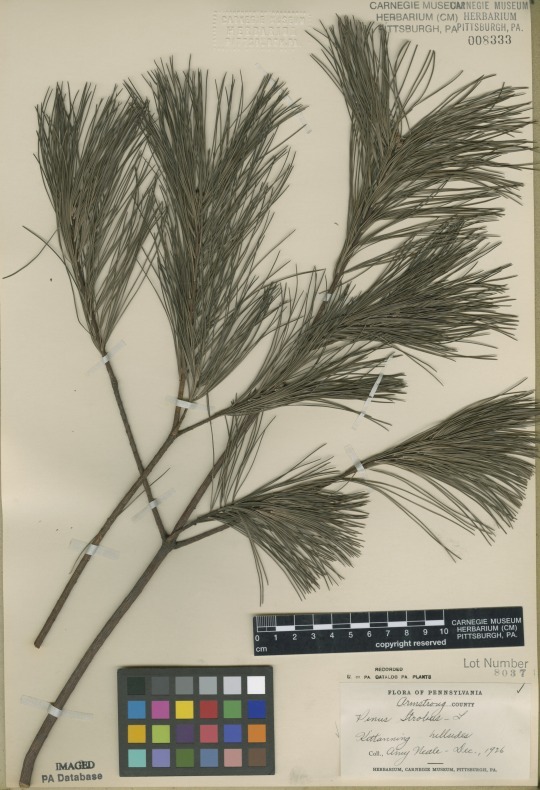
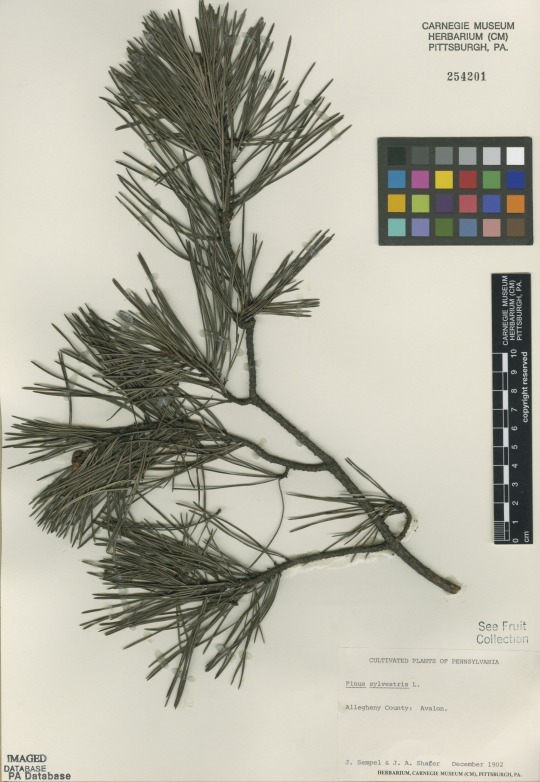
These Pennsylvania specimens shown above were collected sometime in December (exact day unknown): White Pine (Pinus strobus) in Kittanning in 1926 and Scots Pine (or “Scotch Pine”; Pinus sylvestris) from cultivation in
Avalon in 1902. Both species are cultivated and used as decorative trees for the holidays, but less commonly than in the past. Many different evergreen conifer species are cultivated in the United States for decorative use during
the holidays. Needle length, softness, retention, color, and even scent vary by species or variety. Similarly, branching characteristics and branch strength differs by species. Plus, some species grow faster and easier than
others, which means some species are cheaper.
Before farms began cultivating trees for that purpose in the early 20th century, people just went to the woods to cut down their tree for the holidays. Some of the first Christmas tree farms in the United States started in Indiana County as early as 1918. Many farms in the region turned their fields into Christmas tree farms as it became profitable. By 1960, more than 1 million trees were harvested per year in Indiana County alone. The harvest in Pennsylvania has declined for several reasons, including increased popularity of artificial trees and consumer interest in Frasier fir trees (Abies fraseri; which are native to the southern Appalachians and grows slower in Pennsylvania than farms in North Carolina). However, Pennsylvania is still among the top five states in terms of both number of working Christmas tree farms and trees harvested. According to the National Christmas Tree Association, 31,577 acres in Pennsylvania are used as Christmas tree plantations. Many of the Christmas tree lots in southwestern Pennsylvania get their trees from farms in Indiana County.
Botanists at Carnegie Museum of Natural History share pieces of the herbarium’s historical hidden collection on the dates they were discovered or collected. Check back for more!
