by Amy L. Covell-Murthy
While they would probably make pretty decent boat or band names, Boyce Knob, Smithhammer, and Pies are all common names for archaeological sites near Pittsburgh, Pennsylvania. Currently, there are nearly 750 registered archaeological sites in Allegheny County. Besides these silly-sounding common names, all registered archaeological sites must be assigned an official site number from the Pennsylvania Historical and Museum Commission.
The system that they use is known as the Smithsonian Trinomial System. It was established in the 1930s and 40s when there were only 48 states in the union. Each state was assigned a number in alphabetical order with Alabama being 1 and Wyoming being 48. Alaska was assigned 49 when it was admitted, and Hawaii followed becoming 50. Pennsylvania is 36. This means that every archaeological site in Pennsylvania starts out with the number 36.
The second part of the trinomial system is a two-letter code to designate the county in which the site exists. The Allegheny County code is, “AL.” Therefore, every site in Allegheny County starts out with, “36AL.”
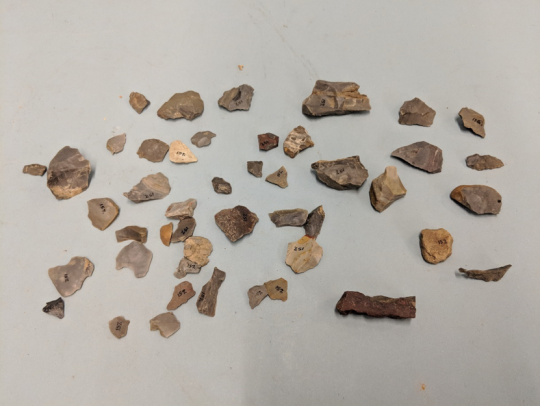
The final trinomial component is a sequential number assigned by the order in which the site is reported to the state and verified as an official site. The first official site in Allegheny County was recorded by Carnegie Museum of Natural History archaeologist William J. Mayer-Oakes, in 1951. It was assigned number 36AL1 and he simply named it, “Large.” It is located near Peter’s Creek. The site contained many ceramic sherds and stone flakes. These artifacts are safely housed in the anthropology collection here at CMNH along with the material Mayer-Oakes also recovered from sites 36AL2 and 36AL3. The photo below shows the stone flakes that Mayer-Oakes recovered.
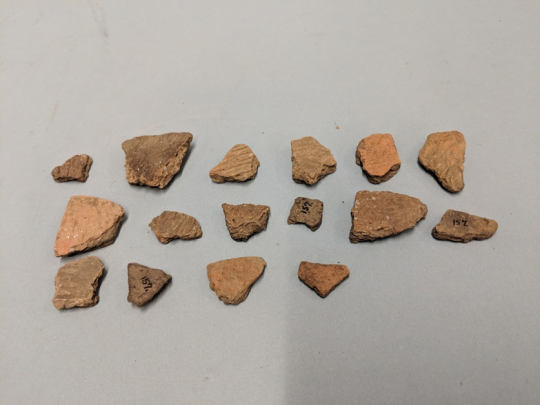
This photo shows the ceramic material from 36AL1 that is housed in the CMNH anthropology collection.
Many of the sites in Western Pennsylvania are nicknamed for the private landowners who allowed the archaeologists to dig there. Examples include Foley Farm, Miller Farm, and McJunkin Farm. Other sites are known by specific place names such as Brunot’s Island or Penn Glenn. “Pies” is a phonetic spelling of the closest road, which was correctly spelled Pysz. If you were to discover an archaeological site in your backyard, what creative name would you come up with to distinguish your site from all the rest? Should this ever happen to you, please visit http://www.phmc.state.pa.us/portal/communities/archaeology/resources/recording-sites.html to learn the correct process for reporting new Pennsylvania archaeological sites.
Amy L. Covell-Murthy is the Archaeology Collection Manager at Carnegie Museum of Natural History. Museum employees are encouraged to blog about their unique experiences and knowledge gained from working at the museum.
