• Skip to primary navigation
  • Skip to main content
  • Skip to primary sidebar

Carnegie Museum of Natural History

One of the Four Carnegie Museums of Pittsburgh

  • Visit
    • Buy Tickets
    • Visitor Information
    • Exhibitions
    • Events
    • Dining at the Museum
    • Celebrate at the Museum
    • Powdermill Nature Reserve
    • Event Venue Rental
  • Learn
    • Field Trips
    • Educator Information
    • Programs at the Museum
    • Bring the Museum to You
    • Guided Programs FAQ
    • Programs Online
    • Climate and Rural Systems Partnership
  • Research
    • Scientific Sections
    • Science Stories
    • Science Videos
    • Senior Science & Research Staff
    • Museum Library
    • Science Seminars
    • Scientific Publications
    • Specimen and Artifact Identification
  • About
    • Mission & Commitments
    • Directors Team
    • Museum History
  • Tickets
  • Give
  • Shop

A Holotype with a History

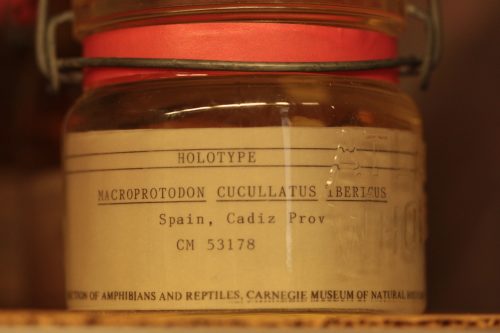
jar with a label that reads "Macroprotodon cucullatus iberius"by José Padial

This jar contains the holotype of Macroprotodon cucullatus iberius, a subspecies of false smooth snake, in the herpetology collection of Carnegie Museum of Natural History.

The holotype is the name-bearer of a species and every species recognized by scientists is associated to an holotype.

The specimen was collected in Cadiz Province, Spain by American herpetologist Stephen Busack. Because of his knowledge of
Spanish, Stephen Busack was deployed in Rota Naval Base during the Vietnam War, and he used his spare time to research the area’s poorly known local fauna of amphibians and reptiles.

His research revealed new species, and the precise locality data he collected is now key to demonstrate the radical transformation that the environment of the area has experienced during the last 40 years.

Many of the populations studied by Busack are now gone. Populations from Cadiz Province are now considered to belong to the species Macroprotodon brevis and it is the smaller and rarest snake of the Iberian Peninsula. It feeds on lizards, baby snakes, blind snakes, and even individuals of its own species!

José Padial is the William and Ingrid Rea Assistant Curator of Herpetology at Carnegie Museum of Natural History. He most recently traveled to the remote Vilcabamba mountains of Peru in the pursuit of biodiversity research. Read more at www.tumblr.com/blog/expeditions-carnegiemnh.

sidebar

About

  • Mission & Commitments
  • Directors Team
  • Museum History

Get Involved

  • Volunteer
  • Membership
  • Carnegie Discoverers
  • Donate
  • Employment
  • Events

Bring a Group

  • Groups of 10 or More
  • Birthday Parties at the Museum
  • Field Trips

Powdermill

  • Powdermill Nature Reserve
  • Powdermill Field Trips
  • Powdermill Staff
  • Research at Powdermill

More Information

  • Image Permission Requests
  • Science Stories
  • Accessibility
  • Shopping Cart
  • Contact
  • Visitor Policies
One of the Four Carnegie Museums | © Carnegie Institute | Privacy Policy | Terms of Use | Accessibility
Rad works here logo