Darwin once predicted the existence of a pollinator after examining the star-shaped flower of the orchid Angraecum sesquipedale, a flower whose nectar is at the end of a 30 cm tube. Darwin wrote that “in Madagascar there must be moths with probosces capable of extension to a length of between ten and eleven inches [25.4–27.9cm].” Twenty years after Darwin’s death, his prediction was proven correct with the discovery of a moth, Xanthopan morganii praedicta, which boasted a proboscis 20 cm in length. In 1992, natural history observations of the moth feeding on the extreme flower and transferring pollen provided even more evidence that this plant and insect were tangled in a coevolution that resulted in their extreme morphology.
Coevolution is now a cornerstone of biology and has been well developed through examples of flowering plants and insects, parasites and hosts, predators and prey, and even gut microbiomes and human health. In fact, the influence of closely associated species on each other in their evolution is so ubiquitous one could argue that evolution is coevolution—as the boundary between what is an individual versus a consortia of different species blends as we dive deeper into the units that natural selection is acting upon. The microbiome and human health example helps illustrate the problem of defining an individual, specifically because scientists now think that microbial cells outnumber human cells in your body. Moreover, there is growing evidence this diversity of symbionts on our bodies complete metabolic pathways and serve other physiological functions. Coevolution crisscrosses the natural histories of organisms, creating nuances that sometimes complicate things.
With so much excitement and work surrounding coevolution, it is romantic to stumble across an example of coevolution fit for a kindergarten class. In the collection of birds at the Carnegie Museum of Natural History, we recently finished an analysis of 24 Costa Rican hummingbirds and the pollen types found on their bodies and were reminded of Darwin’s predictions of coevolution over 100 years ago with orchids and moths. The White-tipped Sicklebill (Eutoxeres aquila) is a hummingbird with an extreme bill curve, with an appearance that would remind kindergarteners of Jim Henson’s Gonzo Muppet. Putting this bird next to its favorite food, Centropogon granulosus, illustrates coevolution in an exciting way that doesn’t tangle you up in learning about microbes or imagining other complex ecological relationships. Like Darwin’s orchid and moth, this hummingbird and its preferred flower allow us to see coevolution is all around us.
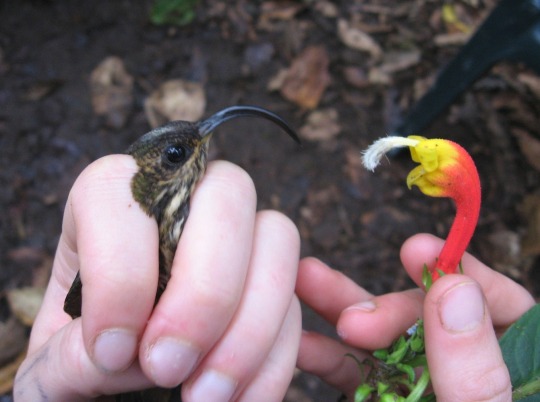
In an ongoing study at the Carnegie Museum of Natural History’s Section of Birds, we were reminded of the natural history observations and predictions that led to an explosion in the field of coevolution. By studying pollen types collected from hummingbirds in Costa Rica we confirmed that the White-tipped Sicklebill (Eutoxeres aquila) feeds mostly on Centropogon granulosus, a match made by coevolution.
Chase Mendenhall is Assistant Curator of Birds, Ecology, and Conservation at Carnegie Museum of Natural History. Museum employees are encouraged to blog about their unique experiences and knowledge gained from working at the museum.
