by Patrick McShea
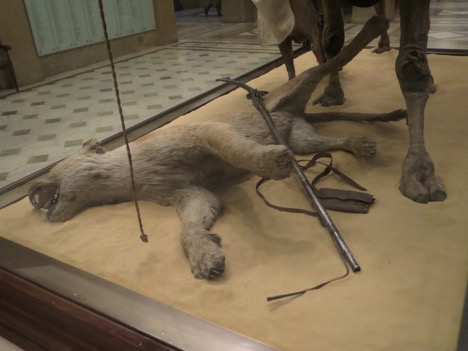
“What would happen if the frozen action depicted in the Lion Attacking a Dromedary diorama continued?”
Before posing that question to school groups, I always ask for evidence-based observations about what has already happened within the 150-year-old display, which was recently restored and moved to the first floor of the museum.
Replies come so quickly that they must be sorted into sequence. The dead female lion attacked first, but she was killed when the man on the camel used a long-barreled gun to fire a bullet behind her left ear. The man dropped the single-shot weapon and unsheathed a long curved knife. Just then, the male lion leapt, clawing its right legs on both the camel and the man in an attempt to gain enough leverage to snap its powerful jaws on the man’s right arm.
Student opinions differ about what happens next, with projections frequently couched by the word “if.” Human and dromedary survival scenarios require the camel to remain both upright and moving forward, the man to have enough arm strength to push the knife deep into the lion’s chest, and the knife blade to be long and flexible enough to reach the heart of the attacking beast.
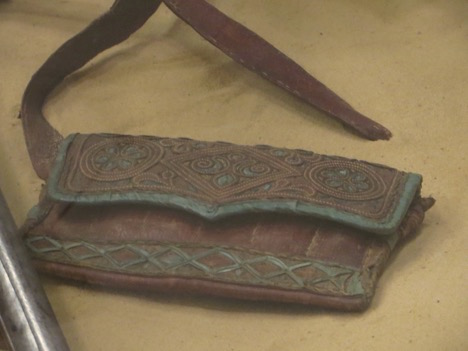
Most students seem willing to accept an unresolved outcome. Because their imaginations have been stimulated by this point in the discussion, I offer one more exercise—“Look at the leather pouch on the sand below the camel.”
We have been observing a diorama that depicts an attack on a camel-mounted messenger. What message might the pouch contain that would be worth the risk of lion attack? A declaration of war? A proposal for a treaty or alliance? Maps of newly explored territory? Today we can instantly send messages across the world at the click of button. This exhibit is a reminder of how far we have come.
Patrick McShea works in the Education and Visitor Experience department of Carnegie Museum of Natural History. Museum employees are encouraged to blog about their unique experiences and knowledge gained from working at the museum.
