I live within walking distance of the Carnegie Museum of Natural History in the neighborhood known as Squirrel Hill. One of my favorite things about living in this neighborhood is springtime – more specifically all of the beautiful blooms. I decided to practice my picture taking skills for the upcoming City Nature Challenge, while staying socially distant from neighbors, by taking a walking tour of the blooming trees of Squirrel Hill. Let’s see what I found.
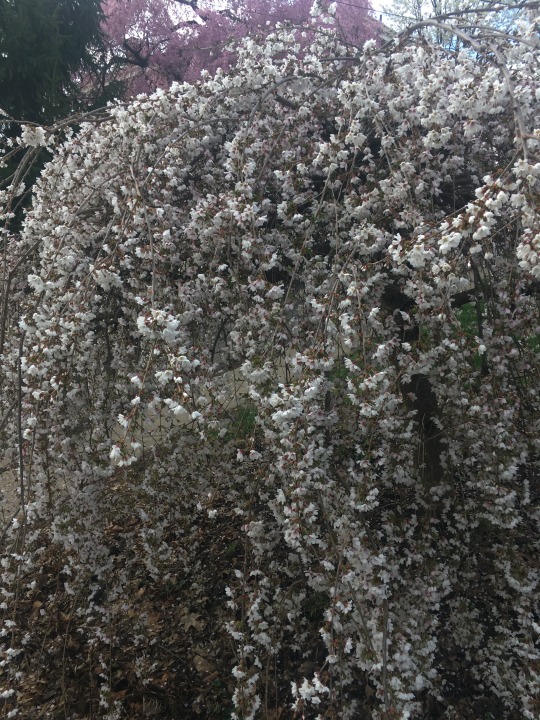
This tree is most likely an almond tree, based on the flower shape and colors. For some trees it is easier to identify them from their leaves, but this early in the year the tree doesn’t have any yet. I used my handy iNaturalist app to help me out with initial identification. While I don’t know for sure if it is in fact an almond tree and not a plum or something similar, now that I have posted it on the app, hopefully someone else will correct or verify the identification in the future.
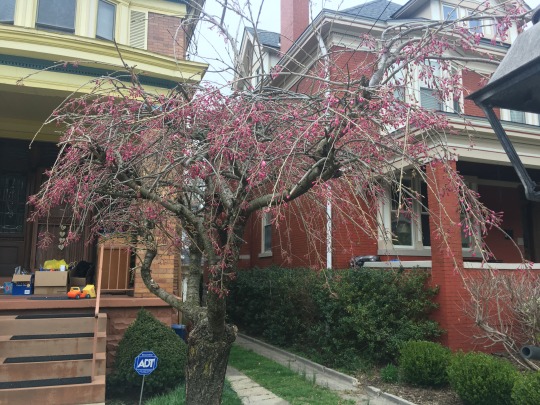
Like the almond tree and this weeping cherry tree, most of the flowering trees in the neighborhood are fruit trees that individuals planted in their yards. This is important to remember when uploading information to iNaturalist, especially during the City Nature Challenge. When I uploaded these images I clicked on the button “Captive / Cultivated” to make sure that it is documented that these trees were purposefully planted by people and would not grow native here in Pennsylvania. While there is nothing wrong with adding non-native plants to our yards, it’s important for people using the data on iNaturalist that we include that information.
My last stop on the neighborhood tour is one of my very favorites: my neighbor’s giant magnolia tree. I recently found out that magnolia trees are a very ancient group of flowering plants, and they evolved to be pollinated by beetles instead of bees! There are a couple of characteristics that show that they were adapted for this type of pollination, including their flower color and size, and a special covering over their seeds to protect them from beetle mouthparts. This lineage of trees is so old that Tyrannosaurus rex and other late Cretacous dinosaurs walked past its relatives. Next time you visit the museum keep an eye out for a tree in Dinosaurs in Their Time that looks a lot like our magnolias today.
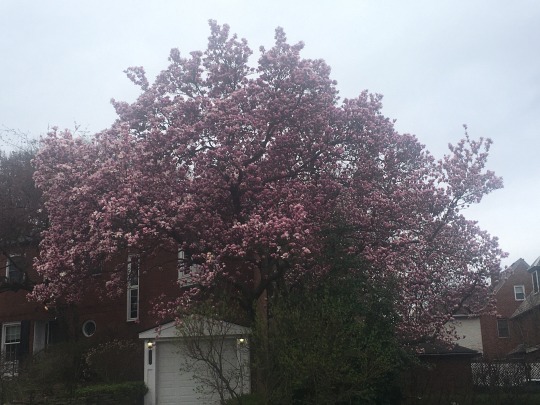
As spring continues the neighborhood will start to look different. All these shades of white and pink will turn to green as the trees grow their leaves and new blooms closer to the ground will take their place. I’m excited to go for more walks and document more nature!
You can learn more about magnolias from the Magnolia Society.
Jenise Brown is a Museum Educator with Carnegie Museum of Natural History. Museum staff, volunteers, and interns are encouraged to blog about their unique experiences and knowledge gained from working at the museum.
