by Kaylin Martin
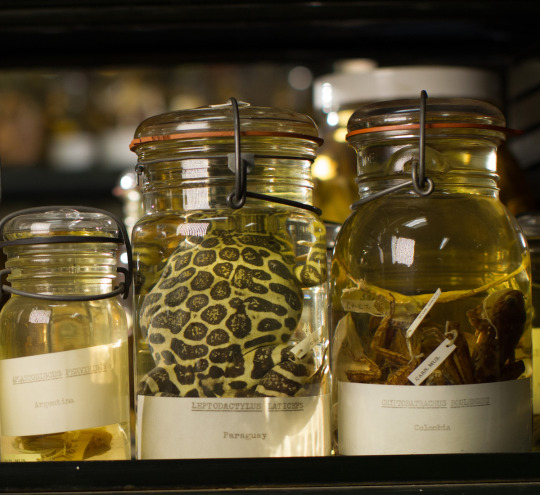
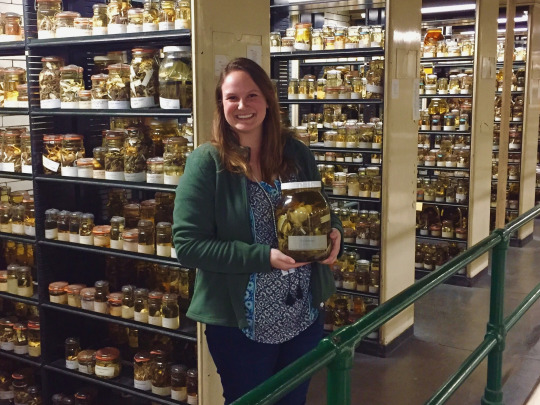
Tucked away under the public galleries of Carnegie Museum of Natural History are thousands of glass jars containing decades of collecting efforts. This collection space, known as the Alcohol House, is the ninth largest herpetology collection in the United States and the most complete collection of Pennsylvanian amphibians and reptiles in existence. The Alcohol House is named for the 70% ethanol alcohol that collection managers use to preserve specimens and prevent
degradation and the formation of bacteria.
The importance of this collection prompted the museum to find funding to improve collection preservation and facilitate public interaction. The Alcohol House secured a three-year grant from the National Science Foundation to hire a full time curatorial assistant, Kaylin Martin, to coordinate efforts to revamp the storage facilities.
The grant will enable Collection Manager Stephen Rogers and Kaylin to purchase new equipment, such as jars, gaskets, tanks, photography equipment, shelving inserts, and specialized cabinets, to update the storage facilities.
During this revamp, they will streamline the database that contains specimen records, reorganize the facility based on updated taxonomy, and tackle the project of digitizing holotype and paratype specimens. The public web interface iDigBio hosts 170,000+ specimen records for public use and research.
The goal is to link the most important specimen records with images. Digitizing the collection makes it accessible to researchers around the world in a few short clicks without the need to travel to Pittsburgh.
Renovations are also under way to make the Alcohol House accessible to the public for guided tours. An accompanying exhibit is being planned for the museum’s public galleries, as well as an introductory exhibit to herpetology at the start of
the planned guided tours. Keep an eye out for the grand opening of these in the near future!
How can you contribute? Carnegie Museum of Natural History is always in need of volunteers to help maintain the wet specimen collection and catalog and update the database. Volunteers are invaluable assets to any museum collection in order to prevent degradation and mobilize data for researchers on a public interface.
If you are interested in helping to maintain this collection for future generations, please contact Kaylin Martin at martink@carnegiemnh.org
Kaylin Martin is a curatorial assistant in the Section of Herpetology. She blogs about the collection in Carnegie Museum of Natural History’s historic Alcohol House, which is home to thousands of fluid-preserved specimens.
