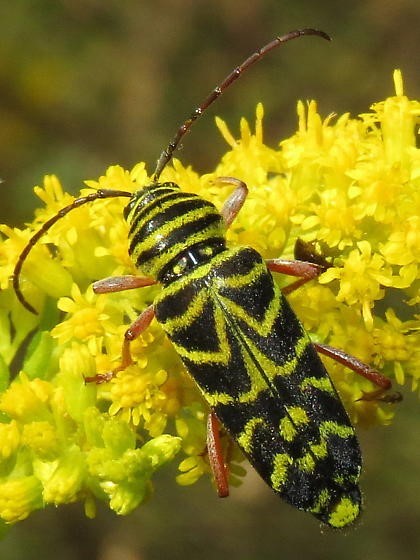
It’s that time of year again when one of my favorite beetles, Megacyllene robiniae (Forster), is starting to appear. Called the “locust borer” due to its larva’s habit of feeding in the living wood of black locust trees, it is one of the last species of long-horned beetle (family Cerambycidae) to emerge in late summer. Adults can be found feeding on the flowers of goldenrod, starting around late August and persisting in the field well into October. The beautiful yellow and black patterned beetles are strikingly colored, but can be quite cryptic when resting on the flowers of goldenrod, which shares the same shade of yellow as the beetle. As long as a larval host source is nearby, a stroll in a field of goldenrod is sure to produce a few adults, boldly feeding on pollen in broad daylight, yet still difficult to visually sort out from the background of the flowers which they visit.
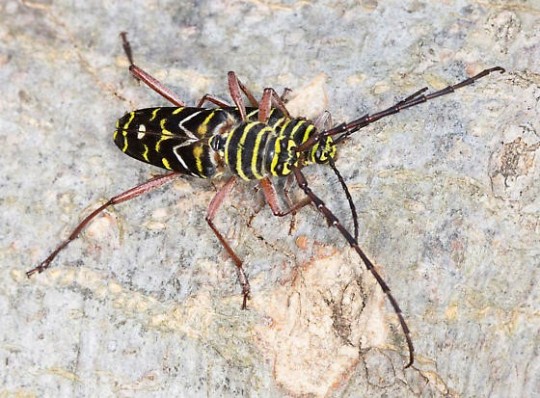
Megacyllene is a genus of Cerambycidae that elicits as much sentimental as scientific interest for me, because it was one of the first long-horned beetles I encountered as a kid. I can still remember coming home from school in the early autumn and heading out into a large field of goldenrod behind my Ohio home to look for the beetles. The only other species of Megacyllene present in Ohio and Pennsylvania is Megacyllene caryae (Gahan) – the “painted hickory borer.” Contrary to M. robiniae – it is one of the earliest cerambycids to emerge in late April to early May, the adults having eclosed in the fall and remaining in their pupal cells until spring. I vividly remember my grandfather bringing home a load of hickory firewood one January, unaware that it was infested with the beetles. Upon splitting a log, he found the adults in their pupal cells awaiting the Spring warmth to emerge. He and I together split those logs smaller and smaller looking for more specimens. We ended up with a nice series of beetles and a bunch of wood whittled down to kindling size!
Monochamus notatus (Drury) is a spectacular species of long-horned beetle, common in Pennsylvania in stands of white pine. The larva feeds under the bark of dying or dead pine and its feeding can be heard as a high-pitched rasping sound as far as 20 feet from the tree. This behavior has earned the species the common name of “pine sawyer” – the noise resembling the sound of an old-fashioned two-man crosscut saw raking back and forth through a log.
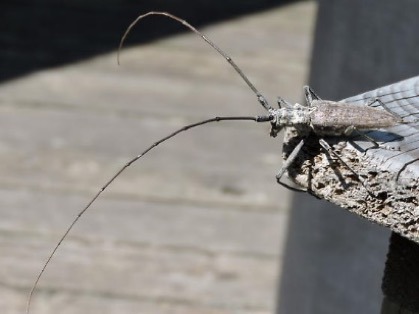
When I was thirteen, while camping at Mohican State Park in north-central Ohio with my family, I was sitting at a picnic table eating lunch. Suddenly, a large male M. notatus came wafting through the campsite, its lengthy antennae trailing behind it, and looking about the size of a small bird to my young bug-enthusiast eyes. I dropped my food, jumped from the table, grabbed my net, and swept the beast out of the air – the first cerambycid beetle that I ever collected! I still have that specimen 46 years later and I attribute it with starting me on the road to specializing on the family Cerambycidae – now my strongest area of taxonomic expertise. I have seen millions of specimens of long-horned beetles from all around the globe during my career, but that one specimen generates more sentiment than the rest combined – I can still smell the pine scent in the air on that day I caught it.
Collecting insects as a kid was the gateway into an amazing world of diversity, and as it turned out, the foundation of what would become my career and lifelong passion. When I look at specimens I caught in those early years, they produce a flood of memories – of specimens caught and of those that got away; of woods where I memorized every fallen log and patch of flowers; of the copy of Josef Knull’s 1946 book “The Long-horned Beetles of Ohio,” with its pages worn and every word read over and over again a thousand times; even the long bike rides, carrying my net and jars out to areas remote from my home in search of “wild” areas in which to hunt for beetles. The specimens serve as little time machines – carrying me back to my childhood and the dawn of my interest in entomology. Going into the field now is more sophisticated, and structured, and planned – better gear, GPS units to record localities, a lifetime of experience to rely upon – not to mention a car that can take me farther afield. But those days of simple exploration, where nearly every venture outdoors uncovered some new wonder, will always be some of my most cherished memories – and those beetles on pins will always be the vehicles that carry me back to that wondrous time in my life.
Bob Androw is a Scientific Preparator in Invertebrate Zoology. Museum employees are encouraged to blog about their unique experiences and knowledge gained from working at the museum.
