by Patrick McShea
Well planned dioramas support multiple levels of interpretation. At the Alaskan Brown Bear diorama, however, it’s initially difficult to consider any narrative not focused upon these powerful creatures.
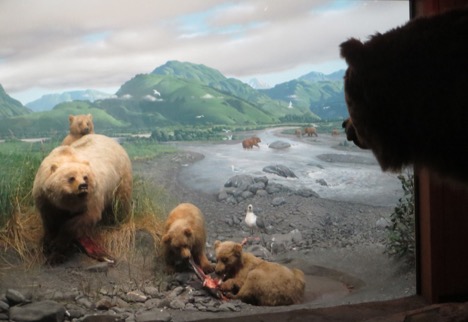
The Kodiak Island scene features nine brown bears – four distant bears are painted into the backdrop landscape and taxidermy mounts of an adult female and three cubs fill the diorama’s left foreground. Facing them from a four-foot high rock ledge outside the exhibit glass, a large male bear adds tension to the display.
The noses of the two adult two adult bears are less than 13 feet apart, a narrow zone that is routinely occupied by museum visitors when they read an adjacent label that highlights the potential for a violent encounter. “Male bears routinely prey on cubs. Fiercely protective, mother bears are known to attack and may even kill larger males that come too close.”
This immersive aspect was created during a 1995 renovation that extensively upgraded an exhibit originally dedicated in 1918.
The upgrade also involved the replacement of king salmon with red or sockeye salmon to accurately represent the species whose summer spawning runs draw bears to the stream. The diorama’s immersive zone is the perfect place to consider how the pair of cubs eating a single fish can represent an enormous transfer of nutrients between ocean and forest ecosystems.
When spawning red salmon return to the stream in which they were born, they do so after spending as long as four years at sea. If they manage to avoid bears and other predators, they still die, often far inland, within a few weeks of spawning. Research studies into the ecological impact of salmon runs have charted the movement of stable nitrogen isotopes from salmon tissue to the stems and leaves of streamside vegetation. The bears, in such cycles, are just intermediary processors.
Patrick McShea works in the Education and Visitor Experience department of Carnegie Museum of Natural History. Museum employees are encouraged to blog about their unique experiences of working at the museum.
