Museum exhibitions, especially those featuring cultural items, can sometimes give the impression of cultures or peoples frozen in time. Behind the scenes, however, CMNH is a flurry of active research and knowledge production. Work to link our collections and exhibitions to the present moment is vital.
As an art historian who studies modern and contemporary art, I often think about the connections over time and space between historic objects. Lately, I’ve been thinking about many of the American Indian belongings we have on display in Alcoa Hall, and contemporary art. This contemplation reveals the influence American Indian artists have exerted and continue to exert on the American art world.
In the early 20th century, Indian artists were instrumental in the formation of American modernism. Artists such as Awa Tsireh (San Ildefonso Pueblo), the members of the Kiowa Five (Spencer Asah, James Auchiah, Jack Hokeah, Stephen Mopope, Monroe Tsatoke and Lois Smoky), Angel De Cora (Ho-Chunk), and potter Maria Martinez (San Ildefonso Pueblo) influenced the growing trends of abstraction and patterning that defined modernist painting in the United States. These artists, along with other American Indian artists and artisans helped establish the US as a growing center of modernism in competition with Europe. Despite having their contributions and innovations undercut or co-opted by Euro-American artists and collectors, Native artists continued to produce artwork as acts of survivance. Survivance, a concept developed by cultural theorist Gerald Vizenor, is an expression of active presence. The term denotes a response to the attempted cultural and physical genocide of Native peoples in the United States that is beyond simple survival, but involves acts of resistance that declare a dynamic presence – often combining traditional ways of knowing with contemporary technologies that are specific to an individual or tribal affiliation.
Later in the century, Native artists continued to define the American art scene. Artists like Fritz Scholder (Luiseno), Kevin Red Star (Apsáalooke), Edgar Heap of Birds (Cheyanne and Arapaho), and Jaune Quick-to-See Smith (Salish) continued (and continue) to challenge the mythology of the Indian in American imaginary. These artists, whose creations have been collected and exhibited by major museums across the country, also view their art as a form of resistance. Their work can therefore be understood as acts of survivance.
Contemporary American Indian artists are still grappling with the politics of representation, regularly fighting stereotypes while also working to preserve the cultural knowledge that the settler state tried to destroy through forced assimilation. Because of these complicated and often violent histories, it is important that, most of us, as descendants of settlers, think critically about Native inspired designs in the objects or clothing we buy. Instead of coopting from indigenous cultures, shop from companies that employ Native designers. Better yet, buy directly from Native artists who are demonstrating how traditional knowledge and ways of making are thriving in the 21st century. Featured below are just a few of the artists whose work is connected to the cultural forms and belongings on display in Alcoa Hall. Many of them also have great items for sale on their websites – just in time to find some special holiday gifts!
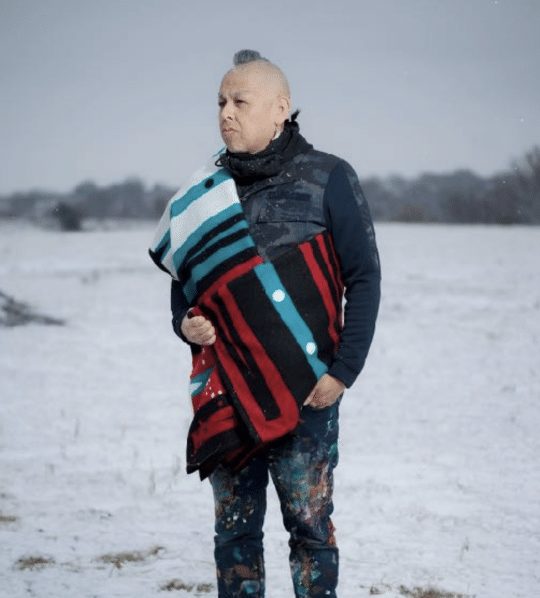
Bunky Echo-Hawk (Pawnee and Yakima) is a painter and designer who has worked with companies such as Nike and Pendleton to design Plains Indian inspired products and fundraise for Native organizations. His eye-catching and exciting work plays with indigenizing popular culture and addressing environmental racism while reinterpreting Plains Indian oral history and record keeping traditions, like winter counts, through his live painting performances. To learn more about winter counts, visit the display in Alcoa Hall featuring the Carnegie Winter Count by Dr. Thomas Red Owl Haukaas. Echo-Hawk was also the subject of a recent episode of American Masters, the PBS documentary series. Check out his website to browse some of the great prints and stickers he has for sale.
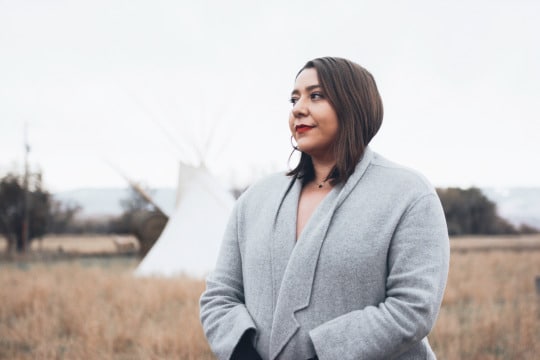
Bethany Yellowtail (Apsáalooke and Northern Cheyenne) is the brilliant designer behind B. Yellowtail, a fashion brand launched in 2015. Her work is intimately connected with her social justice work in Indian Country. Her website features indigenously designed goods as well as her own collections – inspired by Apsáalooke traditions, like elk tooth dresses and ribbon skirts. Her clothing functions as wearable art that demonstrates the power and resilience of Native women and matrilineal cultural systems. I’ve purchased some of their cloth face masks – the proceeds of which benefit Native communities suffering from COVID-19. I’m confident you’ll find something you love on B. Yellowtail’s website.
John Isiah Pepion (Blackfoot) understands the ceremonial importance of making artwork, including its healing power. Pepion’s paintings, drawings, and designs are inspired by traditional practices such as winter counts and ledger drawings. Ledger art dates to the 1850s, when ledger books became one of the primary materials available to Plains Indians, especially to those imprisoned in forts as prisoners of war during the 19th-century Indian wars, without access to traditional materials like bison hides. Pepion’s work in this medium serves as cultural preservation, keeping him and his artwork tied to Blackfoot history and to Blackfoot ancestral lands. His website features original artwork, prints, and all sorts of items with his designs including scarves, stationery, blankets, and jewelry.
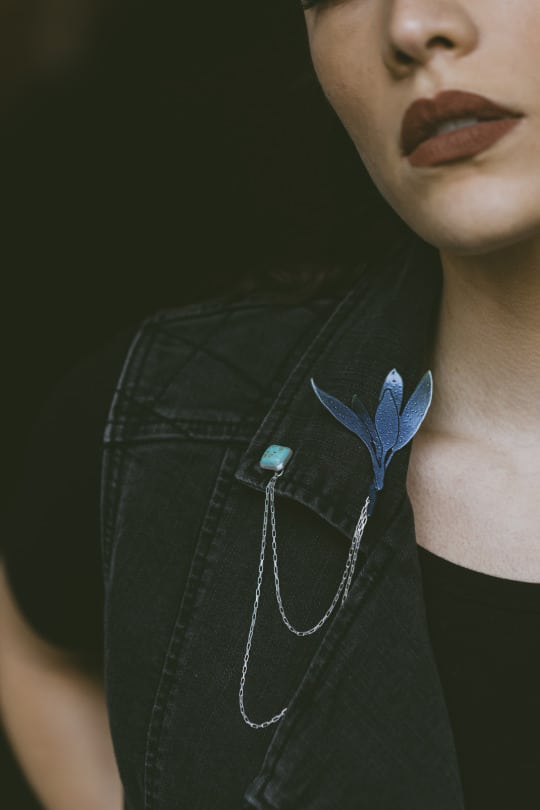
Margaret Jacobs (Akwesasne Mohawk) is a sculptor and jewelry designer who works primarily in steel and pewter. Her forms are primarily abstract, but the material represents not only strength and resistance, but also references the history of Mohawk iron workers, featured in Alcoa Hall. Her abstract forms play between the organic and man-made, connecting color and shape with storytelling and family histories. You can find her sculpture or jewelry, which truly functions as wearable art, on her website.
It is important to note that Carnegie Museum of Natural History, and much of Western Pennsylvania, is on the traditional lands and waterways of the Seneca, Lenape (Delaware), and the people we refer to as the Monongahela (their autonym is currently unknown). These lands and waters were also important to the Shawnee, Wyandotte, and Osage nations. These lands carry the histories of these people from before their forced removal and through their struggles and triumphs for survivance well into the present moment. To find out more about the Seneca Nation (including about Seneca artists) visit the Seneca-Iroquois National Museum or Ganondagan Seneca Art & Culture Center. To learn more about the Lenape, go to the Delaware Nation or the Delaware Tribe of Indians. Or visit the Museum of Indian Culture, in Allentown, PA.
Jessica Landau has a joint appointment as Assistant Curator of Anthropology and Archaeology at Carnegie Museum of Natural History and as a Lecturer in Curatorial Studies in the History of Art & Architecture at University of Pittsburgh. Museum employees are encouraged to blog about their unique experiences and knowledge gained from working at the museum.
