• Skip to primary navigation
  • Skip to main content
  • Skip to primary sidebar

Carnegie Museum of Natural History

One of the Four Carnegie Museums of Pittsburgh

  • Visit
    • Buy Tickets
    • Visitor Information
    • Exhibitions
    • Events
    • Dining at the Museum
    • Celebrate at the Museum
    • Powdermill Nature Reserve
    • Event Venue Rental
  • Learn
    • Field Trips
    • Educator Information
    • Programs at the Museum
    • Bring the Museum to You
    • Guided Programs FAQ
    • Programs Online
    • Climate and Rural Systems Partnership
  • Research
    • Scientific Sections
    • Science Stories
    • Science Videos
    • Senior Science & Research Staff
    • Museum Library
    • Science Seminars
    • Scientific Publications
    • Specimen and Artifact Identification
  • About
    • Mission & Commitments
    • Directors Team
    • Museum History
  • Tickets
  • Give
  • Shop

Ancient Egyptian Column Shafts

by Erin Peters

Here at Antinoupolis, the Italian mission has been excavating since the 1930s and has a long and productive residence at
the site. There are a number of publications resulting from the mission’s work and two recent volumes that include scientific publications of the team’s work since 2000–for these resources and more, see The Antinoupolis Foundation’s bibliography. For this 2017 season, the mission has three active excavation areas open, and today I write about one that is in the east of the ancient city near what was once a monumental gate facing the Via Hadriana. Hadrian built this impressive road through the desert as a new trade route, which ran through Antinoupolis to the Nile for river transport.

The east gate was monumentalized by huge red granite columns, of which fragments are extant. Two column bases (one upright and one overturned) and three column shaft fragments were known before this season and are an impressive sight to see.
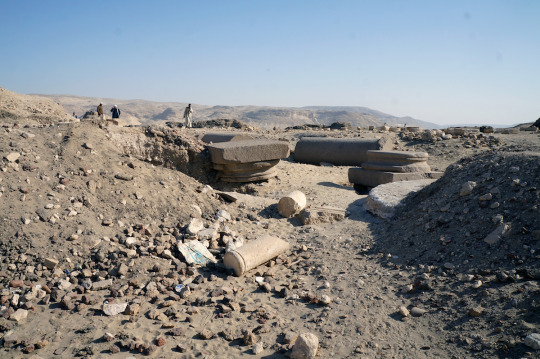
Ancient Egyptian column shafts partially uncovered in an archeology dig
Monumental fragments of red granite column bases and shafts at the east edge of the city


Under supervision of the mission’s architect, Peter Grossman, another section of a column shaft was unearthed this season. This shaft indicates there could be more fragments nearby, possibly under the 4-5th century CE church that Peter’s team is currently excavating, the remains of which you can see above.
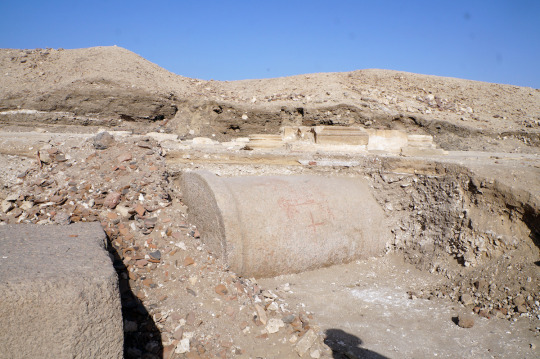
 

Ancient columns being excavated in an archeology dig
View of column shaft fragment excavated this season

Hopefully some of these shafts will be more visible in the near future and draw visitors to the site as recorded in The Antinoupolis Foundation’s February 10 blog post. The mission’s director, Rosario Pintaudi, has put in an application to the Ministry of Antiquities to re-erect the column. If approved, perhaps the column shaft will be soaring at the east edge of the city by the time I return next year!
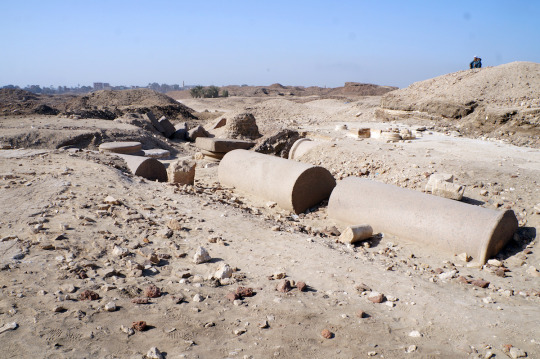
Partially burried columns in a row
Fallen column shaft fragments that may be re-erected in the near future

Erin Peters is an assistant curator of science and research at Carnegie Museum of Natural History. She recently traveled to Egypt for an archaeological research study. This is a series of blog posts she wrote while in the field. Check back for more!

sidebar

About

  • Mission & Commitments
  • Directors Team
  • Museum History

Get Involved

  • Volunteer
  • Membership
  • Carnegie Discoverers
  • Donate
  • Employment
  • Events

Bring a Group

  • Groups of 10 or More
  • Birthday Parties at the Museum
  • Field Trips

Powdermill

  • Powdermill Nature Reserve
  • Powdermill Field Trips
  • Powdermill Staff
  • Research at Powdermill

More Information

  • Image Permission Requests
  • Science Stories
  • Accessibility
  • Shopping Cart
  • Contact
  • Visitor Policies
One of the Four Carnegie Museums | © Carnegie Institute | Privacy Policy | Terms of Use | Accessibility
Rad works here logo