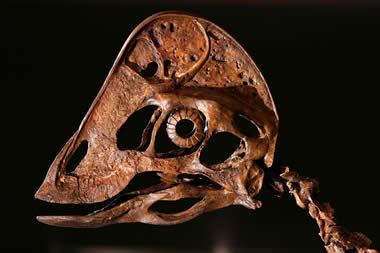
Perhaps better known by its colorful nickname, the “Chicken from Hell,” Anzu wyliei is a bird-like oviraptorosaurian dinosaur. More specifically, it is a member of the Caenagnathidae, a poorly understood group of oviraptorosaurs that lived mainly in North America during the Cretaceous Period. Anzu has distinctive characteristics that are not found in any other dinosaur, plus other typically oviraptorosaurian features such as a crested skull and a toothless beak. It grew to a length of at least nine feet and had a relatively short tail and long, spindly legs with three-toed feet. Its long arms featured sharp, hooked claws that may been used to catch prey or for protection.
With a name that translates to “Wylie’s feathered demon,” this dinosaur presents numerous riddles to scientists. Due to the shape of its toothless jaws, it is unknown if Anzu was a carnivore, like most other theropod dinosaurs, or if it was a plant eater. Anzu may even have been an omnivore, eating both plants and small animals.
Carnegie Museum of Natural History’s two skeletons of Anzu are the most complete oviraptorosaur specimens yet found in the Western Hemisphere. Museum scientists and their collaborators are continuing to study the dinosaur’s bones to gain a better understanding of the species. Because the real fossils are extremely fragile, more so than those of most other dinosaurs on display, the skeleton on exhibit is a cast. It is a combination of replicas of the museum’s two real specimens,
which were discovered in the late 1990s in ~66 million-year-old rocks belonging to the Hell Creek Formation in Harding County, South Dakota. Anzu wyliei was named in 2014 by Carnegie Museum paleontologist Matt Lamanna and three of his colleagues.
