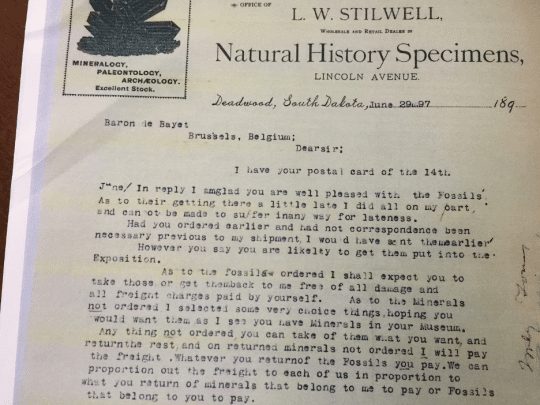
In this, our fourth and final installment, we will look at the Stilwell-Bayet letters. Because letter writing was the central form of communication in the late 19th century, this correspondence documents past collecting practices. Although the Carnegie Museum’s Bayet archive retains only Stilwell’s part of the correspondence, the letters provide insight into their business relationship.
Procuring Fossils Was Time Consuming and Expensive
In June of 1897 (Figure 1), Lucien W. Stilwell wrote, “In reply, I am glad you are pleased with the Fossils. As to their getting there a little late, I did all on my part and cannot be made to suffer in any way for lateness. Had you ordered earlier and hand [sic] not correspondence been necessary previous to my shipment, I would have sent them earlier.” Shipping was labor intensive and costly in the late 1800’s. Additionally, the risk of breakage was high. The trip from South Dakota to Brussels required multiple carriers and involved wagons, trains and ships. From start to finish the trip could take months. One Stilwell receipt dated January 12, 1889, shows the cost of shipping two boxes from New York to Brussels at $5.05, or about $141 today. Keep in mind, this figure does not include the cost of shipping from the Dakota Territories to New York.
Negotiating Was as Wild as the West
Deal making was a delicate dance. Stilwell wanted to maximize profit. Bayet wanted the best price. In March 1889 Stilwell states “I do not know what new animal you spoke of. I sent the new ammonite. As to shipping and getting them away across the ocean, before we agree on price, that is a rather indefinite way and might be an expensive thing. I can say now, that if people do not want to give what I ask for these heads [Cenozoic mammal heads], I do not care to collect them for when I base my prices on the cost of finding and cleaning them and the cash expense and place them as reasonable as anyone can afford to do the work then I would cease to collect them.”
Let the Buyer Beware
Sometimes, lines were crossed. In addition to invertebrates, Stilwell sold Bayet Cenozoic mammal fossils from the Badlands. Stilwell references a mammal skull in the quote above. In 2004, Spencer Lucas of the New Mexico Museum of Natural History and Science, wrote a paper titled “O.C. Marsh and the Eocene Brontothere Teleodus: A Paleontological Hoax. In it he describes negotiations between paleontologist O.C. Marsh and Lucien W. Stilwell. Lucas concludes that Stilwell, or someone in his employ, added extra teeth to a brontotherium skull in order to induce Marsh into paying a higher price. At that time, Marsh did not notice that the teeth were doctored. According to Lucas, Marsh was determined to have the skull at the lowest possible price. He convinced Stilwell that the skull was not a new species and Stilwell eventually sold him the skull for a reduced figure. The altered teeth were not discovered until 1982 by Lucas and Schoch. Lucas concluded in 2004 that, “The Teleodus avus hoax is yet another example of the authenticity problems inherent to the commercial purchase of fossils as well as the great capacity all paleontologists have for seeing what they want to see in a fossil, not what actually is there.”
Albert Kollar notes that to his knowledge there is no indication that any of Bayet’s invertebrate specimens were fabricated or distorted.
The Stilwell-Bayet Correspondence is a fascinating look at collecting and negotiating in the “Wild West” a century ago. Preparation of fossils for shipping was time consuming and risky. Rarity and preservation quality often dictated price and it was a “buyer beware” marketplace. The items in the Carnegie Museum of Natural History collections give a glimpse into the mores, history and values of a past business climate. Stories, such as this one, also provide an opportunity to think about the future. One wonders what collecting adventures, conducted by museum scientists today, will resonate with future generations and what conclusions they may draw.
Joann Wilson is an Interpreter for the Department of Education and a volunteer with the Section of Invertebrate Paleontology and Albert Kollar is Collections Manager for the Section of Invertebrate Paleontology. Museum employees are encouraged to blog about their unique experiences and knowledge gained from working at the museum.
