by Patrick McShea
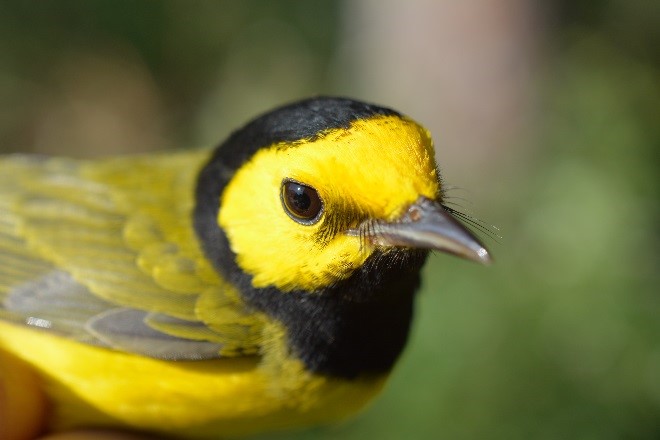
Recently, when a middle school science teacher borrowed a set of taxidermy mounts to stimulate class discussions about natural selection, I included a tiny bird clad in Steelers’ colors.
An account written by a museum curator more than 75 years ago provided a clear explanation for the advantage black and gold feathers provide to Hooded Warblers.
Once I was amazed to find myself eye to eye, as it were, with an adult male of this species. The bird was sitting quietly on a low branch of a leafy maple and must have flown in while my attention was directed elsewhere. Brilliant sun shining through the young leaves made some of them appear as yellow as the bird’s breast, while the green tones of its back were matched by other leaves in the shadow. The black markings of the head and throat were, in this instance at least, true “ruptive markings,” since it was some moments before I could clearly see the outline of the bird, although it was in plain view and in good light.
When examining specimens in the laboratory, it is difficult to think of the Hooded Warbler as protectively colored. I suspect the truth is that at some time and under some circumstances every bird or animal is seen with difficulty, both by man and by its natural predators. It is the nature of things that if the sum total of these occasions gives a species even an infintesimal advantage, the combinations of color that contribute to that survival-value will become genetically fixed.
W.E. Clyde Todd – Birds of Western Pennsylvania – University of Pittsburgh Press 1940
Patrick McShea works in the Education and Visitor Experience department of Carnegie Museum of Natural History. Museum employees are encouraged to blog about their unique experiences of working at the museum.
