Big fleas have little fleas
Upon their backs to bite ‘em;
And little fleas have lesser fleas
And so, ad infinitum.
-Ogden Nash
Flat flies, louse flies, keds. The distinctive members of the fly family Hippoboscidae go by many names. All are obligate blood feeders found on mammals or birds and have a flattened body shape suitable for sliding in between the feathers and fur of their hosts. Their life history is as strange as their appearance, I assure you. While the vast majority of flies and other insects lay numerous eggs to reproduce, female hippoboscids prefer a more mammalian strategy. A single fertilized egg hatches within the female, and the developing larva is nourished within the mother through specialized “milk” glands until it is fully grown. The hugely swollen female then gives birth to a mature larva which immediately pupates, and later emerges as a winged adult hungry for a blood meal.
Hippoboscids are frequently encountered at the banding station at Powdermill Nature Reserve. Last year, most of the birds that were processed here were checked for these parasites, which were collected. Not much is known about these flies on songbirds as most of the research conducted deals with raptors. While identifying the flies under a microscope, we discovered these flies were often carrying some smaller bugs with them on their abdomens. These hitchhikers were bird lice and avian skin mites (see photos).
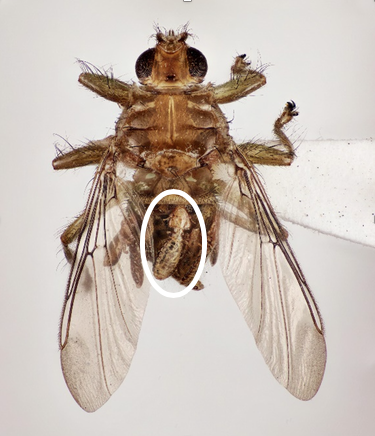
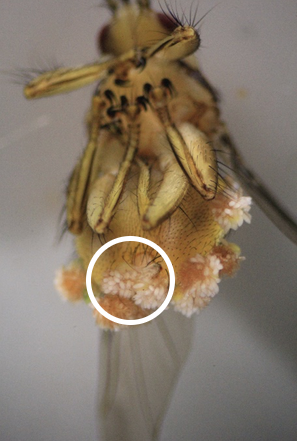
Both of these small parasites are wingless and poor dispersers, but can conveniently get from bird to bird by riding on the hippoboscid flies, a strategy called phoresy. In the case of the skin mites, the females actually require a hippoboscid to reproduce. They attach themselves to the body of the fly and lay their eggs all around them in a clump. To add to the craziness, sometimes the mites attach to the lice which attach to the fly, which you find on birds. So there you have it. Bugs on bugs on bugs… on birds!
Andrea Kautz is a Research Entomologist at Carnegie Museum of Natural History’s Powdermill Nature Reserve. Museum employees are encouraged to blog about their unique experiences and knowledge gained from working at the museum.
