AP3: Antarctica Peninsula Paleontology Project
February 21–28, 2016
Project G-182-N (PI Matt Lamanna)
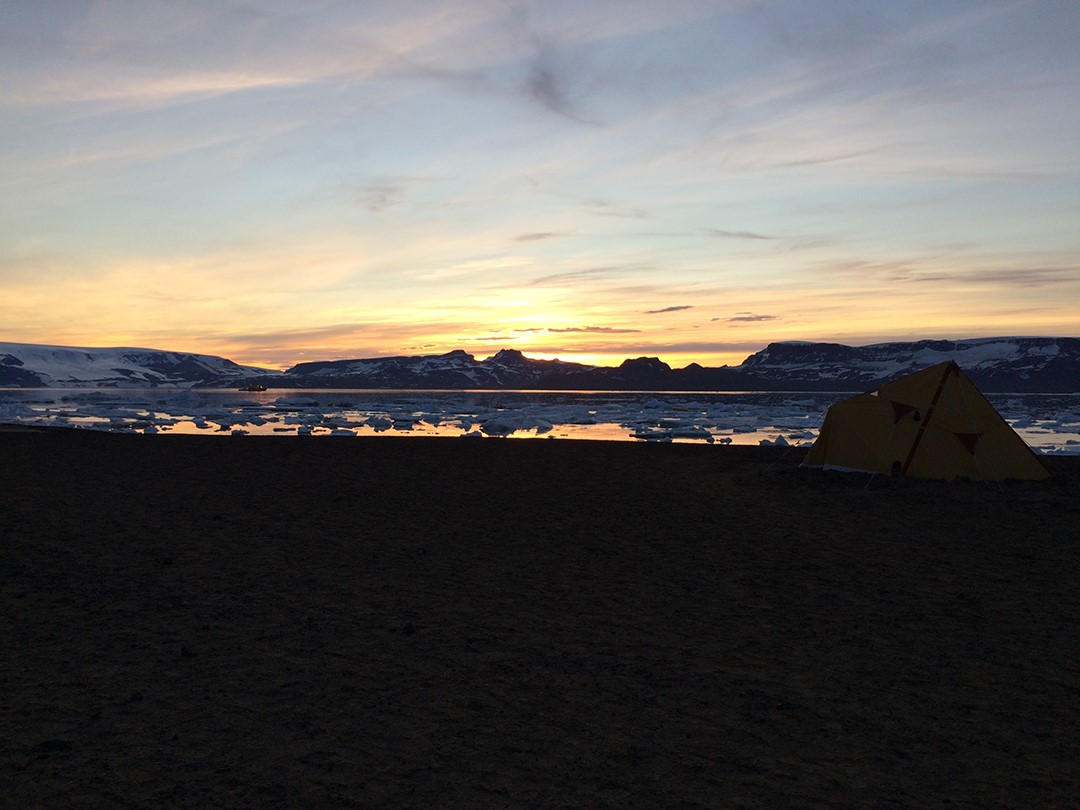
Work at the main basecamp on the western shore of Vega Island continued in week two and resulted in the discovery of a wealth of fossils.
Senior project geologist Eric Roberts located a partial plesiosaur. The specimen, which preserves numerous vertebrae, ribs, paddle bones, and gastroliths (stomach stones), appears to be the most complete marine reptile discovered by the project to date. Many of its bones remain articulated (preserved in life position) and are beautifully preserved within sandstone concretions. With time and effort in the laboratory, much of the postcranial skeleton will likely be reassembled and will likely be significant both for scientific study and possible display.
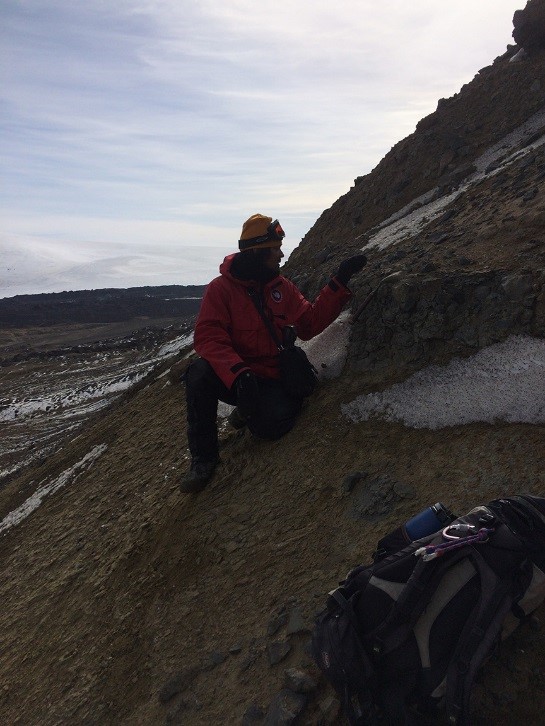
The project made significant progress towards its geological aims as well. Roberts and fellow geologist Zubair Jinnah continued their efforts to decipher the age and depositional environments of the sediments exposed on the uppermost levels of Sandwich Bluff. They collected rock and fossil samples from the uppermost Sandwich Bluff Member and basal Sobral Formation for geochemical and palynological analyses and strontium isotopic dating. They also began to subdivide the Sobral Formation into discrete units, as Roberts and colleagues did for the Sandwich Bluff Member in a 2014 paper.
Helicopter reconnaissance efforts continued with additional trips to Seymour and eastern Vega Island. Considerable effort was expended during week two towards installing a field camp near the Cretaceous–Paleogene boundary horizon in the central area of Seymour Island. Those at the camp are having success in recovering fossils of fishes, putative turtles, and other Cretaceous vertebrates.
Lastly, filmmaker Matt Koshmrl continues to skillfully document all aspects of the project through video and still photography.
Also discovered during week two
– A second plesiosaur partial skeleton. Several partial-to-complete fossil leaves and a conifer branch. Partial skeletons of Cretaceous fishes that may be the most completely-preserved fishes yet found from Cretaceous sediments on Vega Island.
– A partial dorsal rib of a very large-bodied tetrapod, possibly a sauropod (long-necked plant-eating dinosaur)
– Multiple isolated Cretaceous bird bones were also collected, as was a possible avian skull
– An abundance of exceptionally-preserved Eocene penguin bones, including a partial skull of a giant species (possibly Anthropornis nordenskjoeldi or Palaeeudyptes antarcticus). This is exciting as only a handful of cranial elements of fossil penguins have ever been described from Seymour Island.
Matt Lamanna is a paleontologist and the principal dinosaur researcher at Carnegie Museum of Natural History in Pittsburgh. Matt and his team of researchers blog frequently from Antarctica while on expedition at antarticdinos.org.
