• Skip to primary navigation
  • Skip to main content
  • Skip to primary sidebar

Carnegie Museum of Natural History

One of the Four Carnegie Museums of Pittsburgh

  • Visit
    • Buy Tickets
    • Visitor Information
    • Exhibitions
    • Events
    • Dining at the Museum
    • Celebrate at the Museum
    • Powdermill Nature Reserve
    • Event Venue Rental
    • Gift Cards
  • Learn
    • Field Trips
    • Educator Information
    • Programs at the Museum
    • Bring the Museum to You
    • Guided Programs FAQ
    • Programs Online
    • Climate and Rural Systems Partnership
  • Research
    • Scientific Sections
    • Science Stories
    • Science Videos
    • Senior Science & Research Staff
    • Museum Library
    • Science Seminars
    • Scientific Publications
    • Specimen and Artifact Identification
  • About
    • Mission & Commitments
    • Directors Team
    • Museum History
  • Tickets
  • Give
  • Shop

Collected on this Day in 1901

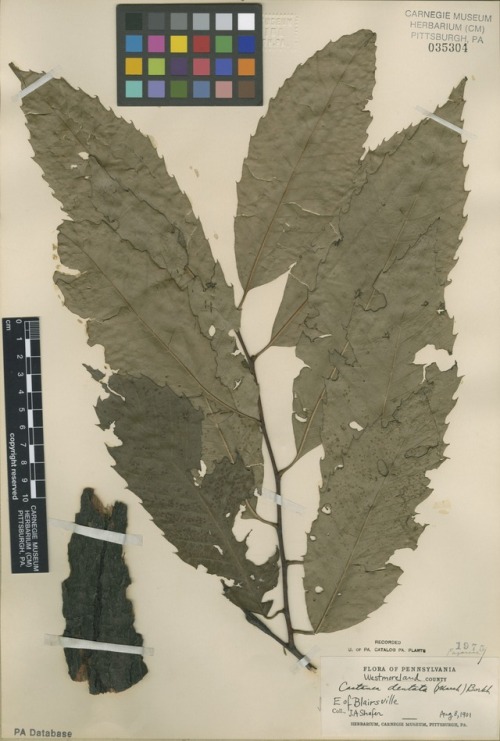
American chestnut herbarium specimen

Collected on August 8, 1901, this American chestnut (Castanea dentata) specimen was found near Blairsville, Pennsylvania by John Shafer.

The American chestnut was once a major player in eastern United States forests, especially Pennsylvania and the Appalachian Mountains. American chestnut provided many ecological functions, including an important food source for wildlife, and was prized by humans for its wood. Some estimated that one in four trees in some forests were American chestnut. Due to chestnut blight, a disease caused by a pathogenic fungus (Cryphonectria parasitica) introduced in the early 1900s from Japan, this is no longer true. The species went from an important component of many forests to being functionally extinct.

The species can still be found in some places as resprouted shoots from existing stumps, but they do not reach reproductive maturity. Breeding efforts are underway to restore the American chestnut through creating blight-resistant chestnuts by crossbreeding with Chinese chestnuts, which are resistant to blight.

There are 264 American chestnut specimens in Carnegie Museum’s herbarium, which document the distribution and biology of this important species before and after the blight. This specimen picture here was collected before chestnut blight was known in the United States.


Botanists at Carnegie Museum of Natural History share pieces of the herbarium’s historical hidden collection on the dates they were discovered or collected. Check back for more!

sidebar

About

  • Mission & Commitments
  • Directors Team
  • Museum History

Get Involved

  • Volunteer
  • Membership
  • Carnegie Discoverers
  • Donate
  • Employment
  • Events

Bring a Group

  • Groups of 10 or More
  • Birthday Parties at the Museum
  • Field Trips

Powdermill

  • Powdermill Nature Reserve
  • Powdermill Field Trips
  • Powdermill Staff
  • Research at Powdermill

More Information

  • Image Permission Requests
  • Science Stories
  • Accessibility
  • Shopping Cart
  • Contact
  • Visitor Policies
One of the Four Carnegie Museums | © Carnegie Institute | Privacy Policy | Terms of Use | Accessibility
Rad works here logo