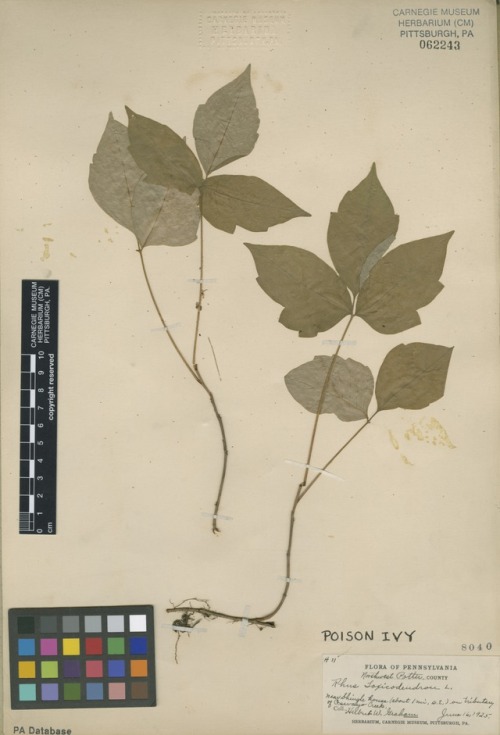
Collected on June 16, 1925, this specimen was found near Potter County, Pennsylvania by H.W. Graham.
Poison ivy (Toxicodendron radicans) is a species with which you might be very familiar! Poison ivy is a native woody vine found in wooded areas across the eastern United States. The species can take various forms and habits, growing as a vine along the ground, up a tree, or as a small shrub.
Poison ivy is famous for a chemical it produces, urushiol, which upon contact can cause a severe skin rash in humans. The rash, which can last up to several weeks, can also lead to an infection due to intense scratching that breaks the skin. Serious health effects can stem from ingesting urushiol or can cause other allergic reactions in eyes and throat when inhaling smoke from burned plants. If you come into contact with poison ivy, the best way to prevent an allergic reaction is washing with water and soap (or other detergent to wash off oils) as soon as possible. Some people are more sensitive to poison ivy than others or become more sensitive after repeated exposure.
Poison ivy is in the cashew plant family (Anacardiaceae), which includes several other species that produce skin irritants. In addition to poison ivy, poison oak, and poison sumac, the family also includes mangos and cashews. Interestingly, the shell of the cashew nut contains chemicals that can cause similar allergic skin reactions as poison ivy.
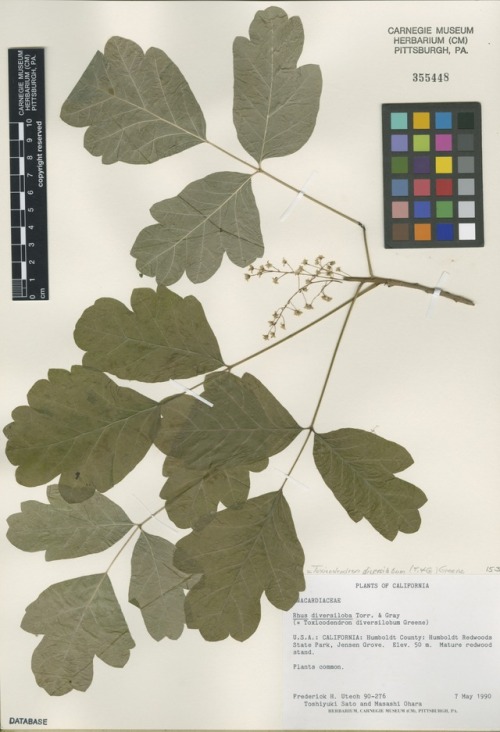
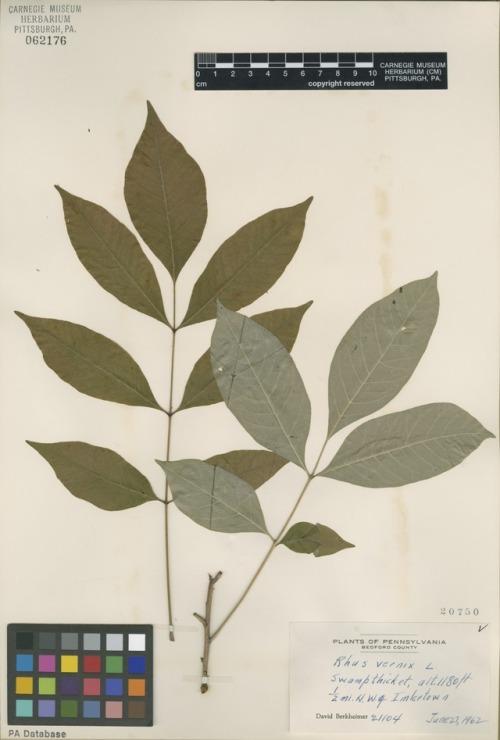
You might have heard “Leaves of three, let it be,” but what does that mean exactly? How do you know if it is poison ivy, poison oak, or poison sumac? Many plants might at first glance resemble poison ivy, but they can be easily distinguished. Poison ivy is common in woods, forest edges, roadsides, and weedy areas throughout Pennsylvania and has aerial, hairy-looking rootlets on stems of vines. Poison sumac (Toxicodendron vernix) is also native to Pennsylvania, but it is less common and only found in swamps and other persistently wet habitats. Poison sumac (Toxicodendron vernix) has leaves made up of many more leaflets than poison ivy. Lastly, poison oak (Toxicodendron diversilobum) is sometimes confused with poison ivy, but it is unlikely you encountered this species in Pennsylvania—it is only native to the western United States.
Botanists at Carnegie Museum of Natural History share pieces of the herbarium’s historical hidden collection on the dates they were discovered or collected. Check back for more!
