• Skip to primary navigation
  • Skip to main content
  • Skip to primary sidebar

Carnegie Museum of Natural History

One of the Four Carnegie Museums of Pittsburgh

  • Visit
    • Buy Tickets
    • Visitor Information
    • Exhibitions
    • Events
    • Dining at the Museum
    • Celebrate at the Museum
    • Powdermill Nature Reserve
    • Event Venue Rental
  • Learn
    • Field Trips
    • Educator Information
    • Programs at the Museum
    • Bring the Museum to You
    • Guided Programs FAQ
    • Programs Online
    • Climate and Rural Systems Partnership
  • Research
    • Scientific Sections
    • Science Stories
    • Science Videos
    • Senior Science & Research Staff
    • Museum Library
    • Science Seminars
    • Scientific Publications
    • Specimen and Artifact Identification
  • About
    • Mission & Commitments
    • Directors Team
    • Museum History
  • Tickets
  • Give
  • Shop

Collected on this Day in 1928

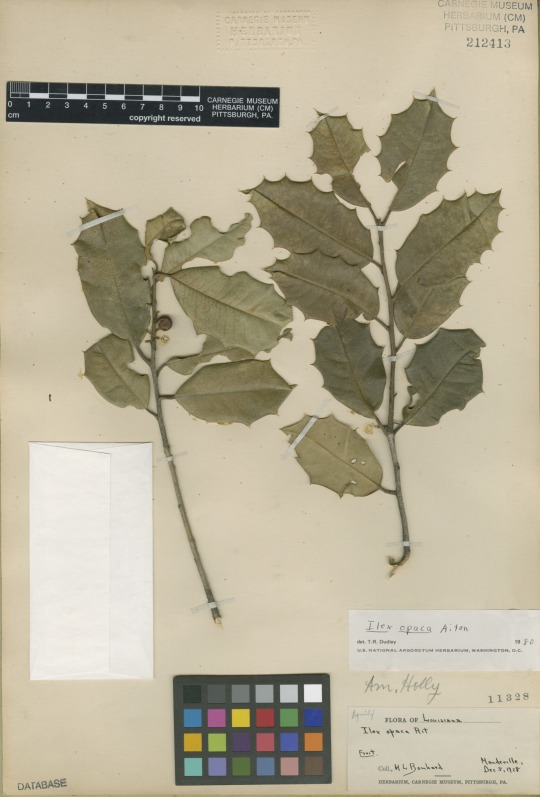
herbarium specimen of holly

Are you decking your halls with boughs of holly?  This specimen of American holly (Ilex opaca) was collected by M.L. Bomhard in Mandeville, Louisiana on December 8, 1928. The holly revered for its holiday cheer usually refers to a related European species, Ilex aquifolium, but there are native holly species in North America that are equally, if not more, cheerful.

Like most other hollies, American holly is dioecious, meaning it has male and female flowers on separate plants. Only the female plants have the characteristic bright red berries we all know and love.  American holly stands out as one of the few broadleaved evergreen trees native to the Eastern US (i.e., has green leaves during winter that are not needles). This species is near the northern edge of its range in Pennsylvania and is more common in southern states. It is listed in Pennsylvania as a species of “special concern” due to its relative rarity.

Botanists at Carnegie Museum of Natural History share pieces of the herbarium’s historical hidden collection on the dates they were discovered or collected. Check back for more!

sidebar

About

  • Mission & Commitments
  • Directors Team
  • Museum History

Get Involved

  • Volunteer
  • Membership
  • Carnegie Discoverers
  • Donate
  • Employment
  • Events

Bring a Group

  • Groups of 10 or More
  • Birthday Parties at the Museum
  • Field Trips

Powdermill

  • Powdermill Nature Reserve
  • Powdermill Field Trips
  • Powdermill Staff
  • Research at Powdermill

More Information

  • Image Permission Requests
  • Science Stories
  • Accessibility
  • Shopping Cart
  • Contact
  • Visitor Policies
One of the Four Carnegie Museums | © Carnegie Institute | Privacy Policy | Terms of Use | Accessibility
Rad works here logo