• Skip to primary navigation
  • Skip to main content
  • Skip to primary sidebar

Carnegie Museum of Natural History

One of the Four Carnegie Museums of Pittsburgh

  • Visit
    • Buy Tickets
    • Visitor Information
    • Exhibitions
    • Events
    • Dining at the Museum
    • Celebrate at the Museum
    • Powdermill Nature Reserve
    • Event Venue Rental
    • Gift Cards
  • Learn
    • Field Trips
    • Educator Information
    • Programs at the Museum
    • Bring the Museum to You
    • Guided Programs FAQ
    • Programs Online
    • Climate and Rural Systems Partnership
  • Research
    • Scientific Sections
    • Science Stories
    • Science Videos
    • Senior Science & Research Staff
    • Museum Library
    • Science Seminars
    • Scientific Publications
    • Specimen and Artifact Identification
  • About
    • Mission & Commitments
    • Directors Team
    • Museum History
  • Tickets
  • Give
  • Shop

Collected on this Day in 1945

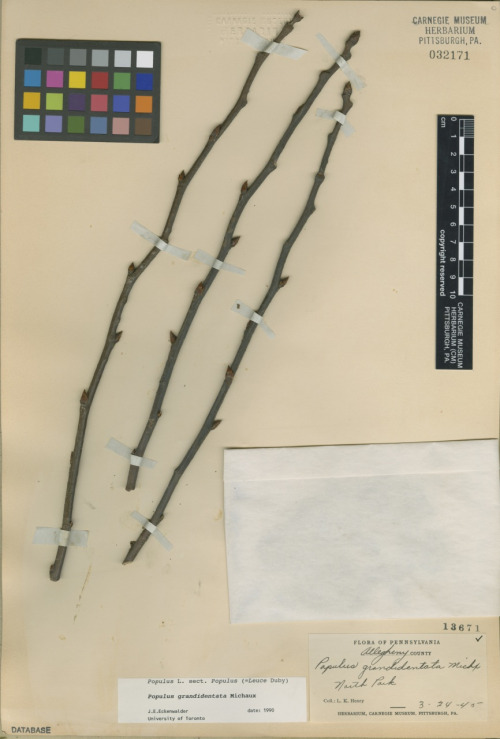
Big-tooth aspen (Populus grandidentata) specimin pressed and dried on paper
Collected on March 24, 1945, this specimen was found by Leroy K. Henry in North Park, just outside of Pittsburgh. Leroy Henry was an influential curator of botany at the museum from 1937-1973 and specialized in taxonomy and ecology of fungi in the region. Big-tooth aspen (Populus grandidentata) is a tree native to northeastern North America. Aspen produces small flowers on hanging clusters known as catkins.

Why collect and preserve a specimen that has no leaves? Since this species flowers in the early spring before it
leafs out, one reason is to be able to collect flowers for further scientific study. Flowers for this specimen are stored in the rectangular envelope in the lower right of the sheet. Along with hundreds of other specimens, this information can be used to understand how flowering dates change through time as a result of climate change. Scientists are using these specimens in ways the original collector never imagined.


Botanists at Carnegie Museum of Natural History share pieces of the herbarium’s historical hidden collection on the dates they were discovered or collected. Check back for more!

sidebar

About

  • Mission & Commitments
  • Directors Team
  • Museum History

Get Involved

  • Volunteer
  • Membership
  • Carnegie Discoverers
  • Donate
  • Employment
  • Events

Bring a Group

  • Groups of 10 or More
  • Birthday Parties at the Museum
  • Field Trips

Powdermill

  • Powdermill Nature Reserve
  • Powdermill Field Trips
  • Powdermill Staff
  • Research at Powdermill

More Information

  • Image Permission Requests
  • Science Stories
  • Accessibility
  • Shopping Cart
  • Contact
  • Visitor Policies
One of the Four Carnegie Museums | © Carnegie Institute | Privacy Policy | Terms of Use | Accessibility
Rad works here logo