• Skip to primary navigation
  • Skip to main content
  • Skip to primary sidebar

Carnegie Museum of Natural History

One of the Four Carnegie Museums of Pittsburgh

  • Visit
    • Buy Tickets
    • Visitor Information
    • Exhibitions
    • Events
    • Dining at the Museum
    • Celebrate at the Museum
    • Powdermill Nature Reserve
    • Event Venue Rental
  • Learn
    • Field Trips
    • Educator Information
    • Programs at the Museum
    • Bring the Museum to You
    • Guided Programs FAQ
    • Programs Online
    • Climate and Rural Systems Partnership
  • Research
    • Scientific Sections
    • Science Stories
    • Science Videos
    • Senior Science & Research Staff
    • Museum Library
    • Science Seminars
    • Scientific Publications
    • Specimen and Artifact Identification
  • About
    • Mission & Commitments
    • Directors Team
    • Museum History
  • Tickets
  • Give
  • Shop

Collected on this Day in 1959

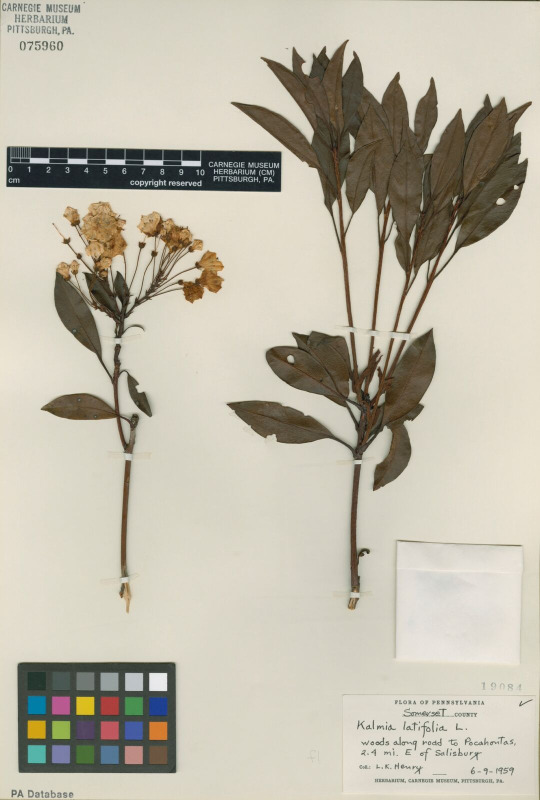
Herbarium specimen of Mountain laurel (Kalmia latifolia)

Collected on June 9, 1959, this specimen was found in the woods in Somerset County by Leroy Henry, a past curator of botany at the museum. Mountain laurel (Kalmia latifolia) is the state flower of Pennsylvania. It is a broadleaved evergreen shrub native across the eastern United States, especially in forests of mountainous areas. This specimen was collected not too far from the highest point in Pennsylvania and the Maryland border. It is often mistaken for rhododendron because rhododendron
and mountain laurel are found in similar habitats and belong to the heath family (Ericaceae). Despite its beauty, mountain laurel has a dark side—all parts contain toxins that are poisonous to humans, pets, horses, and cattle.

Ingesting this plant can cause vomiting, diarrhea, impaired vision, convulsion, cardiovascular distress, and death. Honey made by bees from mountain laurel can also cause medical problems to humans. Benjamin Smith Barton (an American botanist in the late 1700s) wrote that in the autumn and winter of the year 1790, many people died in Pennsylvania from the effects of wild
honey, collected from Kalmia plants.


Botanists at Carnegie Museum of Natural History share pieces of the herbarium’s historical hidden collection on the dates they were discovered or collected. Check back for more!

sidebar

About

  • Mission & Commitments
  • Directors Team
  • Museum History

Get Involved

  • Volunteer
  • Membership
  • Carnegie Discoverers
  • Donate
  • Employment
  • Events

Bring a Group

  • Groups of 10 or More
  • Birthday Parties at the Museum
  • Field Trips

Powdermill

  • Powdermill Nature Reserve
  • Powdermill Field Trips
  • Powdermill Staff
  • Research at Powdermill

More Information

  • Image Permission Requests
  • Science Stories
  • Accessibility
  • Shopping Cart
  • Contact
  • Visitor Policies
One of the Four Carnegie Museums | © Carnegie Institute | Privacy Policy | Terms of Use | Accessibility
Rad works here logo