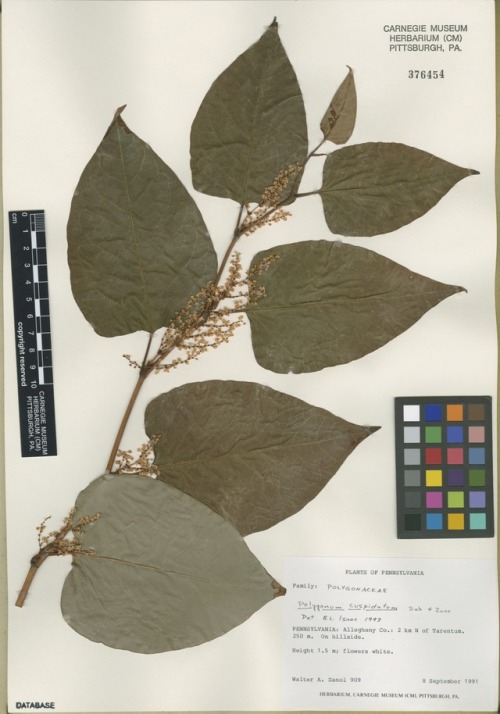
Collected on September 8, 1991, this specimen was found near Tarentum, Pennsylvania by Walt Zanol.
If you had to pick the most aggressive, invasive plant in the Pittsburgh area, knotweed would be among the top choices. This particular specimen is Bohemian knotweed (Fallopia xbohemica), a hybrid between giant knotweed (Fallopia sachalinensis) and Japanese knotweed (Fallopia japonica). Japanese knotweed was introduced from East Asia, and giant knotweed came from Sakhalin (Russia). The hybrid likely originated when these two species met after they were introduced in Europe.
Both species and their hybrid can be found around Pittsburgh, often in enormous dense clusters along highways and waterways. Take note on your drive to work or walk in the neighborhood—knotweeds
are all around!
Giant knotweed is distinguished by its large (usually much larger than your hand), heart-shaped
leaves. Japanese knotweed and the hybrid Bohemian knotweed are much more difficult to distinguish, with much variation in leaf shape. In fact, the hybrid was only recognized in the early 1980s and
was largely overlooked in the United States until even more recently. Some suggest it invades more aggressively than its parents.
Most specimens in Carnegie Museum of Natural History’s herbarium were originally identified as Japanese knotweed. Last year, Allison Cusick, a research associate at the museum, went through all 212 knotweed specimens and re-identified many as the hybrid. In fact, only three of the specimens from
Allegheny County were identified as Japanese knotweed!
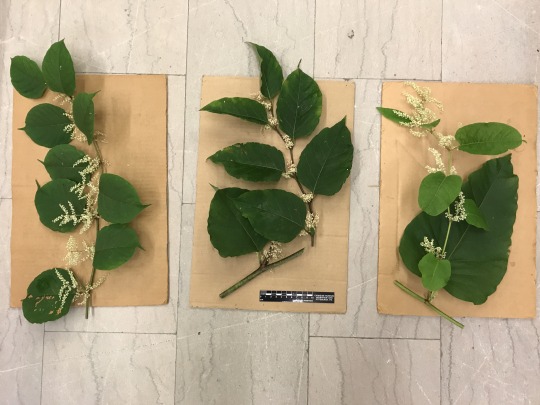
All three knotweeds collected at the same site near the Allegheny River and Barking Slopes Conservation Area, New Kensington/Plum, Pennsylvania.
Botanists at Carnegie Museum of Natural History share pieces of the herbarium’s historical hidden collection on the dates they were discovered or collected. Check back for more!
