• Skip to primary navigation
  • Skip to main content
  • Skip to primary sidebar

Carnegie Museum of Natural History

One of the Four Carnegie Museums of Pittsburgh

  • Visit
    • Buy Tickets
    • Visitor Information
    • Exhibitions
    • Events
    • Dining at the Museum
    • Celebrate at the Museum
    • Powdermill Nature Reserve
    • Event Venue Rental
    • Gift Cards
  • Learn
    • Field Trips
    • Educator Information
    • Programs at the Museum
    • Bring the Museum to You
    • Guided Programs FAQ
    • Programs Online
    • Climate and Rural Systems Partnership
  • Research
    • Scientific Sections
    • Science Stories
    • Science Videos
    • Senior Science & Research Staff
    • Museum Library
    • Science Seminars
    • Scientific Publications
    • Specimen and Artifact Identification
  • About
    • Mission & Commitments
    • Directors Team
    • Museum History
  • Tickets
  • Give
  • Shop

Collected on this Day in 2001

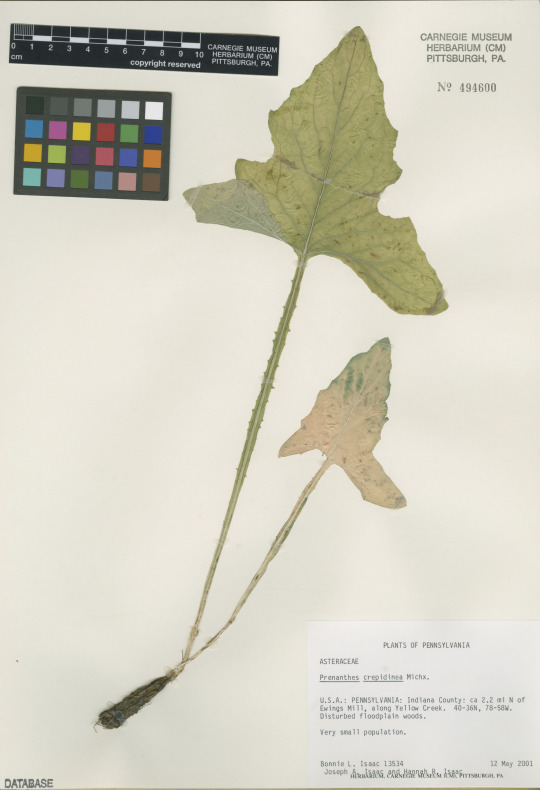
Herbarium specimen of Prenanthes crepidinea (nodding rattlesnake root)

Collected on May 12, 2001, this specimen was found in Indiana County by Bonnie Isaac, along with her family Joe and Hannah Isaac. Bonnie is the collection manager in the Section of Botany at the museum and an expert on the plants of Pennsylvania. Research for her master’s degree focused on the ecology and distribution of this species, Prenanthes crepidinea (nodding rattlesnake root).

Of conservation concern and endangered in some states, this species is native to rich woods and wet areas in north-central United States, including western Pennsylvania. Bonnie discovered that young plants emerge early in the spring, often before the canopy fully leafs out, and die back by the end of June. Few larger, older individuals persist and send up a flowering stalk August through November. The species is monocarpic, meaning that once a plant gets enough energy to flower (which may take several years), it blooms once and then dies. Her research informs conservation efforts to locate new populations of this uncommon species, finding that the best time to spot it is in early spring, before young plants disappear for the season. This specimen of a young, nonflowering plant serves as a voucher specimen that provides verifiable documentation of this population and for use in future research.


Botanists at Carnegie Museum of Natural History share pieces of the herbarium’s historical hidden
collection on the dates they were discovered or collected. Check back for more!

sidebar

About

  • Mission & Commitments
  • Directors Team
  • Museum History

Get Involved

  • Volunteer
  • Membership
  • Carnegie Discoverers
  • Donate
  • Employment
  • Events

Bring a Group

  • Groups of 10 or More
  • Birthday Parties at the Museum
  • Field Trips

Powdermill

  • Powdermill Nature Reserve
  • Powdermill Field Trips
  • Powdermill Staff
  • Research at Powdermill

More Information

  • Image Permission Requests
  • Science Stories
  • Accessibility
  • Shopping Cart
  • Contact
  • Visitor Policies
One of the Four Carnegie Museums | © Carnegie Institute | Privacy Policy | Terms of Use | Accessibility
Rad works here logo