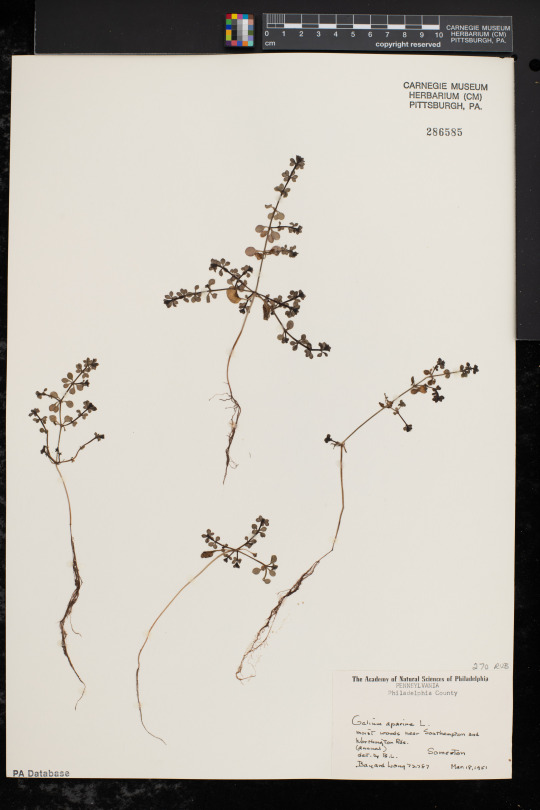
This bedstraw specimen was collected on March 18, 1951 by Bayard Long in Philadelphia county, Pennsylvania.
Bayard Long (1885-1969) was a Philadelphia-area botanist and an active member of the Philadelphia Botanical Club (founded in 1891 and still exists today). He was a prolific collector and served as Curator of the Club’s Local Herbarium for 56 years (housed at the Academy of Natural Sciences).
Fogg writes of his collections in 1970 in the journal Rhodora: “It is doubtful that anyone ever possessed a higher standard for the quality of an herbarium specimen than Bayard Long. Every leaf had to be laid out flat, every inflorescence properly displayed, every flower part clearly shown. Extra flowers and loose fruits and seeds were placed in pockets affixed to the sheet. Root systems (collected in their entirety whenever possible) were scrupulously clean, habitats were accurately described, and localities were identified to the nearest tenth of a mile and closest compass point. All of this seems the more remarkable when it is realized that Long collected close to 80,000 numbers, not including collections made as a member of Fernald’s expeditions.”
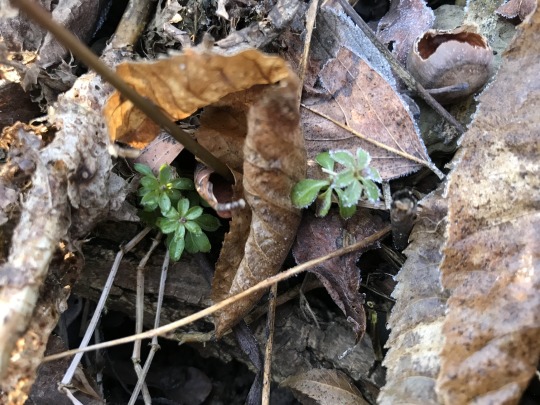
Bedstraws (species in the genus Galium, in the coffee family Rubiaceae) are common and memorable in our woods. They have many historical and traditional uses. In particular, they were used to stuff mattresses, hence the funny name. Also called cleavers or catchweed, the stems are sticky (due to fine hook hairs) and can be fun to stick on your clothes. They have likely stuck to you or your pet. This specimen is Galium aparine. An annual plant, seeds germinate in spring and produce tiny white flowers. They are emerging now, poking through the leaf litter.
Find this specimen and more here.
There are >64,000 specimens collected by Bayard Long currently digitized and online.
Check back for more! Botanists at the Carnegie Museum of Natural History share digital specimens from the herbarium on dates they were collected. They are in the midst of a three-year project to digitize nearly 190,000 plant specimens collected in the region, making images and other data publicly available online. This effort is part of the Mid-Atlantic Megalopolis Project (mamdigitization.org), a network of thirteen herbaria spanning the densely populated urban corridor from Washington, D.C. to New York City to achieve a greater understanding of our urban areas, including the unique industrial and environmental history of the greater Pittsburgh region. This project is made possible by the National Science Foundation under grant no. 1801022.
Mason Heberling is Assistant Curator of Botany at the Carnegie Museum of Natural History. Museum employees are encouraged to blog about their unique experiences and knowledge gained from working at the museum.
