by Mason Heberling
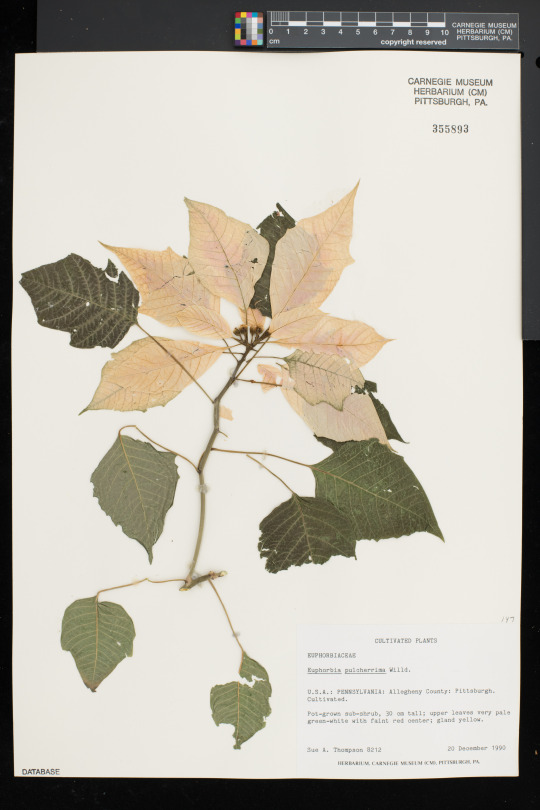
This poinsettia specimen was collected on December 20, 1990 by Sue Thompson from a potted plant in Pittsburgh. Poinsettia (Euphorbia pulcherrima) are native to Mexico, but now widely cultivated.
Look closely at the colorful “flowers” of poinsettia. Upon close inspection, you’ll notice that those bright red or white (or otherwise colorful) structures are not flower petals, but specialized leaves called “bracts.” The actual flowers are yellow and quite tiny. The brightly colored bracts function to attract pollinators to the flowers.
Poinsettias are an excellent example of a “short-day” plant. (Or, more accurately, a “long-night” plant.) That means that as the length of darkness at night increases, a complex process begins that signals flowering and the production of pigments in the bracts.
Poinsettias are woody perennials – meaning you don’t need to throw them away after the holidays! However, to flower again for next season, it takes some effort. They must experience days with less than 12 hours of daylight for 8-10 weeks straight. That means you must provide the plant with 13-16 hours of complete darkness (uninterrupted!) in order for it to flower for December. This may take some commitment to remember to put it in a dark closet each day, but well worth the effort. Or just enjoy the green foliage year after year as it grows larger.
Check back for more! Botanists at the Carnegie Museum of Natural History share digital specimens from the herbarium on dates they were collected. They have embarked on a three-year project to digitize nearly 190,000 plant specimens collected in the region, making images and other data publicly available online. This effort is part of the Mid-Atlantic Megalopolis Project (mamdigitization.org), a network of thirteen herbaria spanning the densely populated urban corridor from Washington, D.C. to New York City to achieve a greater understanding of our urban areas, including the unique industrial and environmental history of the greater Pittsburgh region. This project is made possible by the National Science Foundation under grant no. 1801022.
This specimen image is now publicly available online.
Mason Heberling is Assistant Curator of Botany at Carnegie Museum of Natural History. Museum employees are encouraged to blog about their unique experiences and knowledge gained from working at the museum.
Related Content
Collected on This Day in 1934: European larch
Indiana, Pennsylvania: Christmas Tree Capital of the World
Collected on Christmas Eve 1883: Mistletoe
Carnegie Museum of Natural History Blog Citation Information
Blog author: Heberling, MasonPublication date: December 20, 2018
