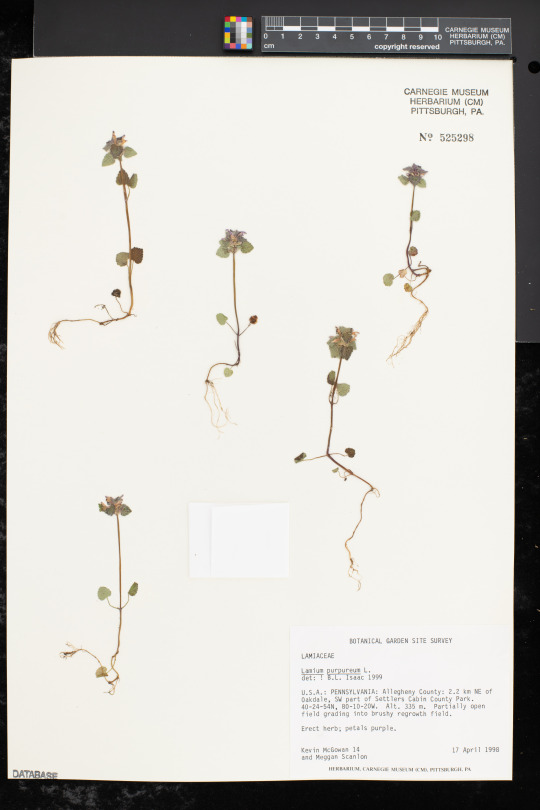
This specimen of purple dead-nettle (Lamium purpureum) was collected on April 17, 1998 by Kevin McGowan and Meggan Scanlon near Settler’s Cabin County Park in Oakdale, PA on property that is now the Pittsburgh Botanic Garden. As seen in the title of the specimen label, it was collected as part of a biological survey for the planning of the site, a large ongoing restoration of the formerly mined property.
Purple dead-nettle is probably in your backyard. Or if not, you likely don’t have to go far to find it in a lawn or sidewalk crack. Some call it a “weed.” Or, in the case of in your lawn, “spontaneous vegetation” is a lighter hearted term. It is native to Europe and Asia but now widespread across the world, including North America.
Purple dead-nettle is not related to stinging nettle, despite the name. It was named “dead-nettle” because is reminiscent to nettles (well, at least to whoever came up with the common name) but does not have stinging hairs.
Purple dead-nettle is in the mint family (Lamiaceae) with square stems often characteristic of mints. Try rolling the stem between your fingers and you’ll notice the square stems.
The City Nature Challenge is just around the corner (April 30 – May 3, 2021)!
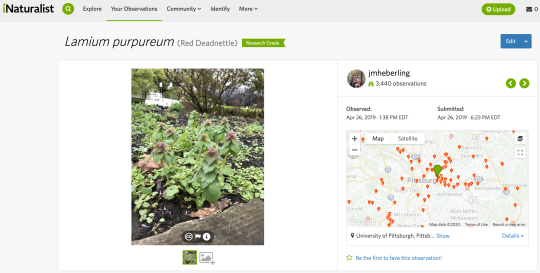
Lamium purpureum was the 9th most observed species in the Pittsburgh region for City Nature Challenge 2019. Here’s an observation of purple dead-nettle from the 2019 challenge from the flower bed near the Dippy statue at the Carnegie Museum of Natural History.
The City Nature Challenge is a global event where cities come together to share the biodiversity seen in their urban areas. Your nature sightings are shared through the free community science platform, iNaturalist. If you have never used iNaturalist, the City Nature Challenge is a great way to introduce yourself to iNaturalist. You’ll be hooked.
Past years have been (friendly) competitions among cities, competing for the most observations or species. But given the current pandemic, this year is different. It is not about the number of observations you make. It is a celebration of nature, wherever you can safely be this year…which for most, is your backyard! Or the sidewalk near your house. Or the parking lot. Or a local park. Or maybe even inside your house.
Keep a look out for purple dead-nettle. You won’t have to go far! In City Nature Challenge Pittsburgh 2019, this species was the 9th most observed species!
Or if you can’t safely be outside, you can view other observations on iNaturalist.org at any time! You can help identify photos or just click around and go for a virtual botanical hike around Pittsburgh!
Or look online at Carnegie Museum’s 185 herbarium specimens of purple dead nettle, going back to 1826 in England! Or this one growing 138 years ago collected in Beaver county.
However you can, there are plenty of ways to participate and connect with nature while staying safe!
Find this specimen of purple dead-nettle here.
Check back for more! Botanists at the Carnegie Museum of Natural History share digital specimens from the herbarium on dates they were collected. They are in the midst of a three-year project to digitize nearly 190,000 plant specimens collected in the region, making images and other data publicly available online. This effort is part of the Mid-Atlantic Megalopolis Project (mamdigitization.org), a network of thirteen herbaria spanning the densely populated urban corridor from Washington, D.C. to New York City to achieve a greater understanding of our urban areas, including the unique industrial and environmental history of the greater Pittsburgh region. This project is made possible by the National Science Foundation under grant no. 1801022.
Mason Heberling is Assistant Curator of Botany at the Carnegie Museum of Natural History. Museum employees are encouraged to blog about their unique experiences and knowledge gained from working at the museum.
Related Content
Collected on This Day in 1998: Common Chickweed
Carnegie Museum of Natural History Blog Citation Information
Blog author: Heberling, MasonPublication date: April 17, 2020
