by Mason Heberling
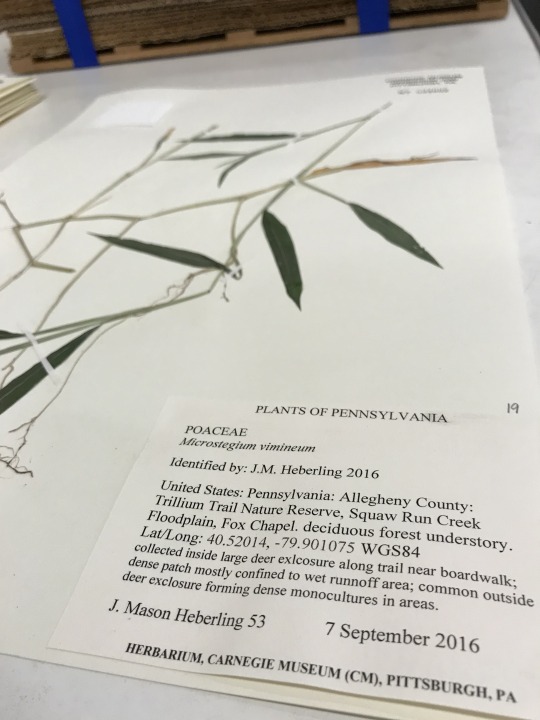
It is now a common plant in forests across Pennsylvania, but it wasn’t always. This specimen of Japanese stiltgrass (Microstegium vimineum) was collected on September 7, 2016 by Mason Heberling (me!) at Trillium Trail, Fox Chapel, PA. Native to East Asia, Japanese stiltgrass is an annual grass that is said to have first been introduced accidentally to Knoxville, Tennessee around 1919, used as packing material for porcelain dishes from China. It has since become a major invasive species, spreading across forests of Eastern North America. It is commonly found along trails, forest roads, and floodplains. It has been shown to be facilitated by deer overabundance. A recent study of unconventional gas well pads (such as “fracking”) in Pennsylvania by Penn State researchers found that recent hydraulic fracturing activities facilitates stiltgrass invasion (Barlow et al., 2017 Journal of Environmental Management). Japanese stiltgrass is especially common in disturbed moist forests, where available light in the understory is higher. Therefore, it often carpets the forest floor in disturbed forests. High densities of deer have also been shown to facilitate stiltgrass invasions. In fact, much of this research was done at Trillium Trail by Susan Kalisz (then at University of Pittsburgh, now at University of Tennessee Knoxville). They used fences to exclude deer and found that stiltgrass was not present in fenced plots, but abundant when deer were allowed access. The Kalisz lab actively remains at Trillium Trail.
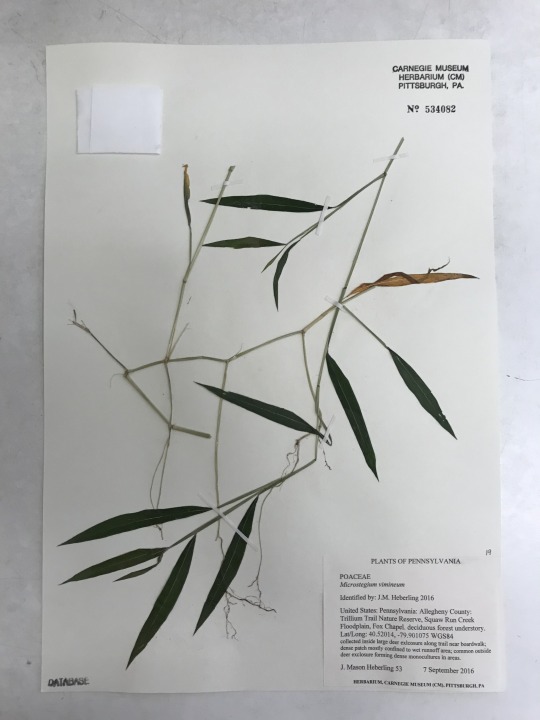
Although collected only two years ago, I was surprised to find that this specimen was the oldest Japanese stiltgrass specimen collected in Allegheny county! There is a chance it had been collected earlier and exists in another herbarium. It was said to be uncommon (possibly absent) at Trillium Trail until 2002.
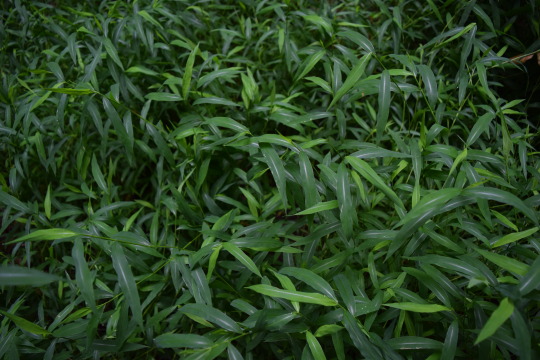
What will our forests look like in another 10 years? Herbarium specimens are important, verifiable sources to document our changing flora. And ultimately, help conserve our flora.
Mason Heberling is a Postdoctoral Research Fellow in the Section of Botany at the Carnegie Museum of Natural History. Museum employees are encouraged to blog about their unique experiences working at the museum.
