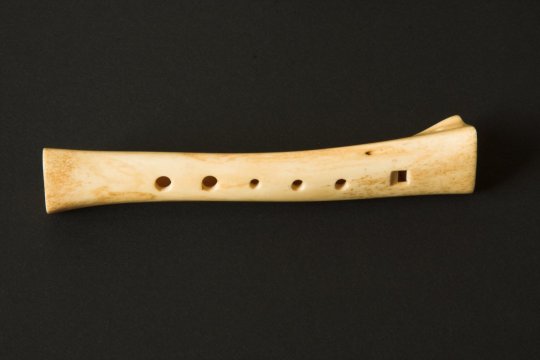
Do you like to listen to music? Have you ever admired the skill of a musician? Maybe you even know how to play an instrument yourself. Unsurprisingly, humans (Homo sapiens) have enjoyed this rewarding art for all of recorded history. In fact, the earliest evidence of musical instrument construction dates back to the great unknown ages of prehistory.
In 1995, researchers excavating deposits thought to be between 40,000 and 60,000 years old in a cave called Divje Babe (which translates to “Witch Cave”) in Slovenia found the femur (a leg bone) of a juvenile cave bear with an unusual line of small holes perforating one side. The find was recognized as being a fragment of a flute-like musical instrument. Due to the age and location of the discovery, the manufacture of the flute was attributed to Homo neanderthalensis (the Neanderthals) rather than Homo sapiens!
This discovery was extremely important in shaping our view of the Neanderthals, another species of hominid with which we share a common ancestor. Prior to this, they were often viewed as brutish, animalistic, and wholly incapable of aesthetic sensibilities. However, if they made musical instruments and played them for entertainment or ritual purposes, these activities mean that the Neanderthals were creating a complex culture reminiscent of our own when they went extinct around 40,000 years ago for reasons still unclear. The ability to modify a material so that it can then be used to create a variety of pitches implies, in the minds of some researchers, greater motor ability and a higher capacity for abstract thought.
There are many skeptics, however. Some posit that the holes in the bones are the result of hyenas making a meal of a juvenile cave bear, while others point to uncertainty about exactly when the perforations in the bone were created. Perhaps the interpretation of a modified bone as a musical instrument is all exaggeration brought on by our desire to relate to those who came so long before us. As of this writing, the scientific community is still undecided about how the holes into the bone were created and when it happened. There are two things we can all agree on, though: we hope someday to uncover the true origin of the Divje Babe bone flute, and musical instruments certainly rank among the greatest inventions of members of the genus Homo.
Niko Borish is a Teen Volunteer in the Education Department. Museum employees, volunteers, and interns are encouraged to blog about their unique experiences and knowledge gained from working at the museum.
Works Cited
Montagu, J. (2017, June 20). How Music and Instruments Began: A Brief Overview of the Origin and Entire Development of Music, from Its Earliest Stages (A. Nikolsky, Ed.). Frontiers in Sociology. Retrieved September 5, 2020, from https://www.frontiersin.org/articles/10.3389/fsoc.2017.00008/full
National Museum of Slovenia (Ed.). (n.d.). Neanderthal flute. Narodni Muzej Slovenije. Retrieved September 5, 2020, from https://www.nms.si/en/collections/highlights/343-Neanderthal-flute
The Royal Society. (2015, April 9). Are Neanderthal bone flutes the work of Ice Age hyenas? Phys.org. Retrieved September 5, 2020, from https://phys.org/news/2015-04-neanderthal-bone-flutes-ice-age.html
University of Wisconsin (Ed.). (2017). Neanderthal jam. The Why Files. Retrieved September 5, 2020, from https://whyfiles.org/114music/4.html
Related Content
Ancient Egypt Through its Pottery
Archaeology Merit Badge: Who Had More Fun, Me or the Boy Scouts?
