by Joe Sawchak
In the depths of Carnegie Museum of Natural History’s basement, in the Vertebrate Paleontology (VP) collection area known as the Big Bone Room, there is a small model of a prehistoric pig-like mammal known as Dinohyus. The name Dinohyus translates to “terrible pig,” and in life, this buffalo-sized beast must indeed have been a terrifying sight. Even so, to several members of the VP staff, including myself, the model—lovingly known as The Hyus—is perhaps even more horrifying than the actual creature itself. See for yourself:
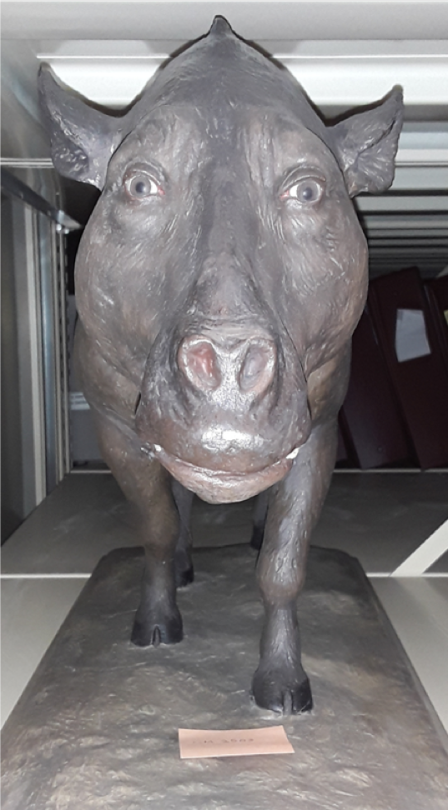
Notice anything weird?
Like, maybe, the eyes?!
If so, then you’re not alone. To those other VP staff and I—plus most of the few other people to whom we’ve shown this model—the eyes seem so ‘emotive’ or ‘human’ that it’s disturbing. It almost seems as though they’re staring right into your soul…
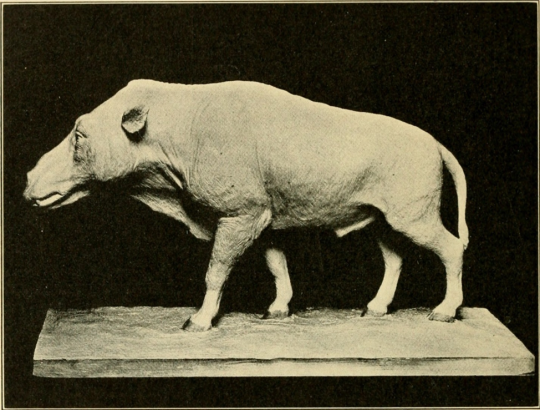
So, how did such a bizarre model come to be in our museum’s collection? Well, none of us really knew, so I did some digging into our archives. As it turns out, the model was sculpted by one Theodore Augustus Mills, born April 24, 1839 in Charleston, South Carolina. Beginning in 1860, Mills studied at the Munich Royal Academy of Fine Arts for five years. Afterward, he was employed by the Smithsonian and a few other institutions. Then, in 1898, he began work at Carnegie Institute, the parent organization of what is now known as Carnegie Museum of Natural History. Soon thereafter, he was permanently hired in the Section of Vertebrate Paleontology to make models of prehistoric animals. His Dinohyus model was completed in 1909 and catalogued as specimen CM (Carnegie Museum) 2503. A mold was made of the sculpture, and as such, the museum actually possesses multiple copies of the model. Mills worked at the Carnegie until his death from pneumonia on December 11, 1916.
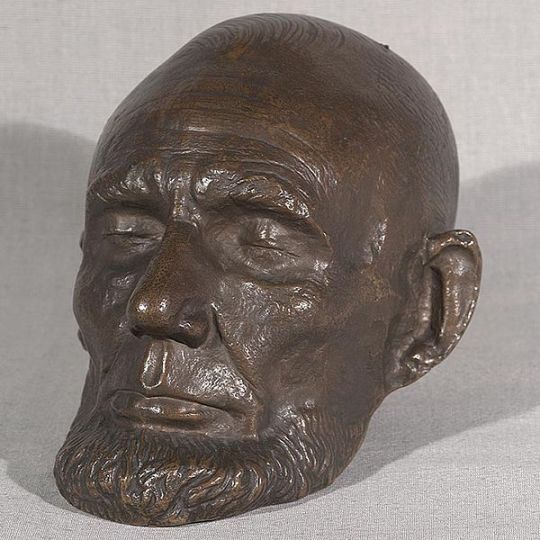
An interesting side note regarding Theodore Mills is that, early in his career, he assisted his father Clark Mills in making a cast of US President Abraham Lincoln’s face. This cast was made only 60 days prior to Lincoln’s assassination in 1865.
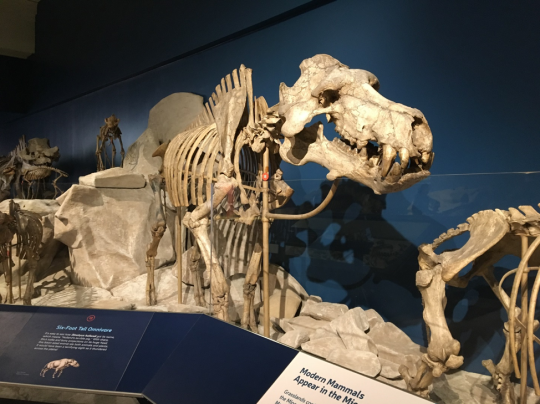
But back to the question at hand: why does Carnegie Museum of Natural History house The Hyus? The answer is that the museum is also home to what is probably the most complete, best-preserved fossil skeleton of its namesake species that has ever been discovered. In 1905, Carnegie Museum field collector T. F. Olcott unearthed this skeleton (now catalogued as specimen CM 1594) from the Agate Springs Fossil Quarry in the northwestern corner of Nebraska. Later that year, another Carnegie paleontologist, O. A. Peterson, designated that fossil as the type, or name-bearing, specimen of a new species that he called Dinohyus hollandi. As explained above, Dinohyus translates to “terrible pig,” whereas hollandi refers to William Jacob Holland, the Director of Carnegie Institute at the time. Dinohyus is an entelodont, an extinct group of pig-like (but not closely related to modern pigs) mammals that probably ate both meat and plants. Standing about six feet tall at the shoulder, it was among the largest of its kind. Dinohyus inhabited North America between roughly 29 and 19 million years ago during the late Oligocene and early Miocene epochs.
Shortly after its discovery, the type specimen of Dinohyus hollandi was mounted and put on display here at the Carnegie Museum. We presume that Theodore Mills made his model to accompany this display, intending to give museum visitors a glimpse of what this frightening brute may have looked like in the flesh.
Decades later, beginning in the 1990s, many paleontologists have argued that the entelodont species Dinohyus hollandi and Daeodon shoshonensis are actually the same kind of animal. If so, Daeodon would be the correct name because it was coined first.
Today, though the model is relegated to storage in the Big Bone Room (due, perhaps, to its unsettling appearance?), CM 1594 is still on display in Carnegie Museum of Natural History’s exhibition Age of Mammals: The Cenozoic Era. Furthermore, the source of this remarkable specimen, Agate Springs Fossil Quarry, is now the centerpiece of Agate Fossil Beds National Monument.
And though Dinohyus itself is now widely known as Daeodon, Mills’ model will always be The Hyus to us.
Joe Sawchak is a collection assistant for the Section of Vertebrate Paleontology at Carnegie Museum of Natural History. Museum employees are encouraged to blog about their unique experiences and knowledge gained from working at the museum.
Related Content
Meet The Hyus of “Daeodon at the Door” Meme Fame (Video)
Carnegie Museum of Natural History Blog Citation Information
Blog author: Sawchak, JoePublication date: January 7, 2019
