by Patrick McShea
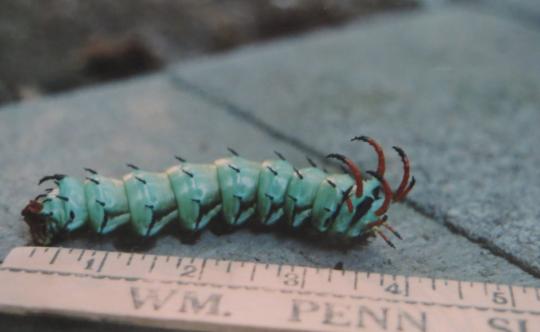
The first grade teacher who provided this picture didn’t realize how much it revealed about her skill in conveying scientific principles. She was more concerned about finding answers for her students’ pressing questions.
The photo and an attached note accompanied a box of preserved insect materials returned to the museum’s loan program one early November day. “A little girl found the ‘creature’ in this picture! She put it in a container and in three days it spun a hard black cocoon, also about four inches long. WHAT IS IT??? And what will
come out of the cocoon???”
Answers were quickly supplied. The mysterious creature was a caterpillar known as a hickory horned devil, the larval stage of the moth bearing the scientific name Citheronia regalis, and the common names regal moth and royal walnut moth. The caterpillars are harmless to touch, but as noted in the USDA Forest Service
publication, Caterpillars of Eastern Forests, hickory horned devils are the “largest and most formidable appearing eastern forest insect.”
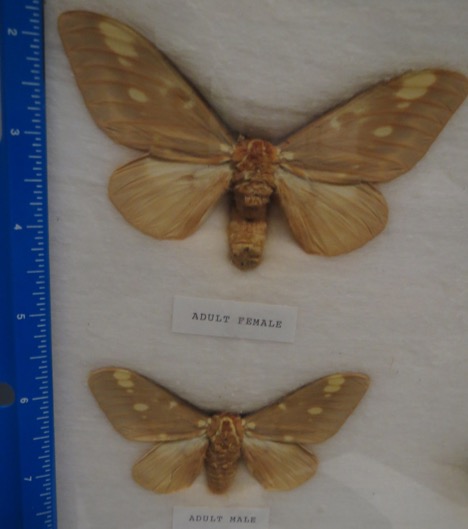
The teacher’s next loan of museum materials included preserved specimens of regal moths (above), and a note praising the use of a ruler as a scale bar in the caterpillar photo. First grade is not too early to learn the importance of making objective measurements when sharing first hand observations, even when the subject is a frightening looking caterpillar.
Pittsburgh teachers looking to learn more about our loan program can visit our website. Schools can have unlimited access to the museum’s loan collection for $200 a year.
Patrick McShea works in the Education and Visitor Experience department of Carnegie Museum of Natural History. Museum employees are encouraged to blog about their unique experiences and knowledge gained from working at the museum.
