• Skip to primary navigation
  • Skip to main content
  • Skip to primary sidebar

Carnegie Museum of Natural History

One of the Four Carnegie Museums of Pittsburgh

  • Visit
    • Buy Tickets
    • Visitor Information
    • Exhibitions
    • Events
    • Dining at the Museum
    • Celebrate at the Museum
    • Powdermill Nature Reserve
    • Event Venue Rental
  • Learn
    • Field Trips
    • Educator Information
    • Programs at the Museum
    • Bring the Museum to You
    • Guided Programs FAQ
    • Programs Online
    • Climate and Rural Systems Partnership
  • Research
    • Scientific Sections
    • Science Stories
    • Science Videos
    • Senior Science & Research Staff
    • Museum Library
    • Science Seminars
    • Scientific Publications
    • Specimen and Artifact Identification
  • About
    • Mission & Commitments
    • Directors Team
    • Museum History
  • Tickets
  • Give
  • Shop

Does it sound strange to walk like an Egyptian on painted floors?

By Dr. Erin Peters

We often see paintings hung on walls today, so it may be hard to believe ancient Egyptians could walk on them! Many surfaces were painted in ancient Egyptian temples and tombs, even floors. We have a fragment of a painted floor from the Meru-Aten palace/temple at Akhetaten (modern Tell el-Amarna) in the Section of Anthropology’s storage. Amarna was the capital city of the pharaoh Akhenaten and his wife, Nefertiti, who famously changed Egyptian religion from polytheistic – worshiping many gods – to monotheistic – worshiping a single god. Akhenaten and Nefertiti’s single god was the Aten, the sun itself.
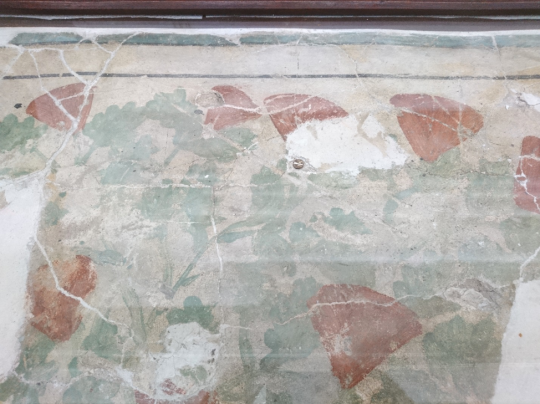
Fragment of a painted floor pavement from the Meru-Aten, Akhetaten
1. Fragment of a painted floor pavement from the Meru-Aten, Akhetaten (el-Amarna), Dynasty 18, acc. # 7106.

Nature was essential to all eras of Egyptian society, but the change to worshiping one natural element heightened this relationship in the Amarna Period. We see this in the art and architecture that survives, like our painted floor pavement. As you can see in the detail, the painting depicts red poppies, a common flower in ancient Egypt. The exquisite interlacing leaves and flowers, along with the visible brush-strokes of the ancient artisan, give the poppies a sense of naturalism characteristic of Akhenaten’s reign.
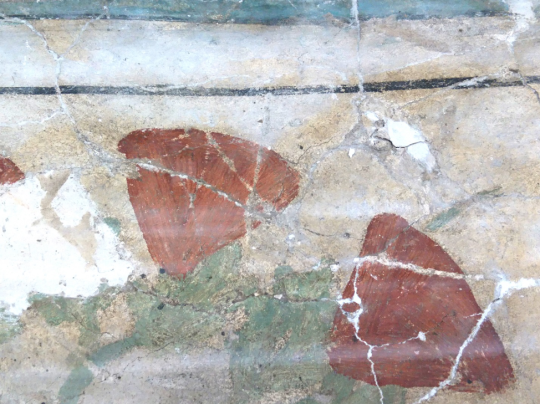
Detail of fragment of a painted floor pavement from the Meru-Aten, Akhetaten (el-Amarna)
2. Detail of fragment of a painted floor pavement from the Meru-Aten, Akhetaten (el-Amarna), Dynasty 18, acc. # 7106.

This naturalism contrasts with art and architecture produced before and after the Amarna Period, like the painting in the Dynasty 19 tomb of Sennedjem at Deir el-Medina. Half of Sennedjem’s tomb is recreated in our Walton Hall of Ancient Egypt. You may be familiar with the scene of Sennedjem and his wife adoring several gods in two rows within a shrine. The other half of the tomb shows Sennedjem and his wife in the Field of Reeds (what we think of as the Afterlife). The fields are surrounded by water and abundant trees and plants, including the mandrake, cornflower, and red poppy in the row at the bottom.
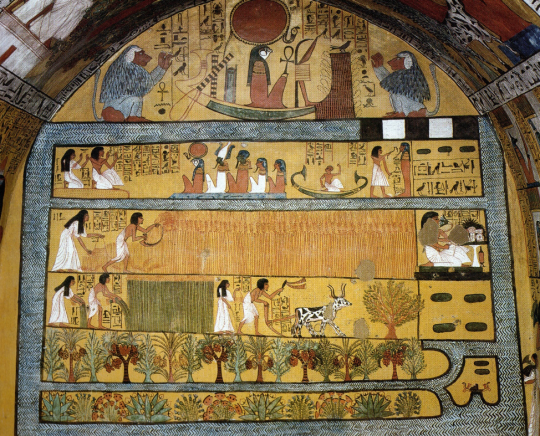
tympanum of the East Wall of the tomb of Sennedjem, Deir el-Medina
3. The tympanum of the East Wall of the tomb of Sennedjem, Deir el-Medina, Dynasty 19.

This detail shows rows of mandrakes, cornflowers, and poppies – all are painted in a more stylistic, or abstract way, than the poppies on our Amarna Period floor pavement.
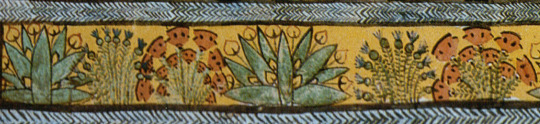
Detail showing mandrake, cornflowers, and red poppies
4. Detail showing mandrake, cornflowers, and red poppies in the tympanum of the East Wall of the tomb of Sennedjem, Deir el-Medina, Dynasty 19.

While we see more naturalistic representations in the Amarna Period, floors were painted in all periods – so walking like an Egyptian could often mean walking on paintings!

Erin Peters is joint assistant curator of science and research at Carnegie Museum of Natural History. Museum employees are encouraged to blog about their unique experiences working at the museum.

sidebar

About

  • Mission & Commitments
  • Directors Team
  • Museum History

Get Involved

  • Volunteer
  • Membership
  • Carnegie Discoverers
  • Donate
  • Employment
  • Events

Bring a Group

  • Groups of 10 or More
  • Birthday Parties at the Museum
  • Field Trips

Powdermill

  • Powdermill Nature Reserve
  • Powdermill Field Trips
  • Powdermill Staff
  • Research at Powdermill

More Information

  • Image Permission Requests
  • Science Stories
  • Accessibility
  • Shopping Cart
  • Contact
  • Visitor Policies
One of the Four Carnegie Museums | © Carnegie Institute | Privacy Policy | Terms of Use | Accessibility
Rad works here logo