by Jo Tauber
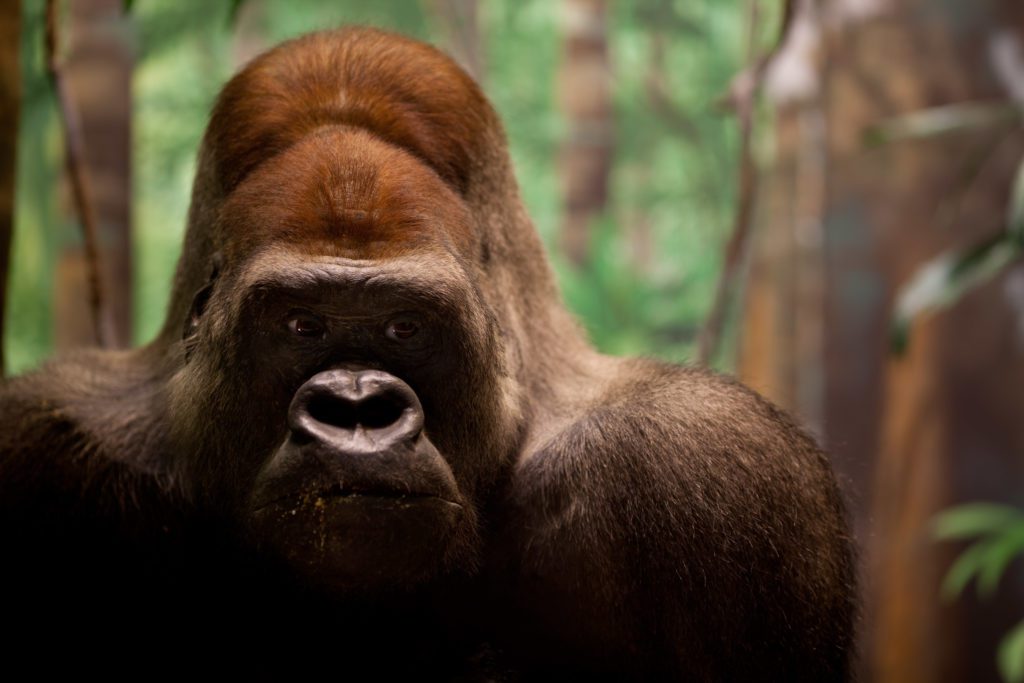
As you pass under the acacia tree in the Hall of African Wildlife, keeping wary of the leopard perched in the branches, you may find yourself mesmerized by the soulful eyes and powerful yet peaceful presence of George, the western lowland gorilla. George was a resident of the Pittsburgh Zoo until his death from natural causes in 1979, when he joined the museum’s collections. George is shown proudly standing in a diorama depicting his natural habitat, a patch of tropical forest in the Congo River Basin. While George’s story may be quite different from those of his wild counterparts, his presence here provides an excellent opportunity for learning more about wild gorilla populations and the threats they face.
Did you know that the mining of a mineral known as coltan has a negative impact on gorilla populations? Or that whatever device you’re reading this blog post on, whether it’s a laptop, cell phone, tablet, or other electronic device, contains tantalum, a product of coltan? Coltan is a shorthand name for columbite-tantalite, which is refined into tantalum, an element used in heat-resistant capacitors in many electronic devices. (Delawala, 2006; Rogers, 2008). If this is new or surprising information, you are not alone–not many people realize the connection between devices like cell phones and the conservation status of these charismatic great apes.
The Congo River Basin is home to two subspecies of gorillas, western lowland gorillas (like George) and eastern lowland gorillas. Unfortunately for both species, much of this area is rich in coltan. There are many factors affecting the conservation status of gorillas, but coltan mining is having a major effect. Both subspecies are critically endangered with fewer than 100,000 western lowland gorillas, and fewer than 4,000 eastern lowland gorillas living in the wild.
The mining of coltan alters the landscape, which not only reduces viable gorilla habitat, but also allows easier access for poachers who seek to kill or capture gorillas (Redmond, 2001). Poachers can also bring and spread infectious diseases that can affect gorillas and other humans alike (Redmond, 2001). Miners may also hunt gorillas as a food source while they work excavation sites (Redmond, 2001).
Gorillas aren’t the only primate species negatively affected by mining for coltan. Many of the people involved in the mining also suffer greatly. Mining operations are notoriously unsafe, exploit child labor, and require miners to work days over 12 hours long (Rogers, 2008). Coltan has been termed a “conflict mineral,” meaning the mining of this resource is used to fund the actions of warlords in the ongoing civil war in the Democratic Republic of Congo (Rogers, 2008).
Before you swear off electronics entirely, there are less drastic, but still impactful actions we can all take to benefit gorillas! We live in a world where technology is a necessity for many of us. Practicing ways to be responsible with the devices we use is the best way to minimize the unintended consequences involved in their creation. Our individual and collective actions can benefit us all, gorillas included.
One small but important thing to do is keep your electronic gadgets as long as possible, and to recycle them when they need to be replaced. Such actions lessen the need for new coltan to be collected, meaning less mining needs to be done, and less gorilla habitat disrupted. Recycling cell phones also keeps both phones and the precious minerals they contain out of landfills. The EPA estimates that of the average 800 million phones in use annually, only 10% are recycled with the balance contributing to overly full landfills (“Recycle Your Cell Phone. It’s An Easy Call.” 2009).
If you’re wondering how to recycle a cell phone, there is some good news! Carnegie Museum of Natural History is introducing a cell-phone recycling program. When you come to visit us, you can bring unwanted cell phones and drop them in the designated collection bins. Museum staff will then ship them off to be recycled properly. Make sure you also stop by to see George, and the new exhibition We Are Nature, which tells other stories about how humans are impacting our world!
Jo Tauber is the Gallery Experience Manager in CMNH’s Lifelong Learning Department. Museum staff, volunteers, and interns are encouraged to blog about their unique experiences and knowledge gained from working at the museum.
Works Cited
Delawala, I. (2006, January 6). What Is Coltan? ABC News. Retrieved July 11, 2020, from https://abcnews.go.com/Nightline/story?id=128631&page=1
Eastern lowland gorilla. (n.d.). Retrieved July 11, 2020, from https://wwf.panda.org/knowledge_hub/endangered_species/great_apes/gorillas/eastern_lowland_gorilla/
Environmental Protection Agency. (2009). Recycle Your Cell Phone. It’s An Easy Call. [Brochure]. Retrieved March 14, 2021, from https://nepis.epa.gov/Exe/ZyPDF.cgi/P1009IF5.PDF?Dockey=P1009IF5.PDF
Redmond, I. (2001). Coltan Boom, Gorilla Bust: The Impact of Coltan Mining on Gorillas and other Wildlife in Eastern DR Congo.
Rogers, W. (2008, December 2). Coltan, Cell Phones, and Conflict: The War Economy of the DRC. Retrieved July 11, 2020, from https://www.newsecuritybeat.org/2008/12/coltan-cell-phones-and-conflict-the-war-economy-of-the-drc/Society), F., Breuer, T., Greer, D., Jeffery, K., Stokes, E., & Strindberg, S. (2016, January 29). The IUCN Red List of Threatened Species. Retrieved July 11, 2020, from https://www.iucnredlist.org/species/9406/136251508
Western lowland gorilla. (2019, October 03). Retrieved July 11, 2020, from https://nationalzoo.si.edu/animals/western-lowland-gorilla
Related Content
Climate Change Never Takes a Holiday: The Phenomenon of the Pizzly Bear
Paradise Found: The Real-Life Residents of Shangri-La
Carnegie Museum of Natural History Blog Citation Information
Blog author: Tauber, JoPublication date: January 19, 2022
