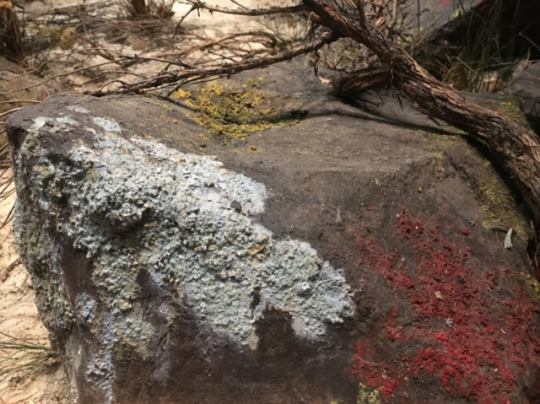
Lichens are scenery elements in many museum dioramas. Within the Pronghorn Antelope diorama in the Hall of North American Wildlife, for example, these frequently overlooked organisms coat a foreground boulder with irregular patches of gray, red, and gold.
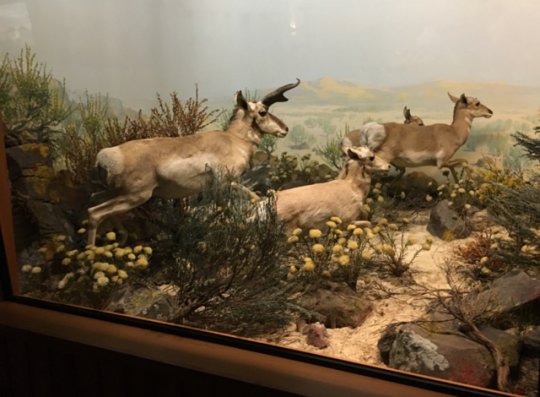
If you approach this artfully recreated western scene with a little background information about lichens, you might find the colorful cluster of immobile organisms in the bottom right corner just as interesting as the four galloping centerpieces.
Lichens are found on every continent and estimates of their global diversity range from 13,000 to more than 17,000 species. Every lichen is a partnership of two different organisms, a fungus whose tissue provides the physical structure to support a second organism capable of photosynthesis. For most lichens the partner with the solar energy power is some form of green algae. The fungus/algae partnership is a living arrangement in which separate identities fade while combined abilities allow for survival in locations where neither organism could live alone.
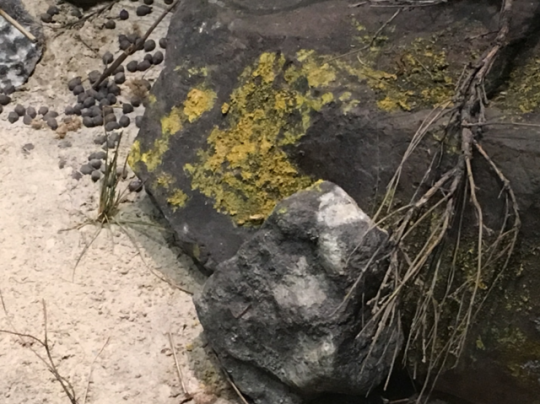
Three distinctive growth forms provide a means for categorizing lichen. The colorful trio sharing the pronghorn antelope diorama are termed “crustose” or crust-like lichens. Lichens with a leaf-like appearance and structure are termed “foliose,” and those with shrubby upright or dangling strands are termed “fruticose.”
Because lichens absorb so much of their nourishment from the air and rainfall, they serve as living air quality indicators. By monitoring a region’s changing balance of pollution sensitive species and pollution tolerant species, a researcher can visually chart the build-up or decrease of pollutants such as sulfur dioxide and nitrogen dioxide.
For more detailed information about lichen ecology, including information about local research efforts, please visit the site maintained by Point Park University Professor Matthew Opdyke.
Patrick McShea works in the Education and Visitor Experience department of Carnegie Museum of Natural History. Museum employees are encouraged to blog about their unique experiences and knowledge gained from working at the museum.
