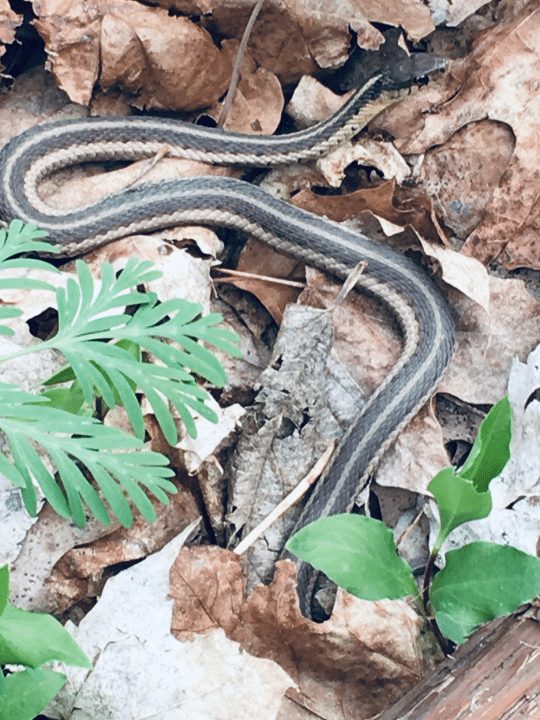
The eastern garter snake never moved. I only noticed the harmless reptile because my hands were within inches of its sleek body as I crouched to photograph a large-flowered trillium. The image above is a result of an abrupt subject change, but rushing wasn’t necessary. I was later able to photograph the intended wildflower without disturbing its striped neighbor.
After perhaps 90 seconds of sharing space with the snake, I backed carefully away from the blooming patch of forest understory within the Allegheny Land Trust’s Barking Slopes Natural Area. Later that day, in the pages of a trusted reference book, I found an explanation for what seemed an unusually passive predator.
Amphibians and Reptiles of Pennsylvania and the Northeast, is a Cornell University Press publication from 2001 by three authors with deep ties to CMNH, Arthur C. Hulse, long a Research Associate for the Museum’s Section of Herpetology, the late C. J. McCoy, a curator within the Section between 1964 and 1993, and Ellen J. Censky, a curator within the Section between 1994 and 1998.
The 5 pages of the 400-page volume devoted to garter snakes includes a description of the snake’s wide range of reactions to close encounters with our species.
“At one extreme, some remain fairly quiescent and allow themselves to be picked up and will not attempt any defensive behavior. At the other extreme, individuals flatten the head and body, flare the lips to expose teeth, and strike violently.”
The authors cite research indicating that young garter snakes are more aggressive after eating a large meal, a behavior that might occur because recently ingested food reduces their mobility, and therefore their chances for successful escape.
By this line of reasoning, the docile creature I encountered might simply have been hungry.
Patrick McShea works in the Education and Visitor Experience department of Carnegie Museum of Natural History. Museum employees are encouraged to blog about their unique experiences and knowledge gained from working at the museum.
