An Indoor Zoo
Did you ever walk through the zoo and have the frustrating experience of not seeing the animals? Perhaps they were sleeping or hiding out under a rock on a hot summer’s day, for whatever reason–they were not visible.
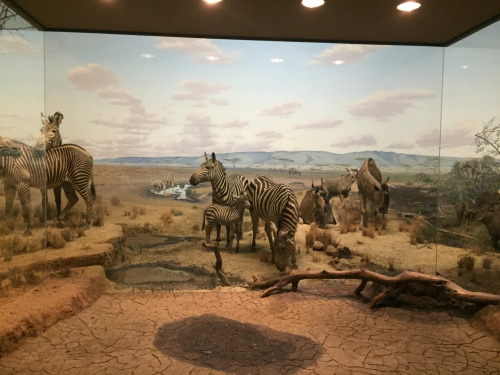
Our halls of North American and African wildlife allow visitors to see the exotic animals in their natural habitats through expert taxidermy and beautiful background scenes created by artists. Visit anytime of year, anytime of day to see a replica of a Baobab tree towering over a rhinoceros, a zeal of zebras cautiously gathered by a watering hole, and a group of mountain goats precariously perched in their native steep, rocky terrain –all on the second floor of Carnegie Museum of Natural History.
The dioramas have been a staple of our museum for decades, but in the 1920′s they became an example of how museums must evolve with changing cultural attitudes. Our museum changed the display of its wildlife almost 100 years ago as Americans embraced the importance of conservation.
A current exhibition at the museum, “Art of the Diorama,” gives some cultural and historical context to our second floor dioramas.
Many American natural history museums opened and grew alongside the public’s blooming interest in nature in the mid to late 1800′s. Exotic animals were a natural fit to fill the halls of these new institutions. At the time, however, most museums
displayed animals in rectangular glass cases or on shelves with little to no foliage or background.
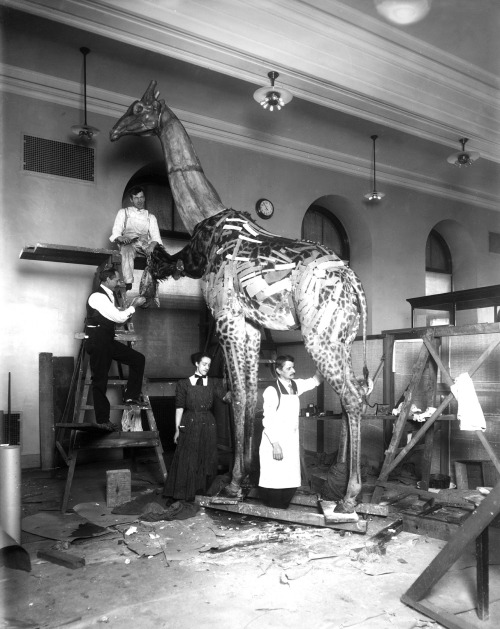
As a new conservation movement gained traction, it inspired curators to reevaluate the display of their collections. In the 1920′s, the art of the diorama emerged. In an effort to give context to their animal specimens, museums began to depict them in their natural environment. Through painted background, native plants, and the inclusion of other animals, these new dioramas told a “biological story.” One that curators hoped would help the public understand that animals were not singular objects for display, but living creatures whose needs are worth protecting.
For more information on the evolution of our dioramas, visit “Art of the Diorama” on the first floor of the Carnegie Museum of Natural History.
