By Patrick McShea
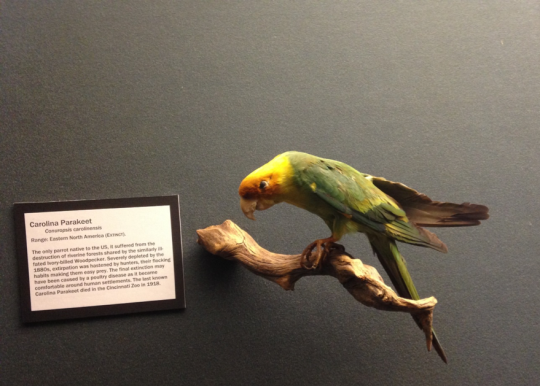
Some exhibits in Carnegie Museum of Natural History can be better appreciated through a visit to Carnegie Library of Pittsburgh. This thought occurred recently when the taxidermy mount of a Carolina Parakeet in Bird Hall triggered a memory of trees full of ornaments.
Four years ago, as preparation for discussions about the centenary anniversary of the Passenger Pigeon’s extinction, I borrowed and read a thought-provoking book by Christopher Cokinos titled with a line of Emily Dickinson’s poetry, Hope Is The Thing With Feathers.
The book, which was published in 2000, includes well-researched accounts of five extinct North American bird species. In describing what we have lost in the Carolina Parakeet’s disappearance from our landscape and “erasure from our memory,” Cokinos quotes an 1877 autobiography of Gert Goebel, a German settler in eastern Missouri recounting the birds’ appearance in earlier winters.
These flocks of paroquets were a real ornament to the trees stripped of their foliage in the winter. The sight was particularly attractive, when such a flock of several hundred had settled on a big sycamore, when the bright green color of the birds was in such marked contrast with the white bark of the trees, and when the sun shone brightly these inhabited tree tops, the many yellow heads looked like so many candles.
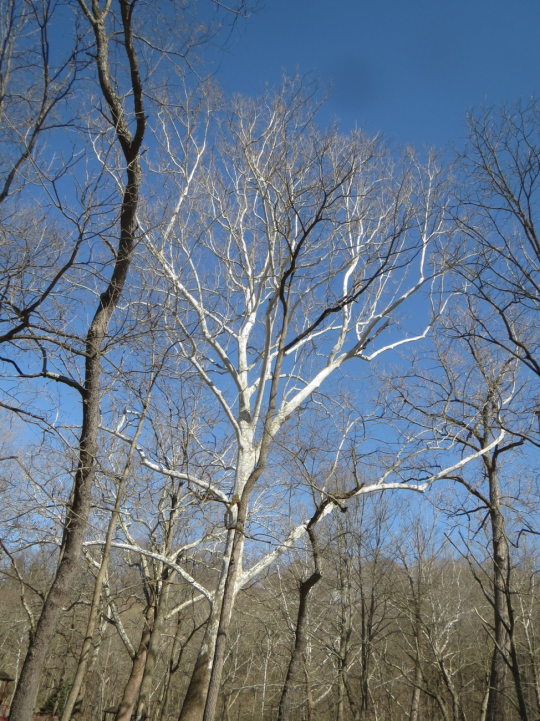
The next time you pass a sycamore, try to imagine the high white bare branches alive with green parrots.
Patrick McShea works in the Education and Visitor Experience department of Carnegie Museum of Natural History. Museum employees are encouraged to blog about their unique experiences and knowledge gained from working at the museum.
