by Patrick McShea
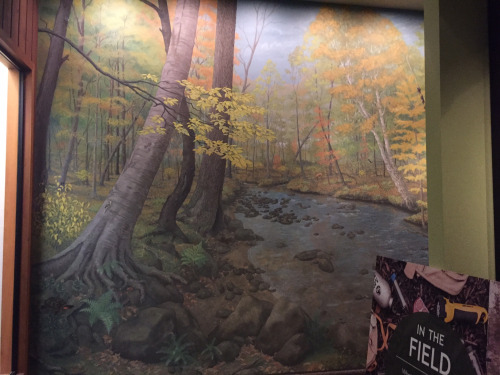
The scene in a new mural on the second floor of Carnegie Museum of Natural History is a fall morning at Powdermill Nature Reserve, the museum’s field research station which is located some 55 miles southeast of Pittsburgh.
The view is upstream along Powdermill Run, just below the place where the stream absorbs the flow of a tributary known as White Oak Run. These waters, gathered from a portion the western slope of Laurel Ridge, eventually flow through Pittsburgh. Their path to the city, a vertical descent of some 650 feet via the meanders of Loyalhanna Creek, the Kiskiminitas, and Allegheny River, is nearly twice the length of the highway route.
As a vital element of the forested landscape, the stream provides a focal point for considering the diverse life forms supported on Powdermill Nature Reserve’s 2,200 acres.
The artists who created the mural paid careful attention to vegetation, depicting specific trees, shrubs, and grasses. They also populated the scene with a variety of creatures. The closer you study the mural the more living details you’ll notice.
See how many plants and animals you can locate and identify, then make plans to visit Powdermill Nature Reserve at any season of the year.
Curious about Powdermill? Visit on June 4 for the annual public day!
Patrick McShea works in the Education and Visitor Experience department of Carnegie Museum of Natural History. Museum employees are encouraged to blog about their unique experiences and knowledge gained from working at the museum.
