Some land snails possess darts in their reproductive systems. During courtship, one or both partners jab the other partner with the dart, which some observers have likened to Cupid’s arrow. If the dart misses or otherwise fails to stab the partner, then courtship and mating stop, unfinished. And we’re not talking about tiny darts; in one species the dart is a fifth the length of the creature’s body!
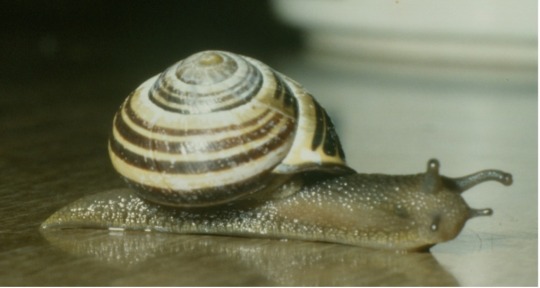
In those species studied, the dart appears to deliver hormones into the partner to increase the chance of paternity. Most land snails are hermaphrodites (both male and female within one individual). During mating, sperm enters the partner’s copulation pouch, which is not a safe haven because digestive processes begin! The hormones help the sperm escape that pouch so they can find their way to the fertilization chamber.
Note that in these land snails, the dart is used during courtship before copulation. These land snails are not using the dart to transfer sperm, a behavior known as traumatic insemination in some other creatures such as saccoglossans (relatives of sea slugs), some flatworms, and bed bugs.
Dart-bearing snails that you might know include the escargot snails (family Helicidae), the large native snails in southwestern USA (Xanthonychidae), and some of the large native slugs of eastern North America (Philomycidae). Note that the Polygyridae, the larger land snails in eastern North America, lack a dart.
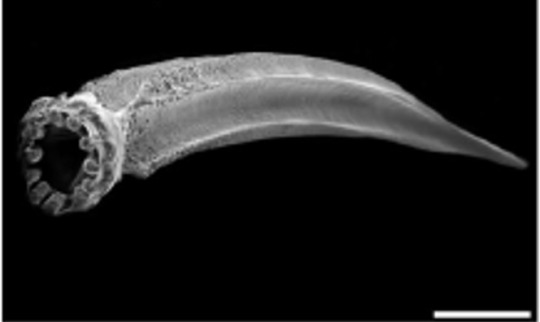
The dart is formed in a structure called a dart sac, and after the dart is used, a new one grows after about a week. While many species have a single dart sac, some snail groups possess two, four, or even more dart sacs, so presumably they can mate again without waiting for the single dart to re-grow.
A mystery: most groups of land snails lack darts in the reproductive system, although multiple, relatively un-related groups of snails possess darts. Two explanations exist for this diversity of having or lacking darts: (1) the ancestor of all land snails possessed a dart, and then evolutionarily the dart was lost in most groups, or (2) the ancestor lacked a dart, and then a dart was acquired independently in multiple lineages.
Some snail biologists favor the ancestral dart idea, although others (e.g., Tompa 1980) favor the independent origin idea. I like the independent origin idea because of dramatic differences among darts: in some groups, the dart is made of calcium carbonate, in others it is chitin, and in still others it is cartilaginous. I hold that in evolution, it is sometimes easier to start over from scratch than to change fundamental building materials. Nevertheless, most snail biologists agree that the ancestor to the superfamily Helicoidea, which contains the familiar escargot snails, had at least one dart (e.g., Schileyko 1989), but whether it was one dart that proliferated into multi-dart forms or vice versa remains unresolved.
One way to solve this mystery could be to examine molecular processes used in forming and deploying the dart. If all dart-possessing land snails use similar biochemical pathways to form and deploy their darts, those similarities would be consistent with the ancestral dart idea. On the other hand, if love darts of different groups rely on different biochemistry to form and deploy, that would suggest multiple independent origins of darts, with their apparently similar shapes and functions being due to convergent evolution.
Meanwhile, snails continue reproducing, and for those that use a dart, I say, “A jab well done!”
References
Koene, J.M. & Schulenburg, H. 2005. Shooting darts: co-evolution and counter-adaptation in hermaphroditic snails. BMC Evolutionary Biology 5(25): 13 pp. https://doi.org/10.1186/1471-2148-5-25
Schileyko, A.A. 1989. Taxonomic status, phylogenetic relations and system of the Helicoidea sensu lato (Pulmonata). Archiv für Molluskenjunde 120: 187-236.
Tompa, A.S. 1980. The ultrastructure and mineralogy of the dart from Philomycus carolinianus (Pulmonata: Gastropoda) with a brief survey of the occurrence of darts in land snails. Veliger 23: 35-42.
Tim Pearce is the head of the mollusks section at Carnegie Museum of Natural History. Museum employees are encouraged to blog about their unique experiences and knowledge gained from working at the museum.
Related Content
Ask a Scientist: Are slugs just snails with their shells taken off?
Nerding Out Over Masting, or Why Unusual Plant Reproduction Excites Animal Ecologists
The Story of a Beetle, a Dolphin, and Some Remarkable Genitalia
