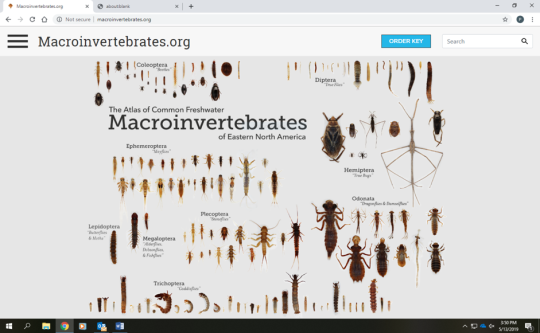
The Atlas of Common Freshwater Macroinvertebrates of Eastern North America is an online guide and accompanying set of teaching and learning resources designed to support water quality monitoring in citizen science projects and fresh water ecology education.
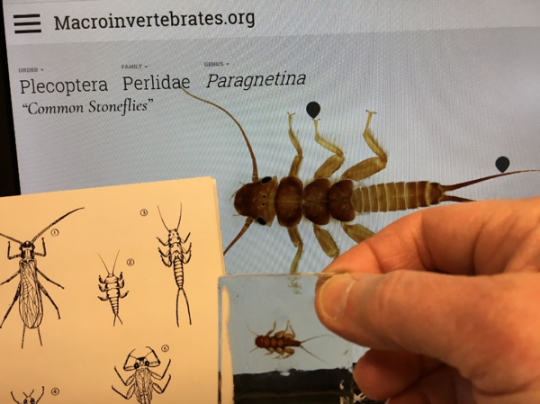
For the team of entomologists, learning scientists, software engineers and designers who collaborated in the National Science Foundation-supported effort to plan, develop, test, and revise the site, six words guided the key design goals for this educational resource—Learning to See, Seeing to Learn. Team members aimed both to support the development of observational skills and provide the rich visual resources needed for observation and identification.
In freshwater environments the term macroinvertebrates refers to animals without backbones that can be seen with the naked eye. Because these insects, crustaceans, worms, and mollusks fill vital roles in aquatic food webs, their presence, absence, abundance, and diversity is key to assessing water quality in streams and freshwater bodies over time.
In early April, I spent several hours demonstrating www.macroinvertebrates.org at a table display during the Creek Connections Student Research Symposium held at the Campus Center of Allegheny College. The Meadville college has been providing opportunities for students to become stream researchers for more than 20 years, so I was confident the website would be well received by these budding young freshwater scientists.
The table displayed two iPads for visitors to explore the Macroinvertebrates.org site, a set of stream insects embedded in Lucite cubes, a traditional Riker mount of pond macros, a field microscope, and a stack of promotional postcards.
During the event I spoke with and handed-out information to approximately 100 people, a mix of middle school and high school students presenting their stream study projects, their teachers, Allegheny College students and faculty, and representatives from other organizations participating in the symposium.
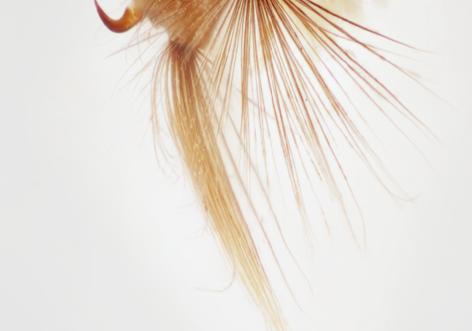
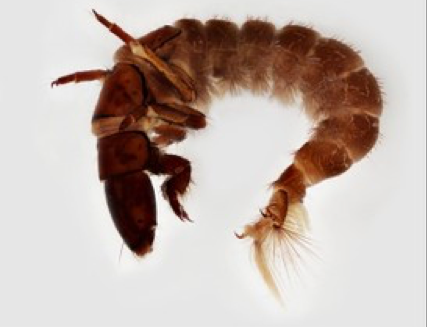
Table visitors were particularly impressed by set-ups on the paired iPads – one screen fully zoomed-in on the abstract art-like image on the “setal fan on a proleg” of a net-spinning caddisfly, the other featuring a whole-body image of the tiny beast. The companion images addressed the linked challenge of learning to see and seeing to learn.
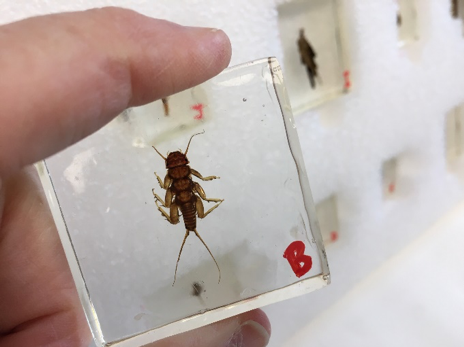
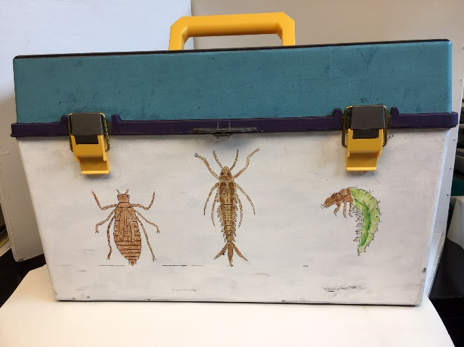
As teachers continue to experiment with ways for their students to use the online guide, the museum has added a set of preserved macroinvertebrates to the Educator Loan Collection. Pictured above is a stonefly embedded in a block of clear resin, and the colorfully-illustrated toolbox that contains a set of ten different specimens prepared in the same manner.
Partners involved in the development of www.macroinvertebrates.org include Carnegie Mellon University’s Human Computer Interaction Institute, University of Pittsburgh’s Learning Research & Development Center, Stroud Water Research Center, Clemson University, and Carnegie Museum of Natural History.
Patrick McShea works in the Education and Visitor Experience department of Carnegie Museum of Natural History. Museum employees are encouraged to blog about their unique experiences and knowledge gained from working at the museum.
