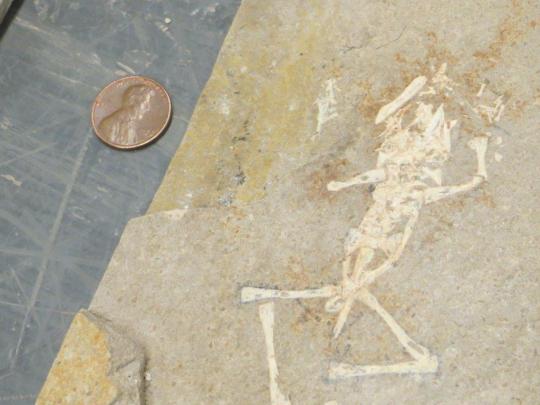
Frog fossil from eastern Nevada.
by Patrick McShea
Dinosaurs get all the attention, but fossils of less glamorous creatures also contribute much to our understanding of evolution and extinction. Consider frogs for example. These widely distributed amphibians first appear in the fossil record roughly 190 million years ago. Since then they have
survived numerous events, including mass extinction, changing climate, and the rearrangement
of continents through plate tectonics.
The study of how frogs adapted to changing environments over vast stretches of time is especially important today in light of dramatic declines of many frog species due to rapid climate change, habitat fragmentation, the global spread of disease, and broad changes in land use.
Frogs are not ignored in Carnegie Museum of Natural History’s Dinosaurs in Their Time. A rectangular display case near the terminus of Diplodocus carnegeii’s exquisitely tapered tail, a cast featuring tiny frog bones from Dinosaur National Monument shares space with the holotype skull of a Jurassic crocodile.
The bones represent a species that must have sometimes dwelled in the literal shadows of sauropod dinosaurs. The species was named Rhadinosteus parvus in a scientific research paper by Amy Henrici, a paleontologist who is the collection manager for the Carnegie’s Section of Vertebrate Paleontology.
Amy has conducted research and published findings on other frog fossils, and regularly serves as a peer reviewer for the research papers of other scientists studying the frog fossils. This fall, at the annual meeting of the Society of Vertebrate Paleontology (SVP) in Salt Lake City, Amy will be presenting
information about an ongoing study of frog fossils from eastern Nevada.
My interest in her research and publications is deeper than that of an admiring co-worker. Amy and I have been married for 28 years, and several times I have worked as her field assistant. This fall, I’ll fill that
role again when she conducts post-SVP Meeting field work at two sites in eastern Nevada. As a museum educator I plan to post pictures and updates about the fossil-hunting expedition, so stay tuned! More frog posts are coming.
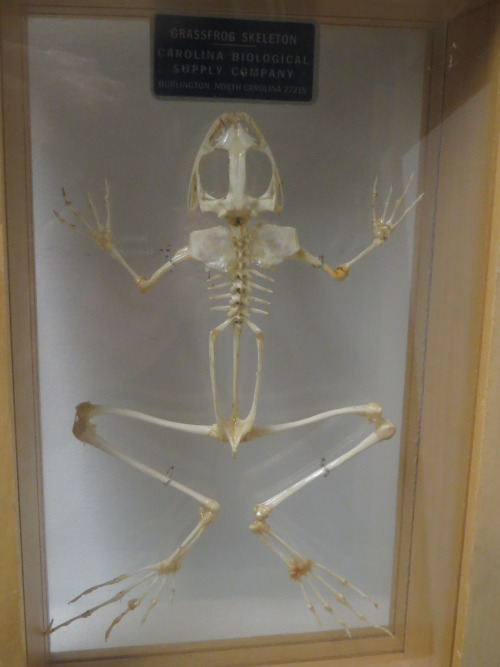
Grass Frog skeleton in the CMNH teaching collection.
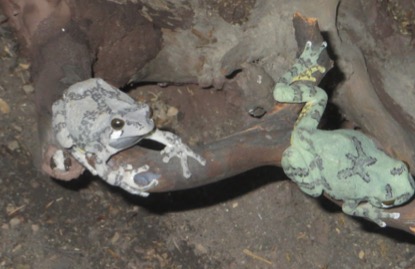
(Eastern Gray Tree Frogs in the Pennsylvania Amphibians display on the Daniel G. & Carole L. Kamin T-rex Overlook.)
Patrick McShea works in the Education and Visitor Experience department of Carnegie Museum of Natural History. Museum employees are encouraged to blog about their unique experiences of working at the museum.
