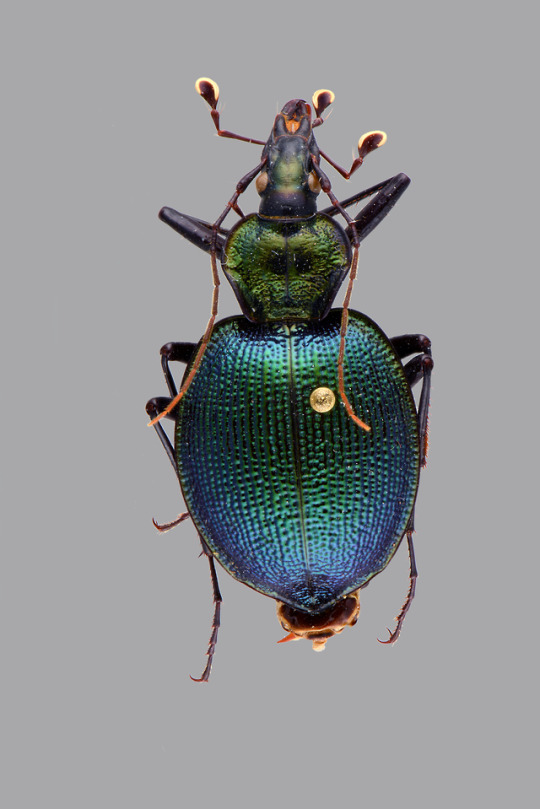
High in the mountains of West Virginia, there occurs an emerald-green beauty about the size of a half-dollar. It is something of a finicky gourmet in that its preferred dinner is snails. Its unusual external appearance is a conglomerate of specializations for tracking snails, capturing snails, poking its front end into snail shells, and digesting snail meat. In fact, these beetles are so highly specialized that the word for any other beetle evolving similar snail-predation adaptions is “cychrinization,” based on the tribal name of this group, Cychrini. In Figure 1 of our as-yet-unnamed green beauty (Scaphinotus new species), and Figures 2 and 3 of another species (Scaphinotus viduus), some of these special adaptions are obvious: very long and narrow head with long, toothed jaws; tapered front end; in side view, slightly curved for walking into snail shells; and, perhaps most striking, four mouthparts with the last segment enlarged, curved, hatchet-shaped, held out forward like mine detectors, with masses of sensory organs concentrated along the front edge.
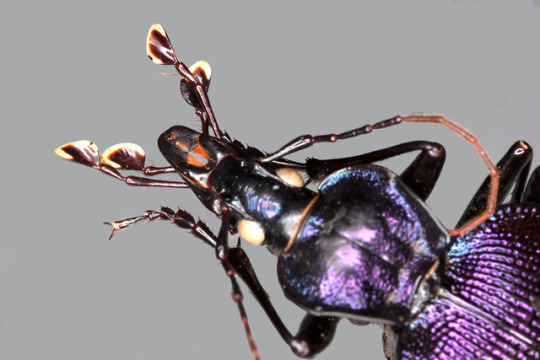
Image credit: Vanessa Verdecia, Section of Invertebrate Zoology
When hunting, their favored technique is to spiral upward around tree trunks until they cross the slime trail of a snail. They seem to be able to detect which direction the snail was going, and they are after it like a hound, those four enlarged “detectors” held forward. When a snail is captured, they shake it around like a puppy with a slipper. The long mandibles with large internal teeth hold the shell on one side of the opening, and they begin to egest digestive enzymes onto the snail meat as they gradually work their way deeper into the shell. In essence, they are throwing up enzymes into the snail as they go along, so perhaps they are not as finicky as I originally suggested. But they are finicky compared with less elegant, cruder invertebrates that eat snails by simply crushing the whole shell, rather than leaving the shell intact.
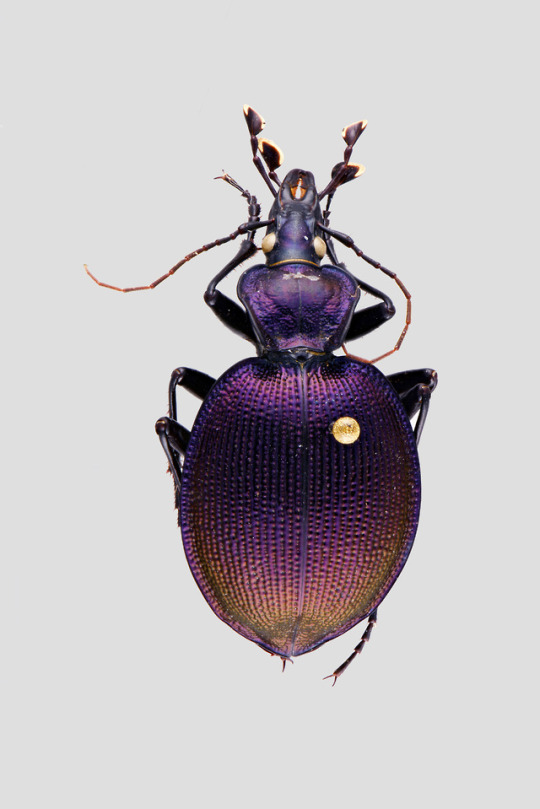
Image credit: Vanessa Verdecia, Section of Invertebrate Zoology
Snail-eaters occur over much of the temperate Northern Hemisphere in mountain and forest regions. We have six species right here in Pennsylvania, varying in size and structure to fill various ecological niches and to capitalize on different sizes of snail. There are three lanky tree climbers (though they will also hunt on the ground): one large, one medium and one small, all bright purple with bluish reflections. There are two chunkier surface dwellers: one medium and one small, both black with blue trim. And there is one tiny brown species living deeper in the leaf litter, spending much of its time beneath the surface. The tiny one eats small species of snail, as well as young small individuals of larger snails; the big purple fellow (Figure 3) eats the largest snails.
Robert L. Davidson is the collection manager for the Section of Invertebrate Zoology. Museum employees are encouraged to blog about their unique experiences and knowledge gained from working at the museum.
