Step 1: Deploy pitfall traps across Powdermill Nature Reserve
Step 2: Get out of the way and let nature do the rest
Over the course of 10 days in June of this year, I captured 311 amphibians of 12 different species. Every day, rain or shine, I spent over four hours checking 132 pitfall traps and several more hours identifying, measuring, and weighing the day’s amphibian haul. I did a rinse and repeat of this cycle for 10 days straight. Why would anyone do all of this for what Carl Linnaeus, the father of modern taxonomy, once described as “vile animals” with “a foul odor” (Wahlgren, 2011)? Although this sentiment might still ring true for some people today, I did this because amphibians are in serious trouble—more than 30% of species are facing extinction. The threats to amphibians range from habitat losses to disease epidemics, but these are merely symptoms of the underlying cause: unnatural changes brought about by the Anthropocene. Human-induced alterations to nature are irrevocably modifying biodiversity so rapidly that species we learned about in grade school are now extinct and, if we view amphibians as sentinel organisms, then the worst is yet to come.
The Powdermill Nature Reserve is a protected site in Pennsylvania’s Allegheny Mountains where, since 1956—the year it was established by a forward-thinking herpetologist— the property has functioned in a similar way as forests did before human settlement swept across the region. In the early 1980s, scientists at the Carnegie Museum of Natural History studied the amphibian community at the Powdermill Nature Reserve and, serendipitously, established the empirical baseline necessary to study how environmental changes have affected amphibian biodiversity in the Alleghenies (Meshaka, 2009).
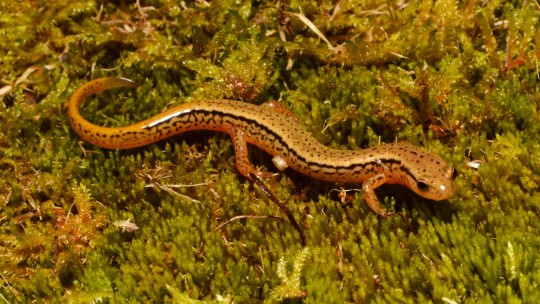
Examining the results of amphibian trapping during two long ago Junes offers insight into the reserve’s value. In June 1982, 78 traps captured 262 amphibians of 11 species. In June 1983, 54 traps captured 174 amphibians of 11 species. While the species richness has not changed much since the 1980s, there has been species turnover and shifts in abundance, with some species becoming more common in the community. The Two-lined Salamander (Eurycea bislineata), for example, went from 0 captures in June of 1982 and 1983 to 7 captures this June. In terms of standardized trap nights in June (i.e., the number of traps multiplied the number of days opened), a combined rate of 0.11 amphibians per trap was detected across the two years in the 1980s, compared to a rate of 0.24 amphibians per trap this year. What could the ecological scenario be that has led to such an apparent increase in the amphibian capture rate over this 40-year period? Could trophic cascades be involved? Perhaps the protection of habitats in 1956 helped forest regeneration, and this change led to improved stream health and greater water retention later into the season via increased canopy cover. By providing better habitat and more resources for the streamside invertebrates that makeup the main prey base of forest-dwelling amphibians, such a transformed system might benefit amphibian communities indirectly. It’s also possible that some entirely different mechanism produced this result.
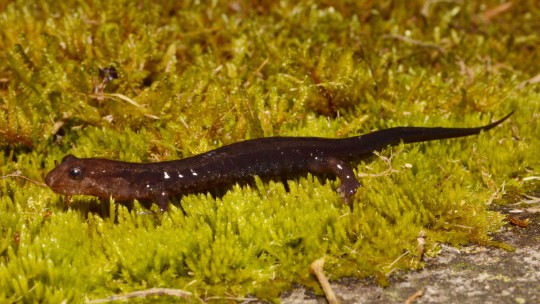
The species that dominated captures historically and today was the Allegheny Dusky Salamander (Desmognathus ochrophaeus), which went from 0.048 individuals per trap in June from the 1980s to a slightly increased rate this June of 0.052 individuals per trap. Interestingly, the average body size of female Allegheny Dusky Salamanders has not changed over the 40-year study period, suggesting stability in morphology despite other studies reporting salamander species either shrinking (Caruso et al., 2014) or growing (McCarthy et al., 2017) in response to warmer temperatures brought about by recent climate change. Without the founding of the Powdermill Nature Reserve and the herculean efforts of historical and modern scientists from the Carnegie Museum of Natural History, we would not be able to understand the extent that humans have impacted biodiversity, let alone the data needed to solve mysteries of the modern world.
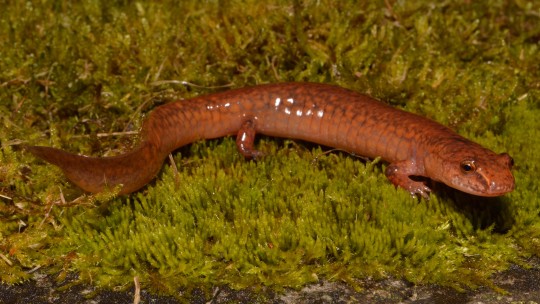
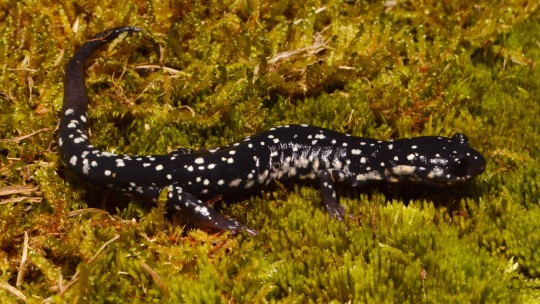
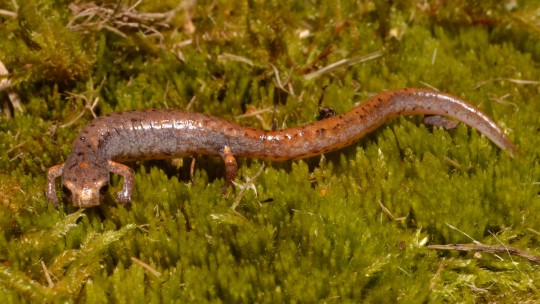
So, when I look at a Spring Salamander (Gyrinophilus porphyriticus) or a Slimy Salamander (Plethodon glutinosis) or a Four-toed Salamander (Hemidactylus scutatum) from the Powdermill Nature Reserve, I don’t see Linnaeus’s “terrible animal” with a “ghastly color”, rather, I see profound resiliency in the face of tremendous pressure, and the power that natural history collections and protected areas hold for improving our relationship with biodiversity.
Daniel F. Hughes is the Rea Post-doctoral Fellow in the Herpetology Section at Carnegie Museum of Natural History. Museum employees are encouraged to blog about their unique experiences and knowledge gained from working at the museum.
References:
Caruso, N.M., Sears, M.W., Adams, D.C. and Lips, K.R., 2014. Widespread rapid reductions in body size of adult salamanders in response to climate change. Global Change Biology, 20: 1751–1759.
Meshaka, Jr., W.E., 2009. The terrestrial ecology of an Allegheny amphibian community: Implications for land management. The Maryland Naturalist, 50: 30–56.
McCarthy, T., Masson, P., Thieme, A., Leimgruber, P. and Gratwicke, B., 2017. The relationship between climate and adult body size in redback salamanders (Plethodon cinereus). Geo: Geography and Environment, 4: e00031.
Wahlgren, R., 2011. Carl Linnaeus and the Amphibia. Bibliotheca Herpetologica, 9: 5–37.
Related Content
The Search for the Near Threatened Green Salamander, Aneides Aeneus
