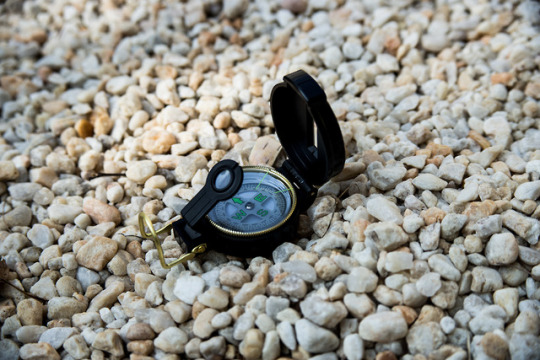
Have you ever heard someone say they need to find their bearings? It dates back to the Age of Discovery and refers to the bearings inside a compass that move the directional needle. That saying has lived on and so has the simple compass! Let’s learn about the military’s preferred version, the lensatic compass. It’s incredibly precise, affordably priced at just a couple of dollars, and easy to find in your local big box or sporting goods store.
What you’ll need
Lensatic compass
Enough room to rotate in a circle
Step 1
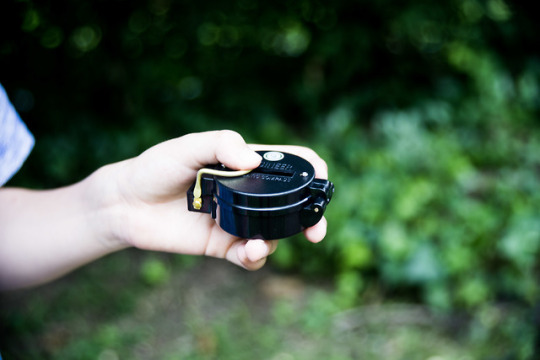
● Hold the compass in the hand that you write with.
● Make sure the side facing up has the open slot in the cover.
Step 2
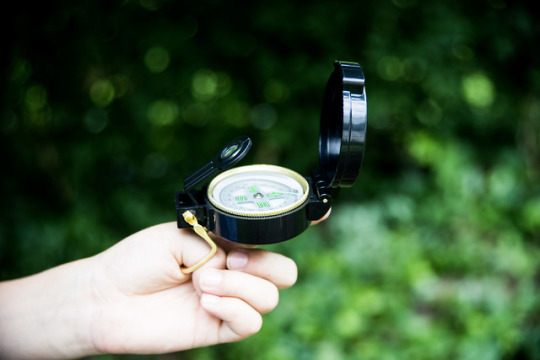
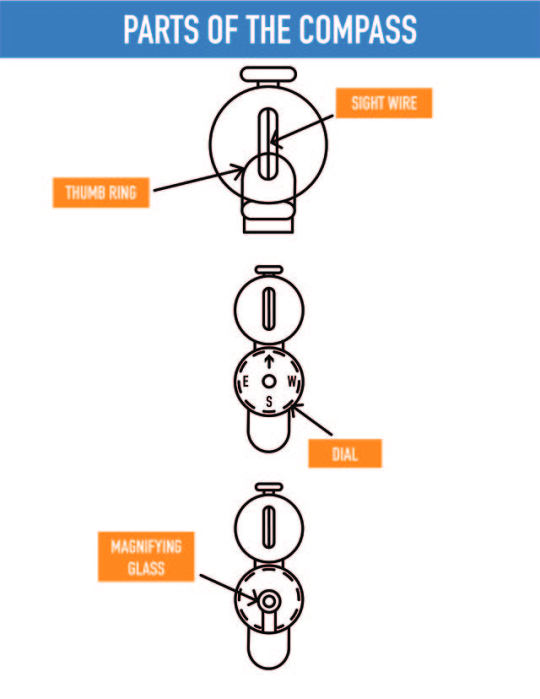
● Use your thumb to pull the thumb ring back about halfway.
● Flip up the lid to a 90-degree angle.
● Flip up the small magnifying glass.
● Pull the ring underneath the compass and put your thumb through.
● Wrap your middle, ring and pinky finger around your thumb for support. Use your index finger to steady the front of the compass.
Step 3
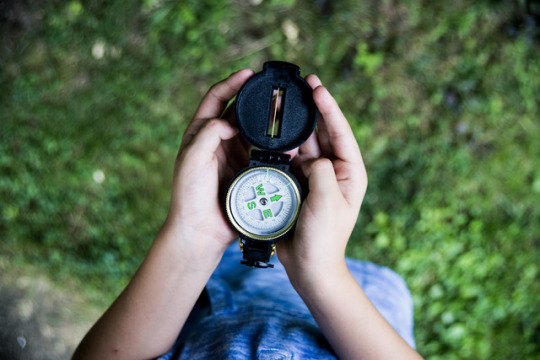
● Notice the slot in the lid has a sight wire running down the middle.
● Turn the dial until the larger line aligns with the sight wire.
● Notice the second line of numbers surrounding the outside of the dial goes from 0 to 360 degrees to represent a full circle. That provides a more accurate direction. Saying an object is at 340 degrees Northwest is more accurate than saying it is Northwest.
Step 4

● Hold the compass in front of your nose with the lid facing out.
● Pick an object, rotate your entire body (not just the compass), and align the object with the sight wire.
● Look through the magnifying glass and find the green line that we matched to the sight wire.
● Locate the number on the inner dial. You will also see the directions North, South, East, and West. Congratulations, you found your bearings!
● Pretend your compass is a cool space laser and say “Zzzap!” as you pretend to fire away at your landmark….OK that last part isn’t necessary, but might be fun!
Fun Fact
The lensatic compass is very versatile. You can also use it as you would a standard compass by pulling back the lid and magnifying glass to fully show directions North, South, East, and West. Hold your elbows tight against your body and the compass near your waist to get your bearings and find out which direction you are facing!
“There’s an app for that”
True, but learning how to read a compass can come in handy.
Do you have a phone or tablet? Look down and check the battery life. How about the WiFi and cellular service? Remember, batteries lose their charge and service can be unreliable in some areas.
Learn this skill in familiar territory like your backyard or a local park.
That way, if you need to use it in unfamiliar territory, you will be ready.
Can you com-pass this text? Give it a try!
Now that you know how to use the compass, let’s put your knowledge to the test! Head into your yard or an outdoors area to begin. Ready? Set? Go!
Locate North. What do you see? _______________
Rotate to the East. What do you see? _______________
Now West. What do you see? _______________
Find South. What do you see? _______________
Great job so far! Let’s make things a little more challenging by incorporating the degrees.
Locate 340 degrees Northwest. What do you see? _______________
Now turn to 120 degrees Southeast. What do you see? _______________
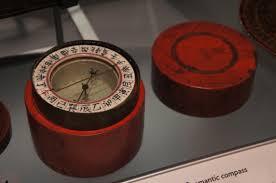
You are now part of a group of navigators that goes back hundreds of years. Research dates the use of the magnetized mineral lodestone as a compass all the way back to the year 1,000. Ancient Chinese explorers learned that they could float the stone on a small piece of wood in a cup of water and the stone would always point to the north pole. Sailors later discovered that rubbing a needle against a piece of lodestone made the needle magnetic and the evolution of the modern compass began, along with superstitions. Prior to the scientific explanation, sailors thought the compass was a magical object that could tell fortunes and cure illness. They also thought that onions and garlic could block the magnetic force, so those ingredients never boarded their ships.
Luckily, we know that compasses today are useful tools that help us find our bearings – no magic required. Congratulations on joining the club of compass navigators!
Blog post by Eddie Phillips. Graphics by Megan Jones.
Learn more in Nature Lab!
