Do you wear your baseball cap with the brim in front or in the back? For some headgear, the orientation matters, for example, a football helmet worn in non-standard orientation might hinder your ability to see.
In most snails (gastropods), the shell coils over the tail. In some other mollusks, the shell coils over the head.
Torsion is a feature of all snails. Torsion is a 180° twisting of the head-foot with respect to the shell and internal organs, early in development. Torsion results in the anus being over the head (snails are real poop heads!). Why snails are torted remains a biological mystery, but a common hypothesis is that torsion also brings the gills and sensory organs to the front, and the anus just came along for the ride.
Snails have muscles that attach their bodies to the inside of their shells. Snails tighten these muscles to pull the body into the shell. A consequence of torsion is that the muscle scars (where muscles attach to the shell) are asymmetrical.
Monoplacophorans are a class of mollusks like snails except they do not undergo torsion. The lack of torsion means the shell coils over the head (in those having coiled shells). Furthermore, the muscle scars on their shells are symmetrical. Few monoplacophorans survive today, but they were more plentiful millions of years ago.
When I see snails in the funny pages in the newspaper, I notice that the cartoonists drew the shells in the standard orientation about half the time (50%, or random chance). When you see a cartoon snail with its shell in a non-standard orientation, you might wonder if it is really a monoplacophoran?
Next time you put on your baseball cap, think about how snails wear their shells, and remember the famous baseball snail: Slicky Mantle – he was quite a slugger – you should see him slide into home plate!
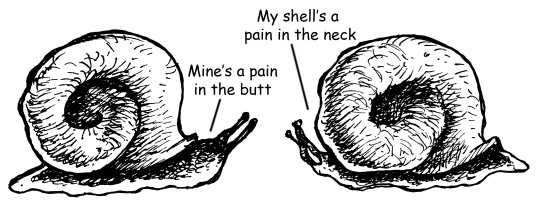
Cartoon mollusks with shell oriented as gastropod (left) and monoplacophoran (right). Illustration by Geoff Weber.
Timothy A. Pearce, PhD, is the head of the mollusks section at Carnegie Museum of Natural History. Museum employees are encouraged to blog about their unique experiences and knowledge gained from working at the museum.
